Government-backed senior employment programs are helping raise self-esteem among marginalized elderly people, according to new data.
The Korea Employment Agency for the Elderly released Tuesday its June infographic analyzing key findings from the Korean Senior Work and Life Panel (KSWL) survey.
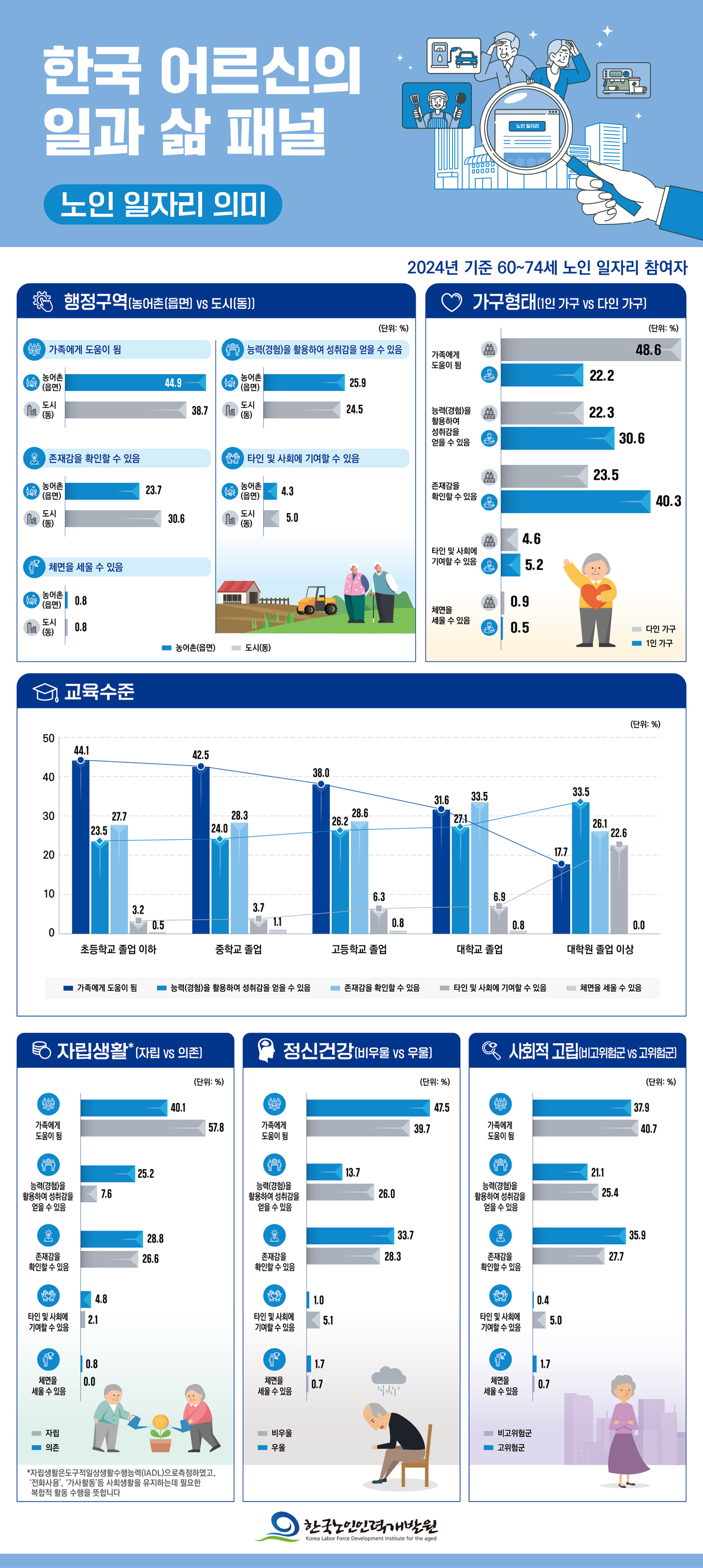
The June edition examined how participants in senior employment programs perceive the "meaning of work," breaking down responses by residential area, household type, income level, capacity for independent living, and whether respondents experienced depression or social isolation.
Among the findings, rural residents — those in towns and townships — were more likely than urban residents to say work helps their family (44.9 percent vs. 38.7 percent). Urban residents, however, were more likely to cite "affirming one's sense of existence" as a meaning of work, at 30.6 percent compared with 23.7 percent for rural residents, a gap of 6.9 percentage points.
By household type, those in multi-person households most often chose helping their family through work (48.6 percent), while single-person households most often chose affirming their sense of existence (40.3 percent). Single-person households also scored higher on using their abilities and gaining a sense of achievement, at 30.6 percent versus 22.3 percent for multi-person households.
Higher education levels were associated with a declining tendency to cite helping one's family through work — falling from 44.1 percent to 17.7 percent — while the share citing using abilities and gaining achievement rose from 23.5 percent to 33.5 percent, and contributing to others and society climbed from 3.2 percent to 22.6 percent.
Among those capable of independent living, 57.8 percent said work helps their family, compared with 40.1 percent among those who depend on others — a gap of 17.7 percentage points. Conversely, the dependent group was more likely to cite using abilities and gaining achievement, at 25.2 percent versus 7.6 percent for the independent group, a difference of 17.6 percentage points.
Respondents experiencing depression were more likely than those without depression to cite helping their family (47.5 percent vs. 39.7 percent) and affirming their sense of existence (33.7 percent vs. 28.3 percent). They were less likely, however, to cite using abilities and gaining achievement, at 13.7 percent compared with 26.0 percent for those without depression.
Among those at high risk of social isolation, 35.9 percent cited affirming their sense of existence, compared with 27.7 percent among those not at high risk — a gap of 8.2 percentage points.
"Senior employment programs are a policy that greatly benefits the mental health of elderly people experiencing social isolation and depression," said Kim Su-yeong, president of the Korea Employment Agency for the Elderly. "We will expand support so that senior employment goes beyond simple income assistance to underpin healthy aging and social participation, and takes root as a social investment that enhances the sustainability of our society."
The KSWL infographic is available on the Korea Employment Agency for the Elderly's website.
thlee@heraldcorp.com