As AI boosts labor productivity, business circles are calling for stronger upskilling and reskilling programs to protect the job security of workers affected by the technology.
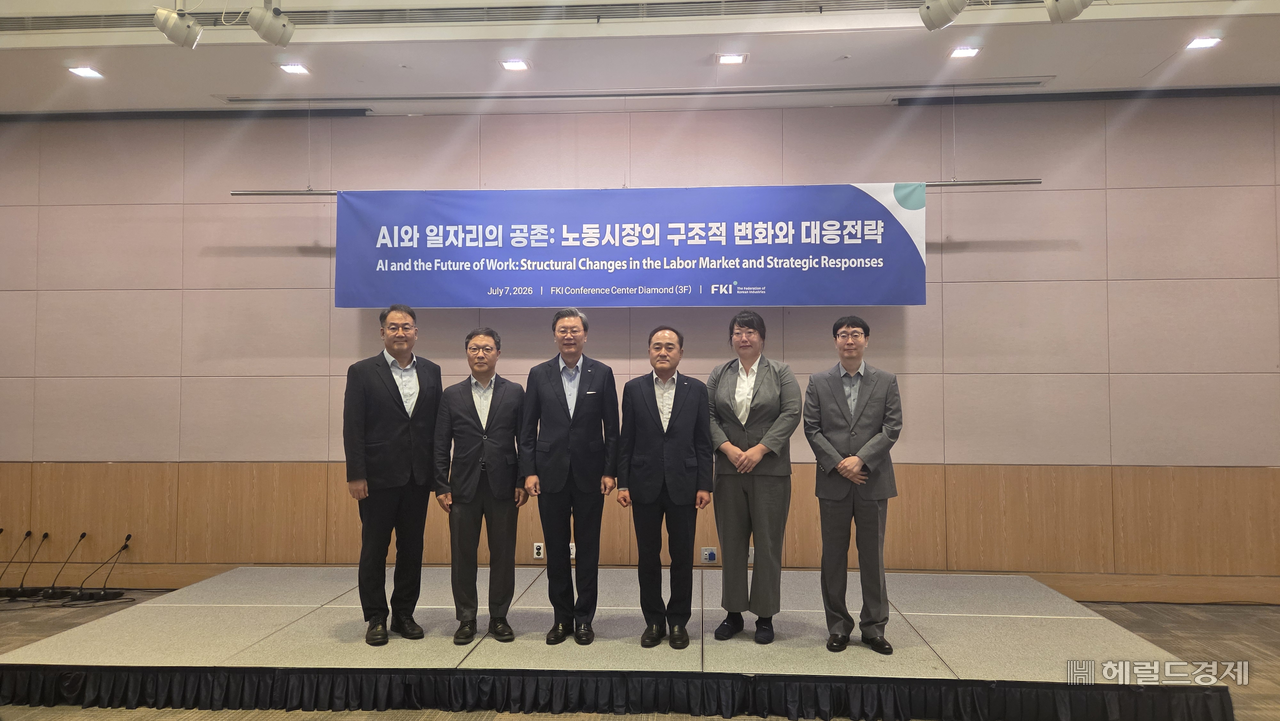
The Korea Business Federation held a seminar titled "AI and Jobs Coexistence: Structural Changes in the Labor Market and Response Strategies" at the FKI Tower Conference Center in Yeouido, Seoul, on Tuesday. Experts warned that while widespread AI adoption raises productivity, it also threatens employment stability, and urged the government to quickly introduce policies that identify at-risk jobs and prioritize retraining in sectors with the highest AI exposure.
The government signaled it shares those concerns. Minister of Employment and Labor Kim Young-hoon, in a video address, said AI is creating "a dual transition in which productivity leaps forward on one side while specific job functions and segments of the workforce are exposed to employment insecurity on the other." He said the government is "carefully examining the industry- and occupation-level impact of the AI transition and is diligently preparing medium- to long-term employment stability policies that strengthen workers' capabilities and build tailored safety nets."
Stein Broek, a senior economist at the OECD, said OECD research shows AI has the potential to raise annual labor productivity growth by 0.4 to 0.9 percentage points over the next decade, but that the impact will vary by occupation depending on each sector's level of AI exposure. "Rather than focusing on the immediate disappearance of jobs, we should pay attention to the great transformation of the labor market — one in which the content of work and the skills required are being restructured," he said.
Lee Chul-hee, a professor at Seoul National University, highlighted a mismatch between sectors facing future labor shortages due to demographic change and those where AI can substitute for human work. "AI exposure is relatively high in high-wage, high-skill sectors such as finance and law, while care, transportation and food service — sectors expected to face labor shortages — are low-wage, low-skill areas where AI-based substitution is difficult," he said, adding that AI diffusion alone is unlikely to ease future labor supply-demand imbalances.
Shift to skills-first hiring and development, away from credentials

Experts across the board stressed the importance of education in securing employment in the AI era. Renee Tan, deputy chief executive of SkillsFuture Singapore, outlined the country's SkillsFuture initiative, under which the government provides credits to all Singaporean citizens aged 25 and older to take training courses, supporting lifelong learning.
Tan said Korea should strengthen a skills-first approach — hiring, placing and developing talent based on workers' practical competencies rather than academic credentials or certificates alone — and connect education and training, employment services and talent strategy into a single ecosystem.
She also said companies must take an active interest in AI education. "Corporate competitiveness in the AI era is not determined solely by whether a company adopts the technology," she said. "Companies that pursue both a business strategy — covering new technology adoption and business expansion — and a talent strategy that develops and deploys workers' capabilities in alignment with it tend to achieve higher performance."
Jung Chul, head of research at the Korea Business Federation and president of the Korea Economic Research Institute, who moderated the panel discussion that followed, said AI diffusion "is not simply a matter of reducing the number of jobs — it is a structural change that alters the very nature of the tasks companies need and the competencies required of workers."
Gil Eun-seon, a research fellow at the Korea Institute for Industrial Economics and Trade, called for redesigning job structures so that technology handles dangerous and physically demanding tasks while people focus on high-value work such as judgment, coordination and exception handling. She said the government should prioritize support for employment-friendly AI adoption that complements workers, improves safety and sustains employment while raising productivity, and should work with labor and management to map out job-transition pathways for workers.
Yoo Jin-sung, a senior research fellow at the Korea Economic Research Institute, said the key challenges for employment stability in the AI era "can be summed up as strengthening upskilling and reskilling." He called for building a system that uses the government's employment services infrastructure to analyze workers' job experience and competencies and identify transition pathways toward occupations closely related to their existing skills that are expected to see strong future demand.
Low-skilled youth face crisis, targeted support needed
Experts also called for targeted support specifically aimed at young workers. Noh Min-sun, a director at the Korea Institute for Small and Medium-sized Enterprises and Startups, said that as AI takes hold in small and medium-sized enterprises, demand is likely to shift toward only highly specialized roles, reducing overall job openings at smaller firms. "On the other hand, AI-based solo entrepreneurship could increase, so startup support policies that build young people's AI capabilities are needed," he said.
Lee of Seoul National University also said the spread of AI is eliminating entry-level jobs through which young workers traditionally build expertise, and urged the government to "invest in restoring the skills ladder" — including subsidizing part of companies' hiring and training costs.
He added that the government should step up support for technology development and commercialization in low-skill, low-wage sectors expected to face future labor shortages, given that private-sector incentives to develop AI solutions for those areas are relatively weak, in order to ease labor supply-demand imbalances.
go@heraldcorp.com