Financial regulators' move to ban subsidiary dual listings in principle — while carving out narrow exceptions — is sending shockwaves through capital markets. The measure was designed to address complaints that such listings harm the interests of ordinary shareholders in parent companies, but industry players warn the stricter review criteria and the application of the so-called "3% rule" could choke off corporate fundraising and slow growth.
The Korea Exchange has said it will handle applications on a case-by-case basis given that each company's circumstances differ, but that stance has itself drawn criticism, with market participants calling for more concrete guidelines.
Companies preparing dual listings were on Tuesday still digesting the detailed framework for "banning dual listings in principle while allowing exceptions" that the Financial Services Commission and the Korea Exchange announced Monday.
The core of the new guidelines is a set of five specific duties — grounded in the fiduciary obligation to shareholders under the Commercial Act — imposed on parent-company boards, alongside a significantly tightened listing review by the Korea Exchange. Under the rules, a parent company's board pursuing a listing must assess the impact on shareholders, draw up shareholder protection measures, and confirm whether shareholder communication or consent has been secured. All steps must pass prior review and approval by an independent special committee.
The most contentious element is the shareholder consent requirement. The Korea Exchange said it will scrutinize the level of shareholder protection efforts in proportion to the need to protect ordinary shareholders, and has recommended consent as the guiding principle.
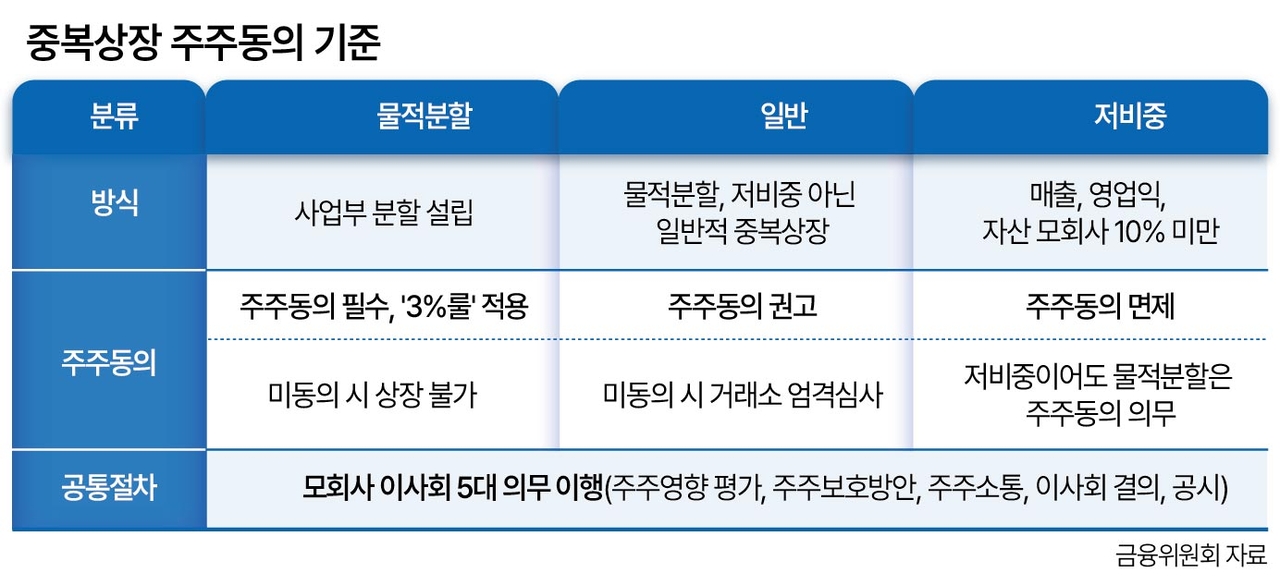
Subsidiaries created by spinning off a parent company's core business — so-called physical spin-off subsidiaries — face a mandatory shareholder consent requirement. The Financial Services Commission said it views physical spin-off listings as carrying a heightened risk of a parent-company discount and has therefore set a stricter standard.
The benchmark for valid shareholder consent is the "3% rule," modeled on the standard used for appointing audit committee members under the Commercial Act. Under the rule, the combined voting rights of a controlling shareholder and related parties are capped at 3%, and a resolution passes only if a majority of participating shares vote in favor and at least one-quarter of all issued shares approve. Companies such as HD Hyundai Robotics and SK Plasma, established through physical spin-offs of existing business units, fall under this rule.
Choi Jun-sun, an emeritus professor at Sungkyunkwan University School of Law, criticized the approach. "The 3% rule exists nowhere else in the world — it is reverse discrimination against controlling shareholders who should be entitled to exercise legitimate property rights over their own assets," he said. "The matters subject to board and general meeting resolutions are already defined by law, yet the 3% rule is being overextended."
For ordinary subsidiaries, however, the Korea Exchange has in effect left open a path to exceptional listing even without shareholder consent, through rigorous individual review. The exchange said it would "differentiate the level of requirements based on the subsidiary's need to raise operating funds, the availability of alternatives, industry characteristics, the background and duration of the parent-subsidiary relationship, and relative size."
Industry participants say that without concrete guidelines or precedents covering factors such as fundraising necessity, whether a company qualifies as an advanced-industry player, or the nature of the parent-subsidiary relationship, navigating the new rules is far from straightforward.
Subsidiaries with sales, operating profit and assets each accounting for less than 10 percent of the parent's are classified as low-weight subsidiaries and are exempt from the shareholder consent requirement, putting them in a relatively easier position. Even so, a low-weight subsidiary created through a physical spin-off remains subject to the mandatory shareholder consent requirement under the 3% rule.
Boston Dynamics, the Hyundai Motor Group unit pursuing a Nasdaq listing, is likely to qualify as a low-weight subsidiary and may therefore be able to proceed without a separate shareholder consent vote. That said, the five board duties applicable to parent companies apply equally to overseas listings, meaning a more carefully structured process will still be needed.
The industry broadly expects dual listings to become extremely difficult in practice. Attention is particularly focused on which individual companies will be the first to win approval under the new guidelines. "Securing shareholder consent is in effect the biggest hurdle," one industry official said. "Asking existing shareholders to approve a listing with no incentive whatsoever is not realistic — and even offering to allocate subsidiary shares to existing shareholders, buy back treasury stock, or expand dividends is unlikely to be a strong enough draw."
The fallout from a failed listing would also be hard to ignore. If financial investors who backed a subsidiary based on its growth prospects find their exit blocked, the situation could escalate into large-scale legal disputes. There are also concerns that companies cut off from public fundraising may turn to private equity and other alternative financing channels.
"Quality subsidiaries may simply delay their listings and opt for private equity investment or other fundraising alternatives — and ultimately, only a select few such as private equity funds will reap the returns," another industry official said.
"Since the financial authorities highlighted Duksan Nepcores — a subsidiary of Duksan Hi-Metal — as a best-practice case, everyone is watching closely for the first dual listing to be approved under the new guidelines," a consulting firm official said. "Given that the Korea Exchange has said it will review cases individually, the outcomes for various companies will effectively serve as the concrete guidelines the market is waiting for."
jiyun@heraldcorp.com