![Boston Dynamics' humanoid robot Atlas lifts and carries a mini refrigerator, demonstrating full-body control by distributing weight and maintaining balance using its arms, legs and torso. [Boston Dynamics]](https://wimg.heraldcorp.com/news/cms/2026/07/08/news-p.v1.20260519.bb2be2e632fb44e2a227fed37a94ce2c_P1.png)
The government is moving to build a comprehensive employment safety net in preparation for the industrial restructuring driven by the spread of AI and the transition to carbon neutrality.
Plans include developing a Korea-specific AI Exposure Index tailored to the domestic labor market, building a "Korean Canary Dashboard" to detect AI-driven job changes in real time, and designating "just transition special zones" in regions expected to bear the brunt of the carbon transition — all aimed at minimizing employment disruption during the industrial shift.
The government unveiled the Basic Plan for Employment Stability in Industrial Transition at a national policy coordination meeting on Thursday. It is the first pan-government medium- to long-term plan designed to minimize employment shocks and expand job creation opportunities during a period of simultaneous industrial transformation driven by AI, carbon neutrality and demographic change.
The government set "an industrial transition with labor that advances together" as its vision, with three strategic directions: proactive response, opportunity creation and equitable sharing of gains.
The government has concluded that AI's impact on the labor market is already materializing. According to the World Economic Forum, 170 million new jobs will be created worldwide by 2030 while 92 million are displaced. The IMF has similarly projected that around 60 percent of employment in advanced economies will be exposed to AI disruption.
A Bank of Korea analysis found that 98.6 percent of the 211,000 youth jobs lost between July 2022 and July 2025 occurred in sectors with high AI exposure, underscoring the urgency of getting ahead of AI-driven job restructuring.
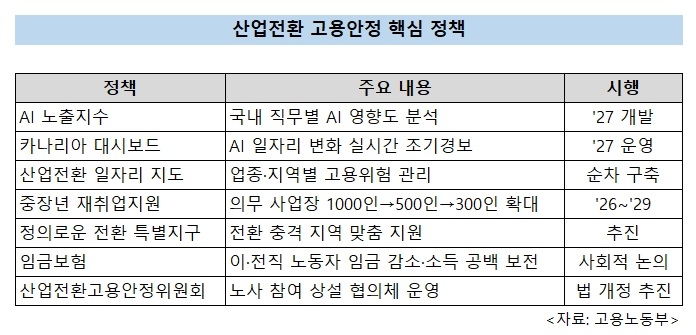
In response, the government will develop a Korea-specific AI Exposure Index by 2027, moving beyond the current practice of simply applying foreign AI impact indices to domestic occupational classifications to more precisely measure AI exposure by job function.
Building on that index, the government will operate the Korean Canary Dashboard to analyze employment changes in high-AI-exposure occupations in real time by industry and age group, enabling early detection of employment crises. An industrial transition job map and a job information hub will also be built to give a clear picture of employment risks by sector and region and to provide tailored support.
The vocational training system will also be overhauled to match the pace of industrial transition. Centered on the National Tomorrow Learning Card, the government will pursue what it calls "three rights for the age of transition" — the right for everyone to learn, the right for youth to grow through AI, and the right for middle-aged workers to make a fresh start.
Through amendments to enforcement decrees, the mandatory reemployment support service will be expanded in stages — from workplaces with 1,000 or more employees this year to those with 500 or more next year, and to those with 300 or more by 2029. The government will also strengthen job-change and career-transition training, including specialized programs at Polytech institutes for middle-aged workers, while introducing a supplementary certification system, revamping the National Competency Standards and expanding AI and green technology convergence training.
The government will provide full-cycle support for AI startups by youth and technology startups by middle-aged workers, and will link fiscal, training and financial support for companies that maintain or create jobs. New job foundations will also be expanded by nurturing green industries such as solar and wind power, as well as AI-driven new industries including AI robots and autonomous driving.
Tailored support will be strengthened for regions bearing concentrated shocks from the carbon neutrality transition. The government will designate just transition special zones targeting industries and regions heavily affected by the shift — including coal power, steel, automobiles and petrochemicals — with central and local governments providing joint support. Plans also include expanding youth work experience opportunities, strengthening the employment safety net for workers changing jobs, expanding social enterprise employment and supporting worker-led business acquisitions.
To address safety risks in workplaces where AI and robots are proliferating, the government will update industrial robot safety standards. It will also pursue the development of a working-hour reduction model and related legislation to ensure that AI adoption leads not only to productivity gains but also to actual reductions in working hours.
The government will establish an Industrial Transition Employment Stability Committee to strengthen the continuity of industrial transition policy. The committee, which will include labor unions and employer associations, will operate sector-specific subcommittees, and special regional subcommittees will be set up for each metropolitan local government to institutionalize tripartite social dialogue. The committee will also coordinate with the Economic, Social and Labor Council, the Carbon Neutrality and Green Growth Committee and the National AI Committee to address employment issues arising from industrial transition.
Wage insurance will be a key social agenda item for the committee. The government plans to examine ways to compensate workers who face unavoidable job changes, career transitions or relocations during the industrial transition for temporary income gaps and wage declines, and to begin a broader social discussion on new income support mechanisms and funding sources. The government said it will look to Germany's early retirement support for coal power workers and Denmark's wage-loss compensation scheme for career changers as reference models when reviewing whether to adopt such a system.
fact0514@heraldcorp.com