
![The exterior of "The New Grandeur Tech Pop-up Store" at Informal Square in Seongdong-gu, Seoul. Hyundai Motor opened its first technology-themed pop-up store to showcase the key new technologies in The New Grandeur and the development process behind them. [Hyundai Motor]](https://wimg.heraldcorp.com/news/cms/2026/07/09/news-p.v1.20260709.656a5603d41245b781e2b12c80443289_P1.jpeg)
"New technology has always started with the Grandeur."
Hyundai Motor's "The New Grandeur Tech Pop-up Store," which opened Thursday at Informal Square in Seongdong-gu, Seoul, was unlike a typical new-car showroom. Rather than a promotional space built around the vehicle itself, it felt closer to a technical briefing — one that pulled back the curtain on the components and engineering decisions hidden inside the car.
It marks the first time Hyundai Motor has unveiled its development process in pop-up store format. What made it unusual was the decision to lead with how the technology was built, rather than design or brand experience. Confidence in the engineering packed into The New Grandeur was evident throughout the venue.
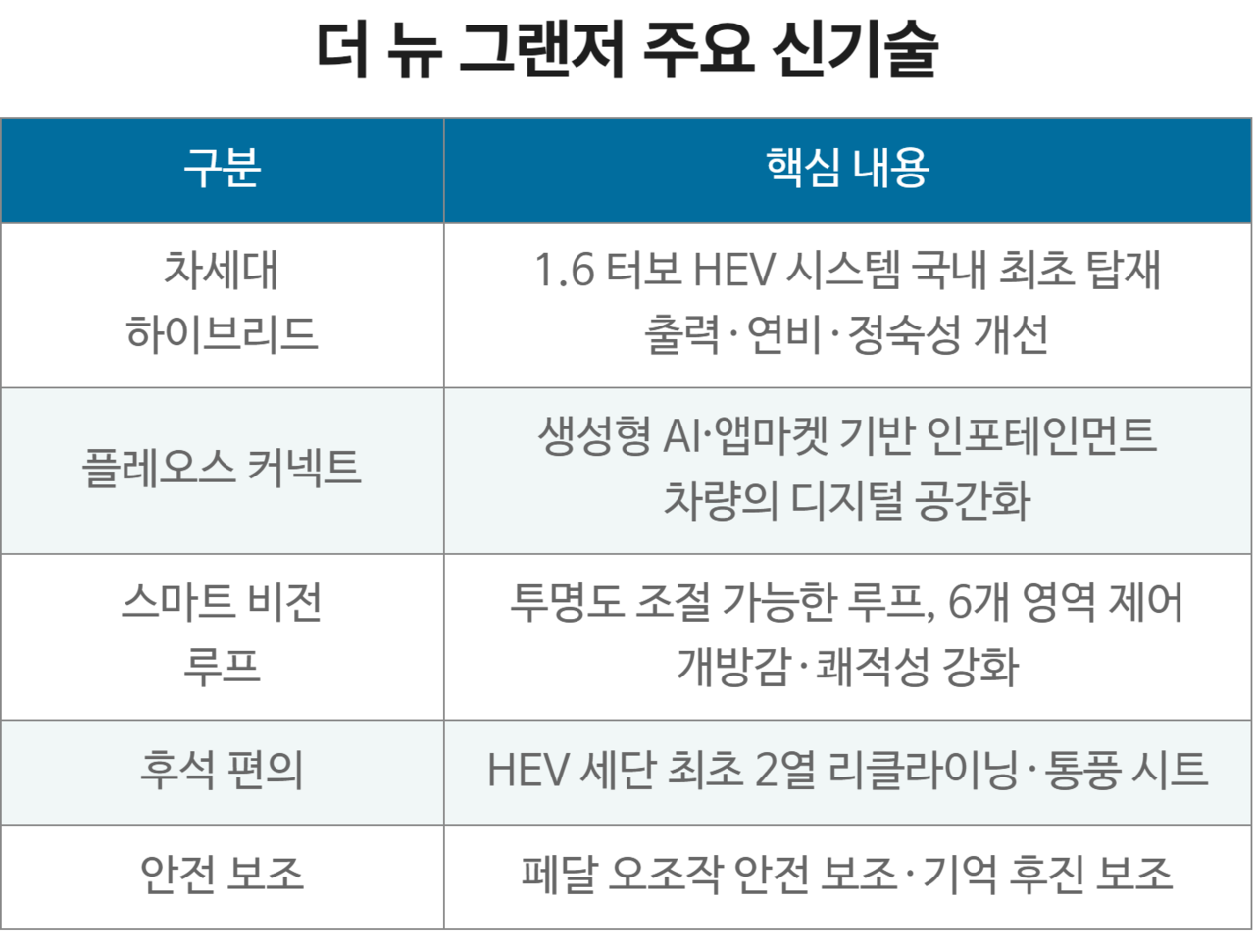
The venue spread across three floors, guiding visitors through the core technologies of The New Grandeur in sequence. On each floor, members of the development team were on hand to explain why a given technology was needed and what problem it solved.
The emphasis was not on showcasing technical achievements for their own sake. The bulk of the content focused on the deliberation and trial and error that went into changing a single component or adjusting a single figure — behind-the-scenes detail that brochures rarely capture, and more than enough to hold the attention of dedicated technology enthusiasts.
![The New Grandeur on display at "The New Grandeur Tech Pop-up Store" at Informal Square in Seongdong-gu, Seoul, on Thursday. Hyundai Motor used the event to share the key technologies applied to The New Grandeur and the development process behind them with the general public. [Hyundai Motor]](https://wimg.heraldcorp.com/news/cms/2026/07/09/news-p.v1.20260709.9ce152725bd143bcac37903790506ce8_P1.jpeg)
The feature that drew the most attention was the second-row reclining seats in the hybrid model. Reclining rear seats may seem straightforward, but in a hybrid vehicle the challenge is considerably greater — a high-voltage battery sits directly beneath the second-row seats. Moving the seat backward risks a collision with the battery, and the battery's cooling structure must also be redesigned.
Hong Seok-hyeon, a researcher on Battery Design Team 2, said the biggest challenge on the project was avoiding interference between the seat and the battery without changing the seat position, while preserving the reclining seat quality found in the gasoline model.
Hyundai Motor shifted the seat mounting position 37 millimeters forward and lowered the height of the battery frame. The cooling duct was also rerouted from the door scuff direction to the trunk. "There were countless design revisions," the development team said.
![The underside structure of the second-row seat in The New Grandeur hybrid. Hyundai Motor adjusted the seat mounting position and battery frame structure to reduce interference between the high-voltage battery and the seat, enabling second-row reclining and ventilated seats. [Hyundai Motor]](https://wimg.heraldcorp.com/news/cms/2026/07/09/news-p.v1.20260709.41d552d120364767ae63a45065f34b5c_P1.jpeg)
Engineers also addressed the vibration characteristic of hybrid powertrains. Lee Seong-baek, a principal researcher on the MLV Electrification Noise and Vibration Test Team, said that anyone who has driven a hybrid will have felt a faint shudder the moment the engine kicks in after running quietly on the motor alone — something developers call "start-up dissonance."
The New Grandeur hybrid addresses this by pre-controlling the position at which the engine stops, so that less vibration is generated when it restarts. The result, according to the team, is a reduction in start-up vibration of up to 51 percent.
The second floor focused on ride comfort and aerodynamic improvements. The development team explained that The New Grandeur was engineered not simply to feel smooth, but to absorb road impacts while keeping the body stable at high speeds.
To bring the hybrid model's drag coefficient down from 0.27 to 0.26, engineers reworked the gaps around the active air flap, the air curtains and the lower rear bumper cover. Adjusting the angles and curvature of small components that are barely visible from the outside produced gains in both fuel efficiency and cabin quietness, the team said.
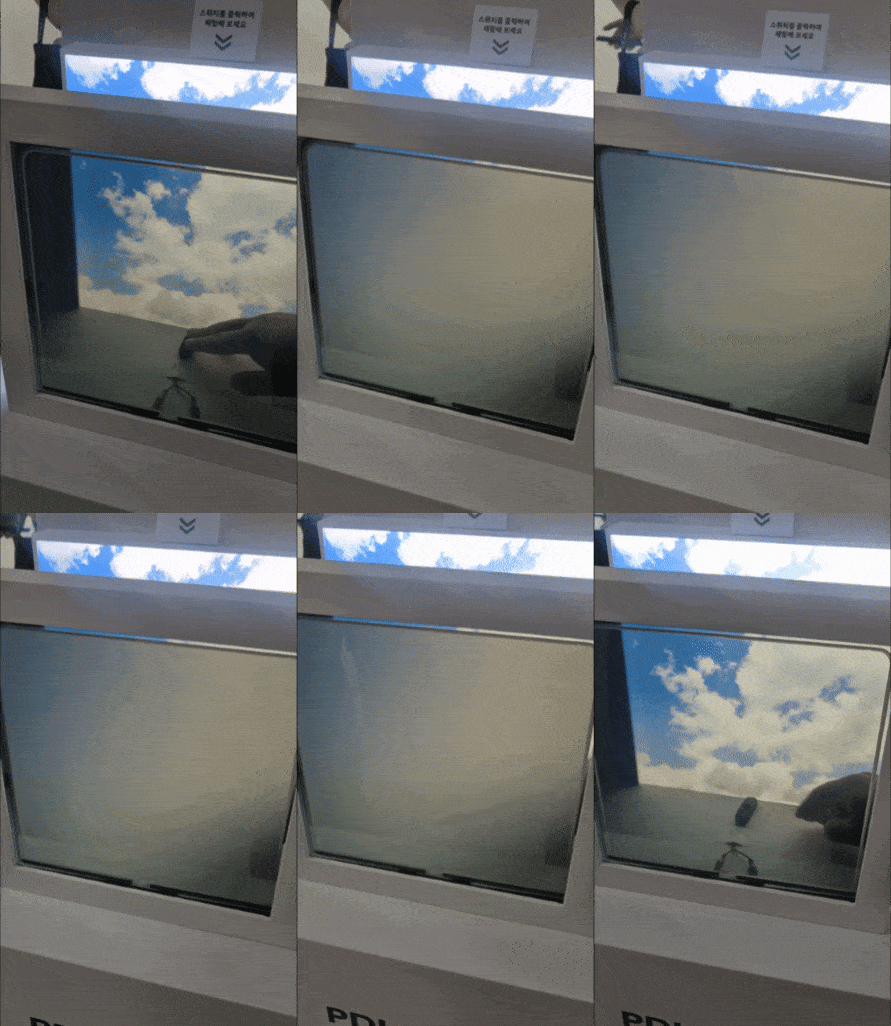
The third floor centered on technologies that transform the interior experience. The Smart Vision Roof expands the open area by about 42 percent compared with a conventional panoramic sunroof and allows the transparency of six separate zones to be adjusted independently.
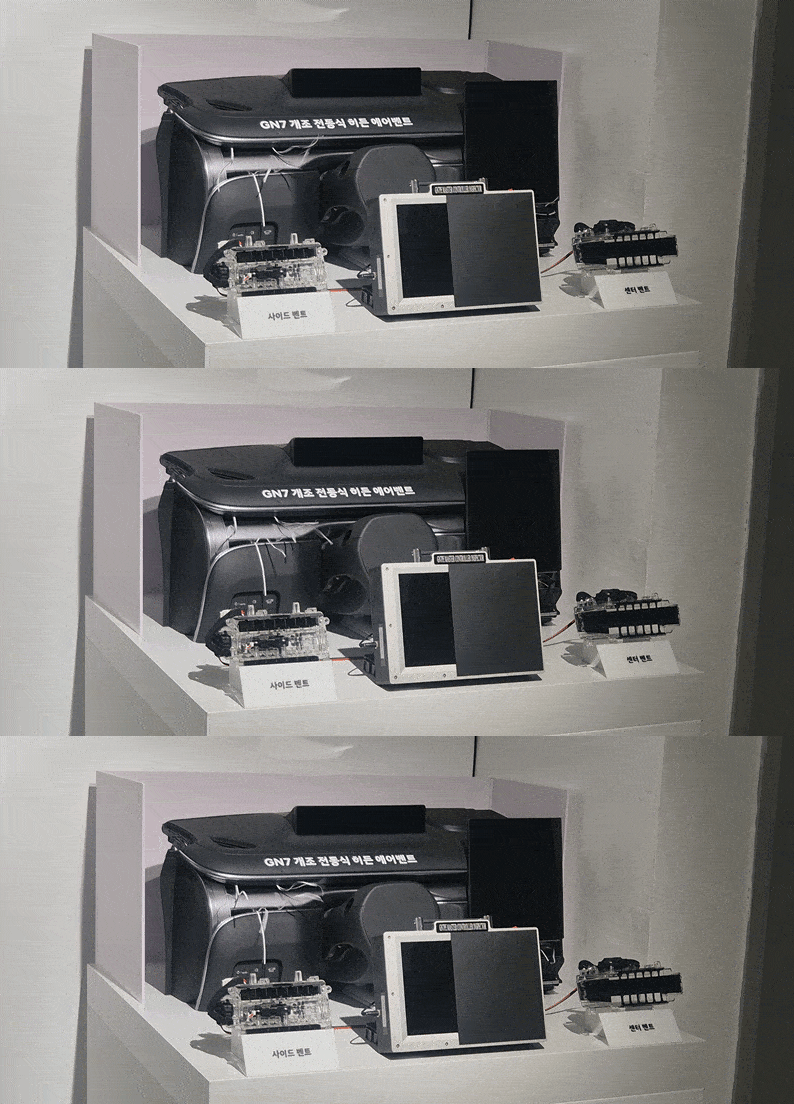
The motorized air vent keeps the vents as unobtrusive as possible while still allowing precise control over airflow direction.
Kim Hyeon-seop, a researcher on the HVAC System Design Team, said the design challenge was to make the air vents as invisible as possible in order to realize an interior worthy of the "premium lounge" concept.
Another centerpiece of The New Grandeur is Pleos Connect, a next-generation infotainment platform making its debut in a Hyundai Motor vehicle. Built around a 17-inch display, it offers the generative AI agent Gleo AI, an app market and over-the-air software update capability.
Shin Yong-jin, a principal researcher on the Infotainment Platform Development Team, said that while conventional voice recognition handled only fixed commands, Gleo AI understands the user's intent and context.
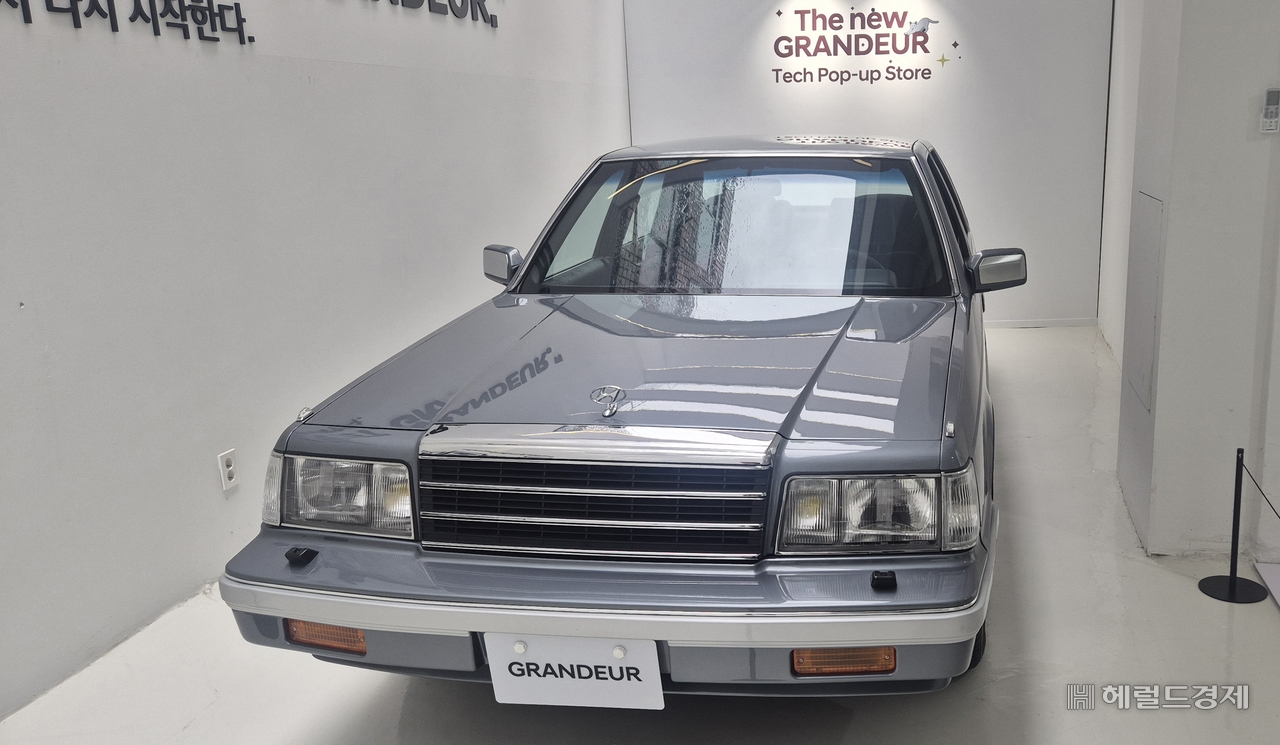
Since its launch in 1986, the Grandeur has served as Hyundai Motor's flagship sedan and the model where new technology has historically made its first appearance. As the company expands into robotics, AI and software-defined vehicles, the pop-up store carries significance beyond a simple new-car showcase — it represents a direct effort to put the engineering inside a finished vehicle in front of consumers.
Kim Pyeong, head of Hyundai Motor's MLV Project Team 3, said the pop-up store was the company's first attempt to present its new-technology development process in this format, adding that visitors could learn what the latest mobility technologies in The New Grandeur went through to reach completion — the full story before and after development.
Meanwhile, The New Grandeur, which went on sale in May, recorded 10,277 orders on its first day, stoking expectations for strong demand. That figure is the second-highest first-day order tally for any Grandeur facelift model on record, trailing only the 17,294 orders logged by the sixth-generation Grandeur (IG) partial facelift when it launched in 2019.
kwater@heraldcorp.com





