

The Fair Trade Commission's approval of Mirae Asset Consulting's acquisition of Korbit is expected to bring significant changes to the digital asset market. Rather than an immediate jump in Korbit's exchange market share, the industry is watching whether the combined entity can develop a range of digital asset products — including exchange-traded funds and real-world assets — by leveraging business synergies with Mirae Asset Group, and ultimately reinvent itself as a Korean equivalent of Robinhood. Analysts say the key lies in how quickly regulators and the National Assembly move to introduce a broader digital asset regulatory regime.
The acquisition stands out among recent exchange investments for both its size and the stake involved. Mirae Asset Consulting acquired approximately 26.91 million Korbit shares for 133.5 billion won ($88.4 million) in February, buying out stakes held by NXC and SK Planet. With Fair Trade Commission approval, Mirae Asset Consulting will hold 92.06 percent of Korbit. Mirae Asset Consulting personnel are expected to join Korbit's board of directors. Korbit said it could not disclose details on individual proceedings as a shareholders' meeting and other steps remain. "We will continue to operate with user protection and stable service provision as our top priorities," the company said.
Industry observers do not expect the acquisition to translate directly into a higher market share for Korbit. Upbit and Bithumb already account for more than 90 percent of total trading volume, and domestic won-denominated exchanges are in effect confined to spot trading.
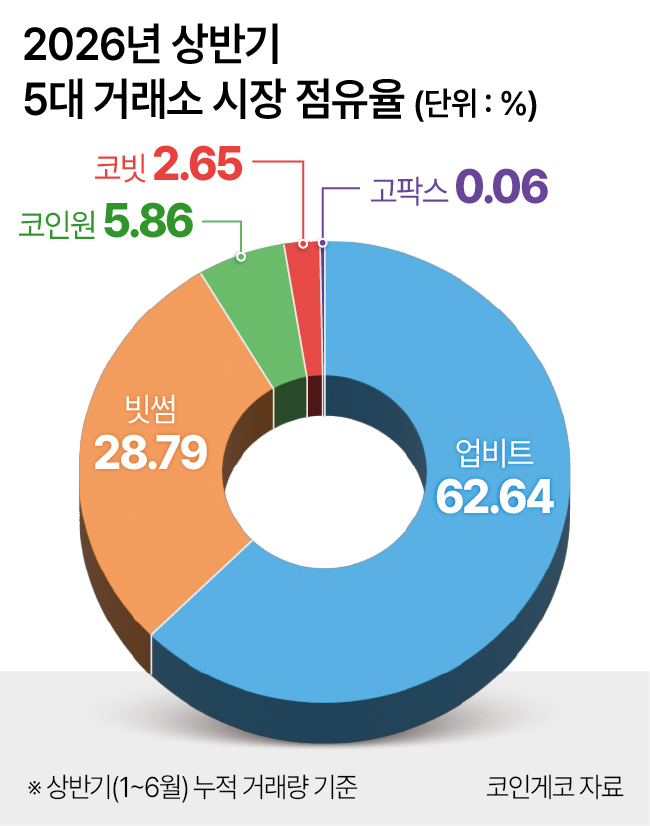
According to global digital asset data platform CoinGecko, the combined trading volume of South Korea's five major won-denominated exchanges reached $70.12 billion in June. Korbit's share stood at just 1.25 percent, far behind Upbit at 63.08 percent and Bithumb at 30.58 percent, and even well short of Coinone at 4.99 percent. The rankings held across the full first half of the year. Upbit commanded the largest share of January-through-June trading volume at 62.64 percent, followed by Bithumb at 28.79 percent, Coinone at 5.86 percent, Korbit at 2.65 percent and Gopax at 0.06 percent.
"Given how wide the gap is between the top two players and the rest, it will not be easy to upend the market through capital injection alone, unless some other variable emerges," said one financial industry official.
Korbit attracted 90 billion won in investment from SK Square in 2021, but that failed to shift the competitive rankings. Even accounting for the market headwinds at the time — including the Terra-Luna collapse — the episode showed the limits of capital alone in shaking up an entrenched competitive order. With the gap in user interface and trading convenience between platforms having narrowed considerably, analysts say a simple brand refresh is unlikely to drive meaningful customer migration either.
Ultimately, analysts say, any market reversal will depend on how broadly the evolving digital asset regulatory regime allows financial firms to participate. As long as business activity remains concentrated in spot trading for retail customers — as it does today — the scope for Mirae Asset and Korbit to combine their respective strengths will remain limited.
If second-phase digital asset legislation — including the institutionalization of stablecoins — is crafted in a market-friendly direction and opens up new business opportunities for financial firms, the synergies between the two companies could begin to materialize in earnest. A broader range of investment products, such as digital asset ETFs, real-world assets and tokenized securities, would create more room to connect Mirae Asset's product development and distribution capabilities with Korbit's trading infrastructure.
The industry expects Mirae Asset Securities to move in earnest toward building an environment where customers can trade domestic and foreign equities alongside digital assets within a single mobile trading system — similar to the US online investment platform Robinhood. Mirae Asset Securities has been working to build an integrated investment platform that breaks down the divide between traditional financial assets and digital assets. A prominent example is MAPS (Mirae Asset Portfolio Service), a global investment platform the company recently unveiled.
MAPS is the first global investment platform launched under "Mirae Asset 3.0," the group's next-generation growth strategy. It is designed to let investors manage and trade traditional financial products — stocks, bonds and ETFs — alongside digital assets, all within a single mobile platform. The vision is to evolve it into a global investment platform that transcends borders and asset classes.
Park Hyeon-joo, global strategy officer of Mirae Asset Group, said at the MAPS launch that the platform represents "not an expansion of the business, but an inflection point." "Mirae Asset's goal is to build a global investment platform," he said. The remarks were widely interpreted as signaling an ambition to build a digital financial ecosystem encompassing investment and asset management as a whole, rather than simply adding new services.
Mirae Asset's existing customer base could also prove an asset for Korbit. Offering differentiated products, fee benefits and dedicated services to high-net-worth clients in particular could allow Korbit to close the gap quickly in the mid-tier exchange segment, where competition is less entrenched. Given the market's characteristic of a small number of customers generating a disproportionate share of trading volume, how effectively the combined entity leverages its existing sales network will be critical.
The opening of the corporate market is another factor to watch in the evolving exchange competitive landscape. Given Mirae Asset's strength in institutional and corporate finance, the combination with Korbit could prove even more powerful if corporate digital asset investment takes off in earnest. Some in the market see potential for the combined entity to build a value chain spanning issuance, custody, trading and distribution in the digital asset ETF market — not merely absorbing corporate trading demand, but developing the capacity to design and supply institutional-grade digital asset investment products directly.
Meanwhile, financial authorities are discussing a proposal under the second-phase digital asset legislation that would cap the major shareholder stake in a digital asset exchange at 20 percent in principle, while allowing up to 34 percent in exceptional cases — including where the major shareholder is a corporation. Should that regulation take effect, Mirae Asset Consulting, which holds 92.06 percent of Korbit, could face pressure to restructure its ownership — including disposing of its excess stake within six years, accounting for any grace period.

kyoung@heraldcorp.com
th5@heraldcorp.com





