
The government is stepping up support for vocational training and professional certification in workplace safety this month, which marks Industrial Safety and Health Month. Plans call for expanding AI-based hazard analysis education and upgrading the vocational training system so that both prospective and current workers can deepen their expertise in industrial safety.
The Ministry of Employment and Labor on Thursday unveiled its monthly vocational competency policy, highlighting national technical qualifications in industrial safety alongside training channels including the National Tomorrow Learning Card, the online vocational training platform STEP and Korea Polytechnic University. The ministry said preventing workplace accidents requires not only proper systems and equipment but also workers who can identify and respond to hazards.
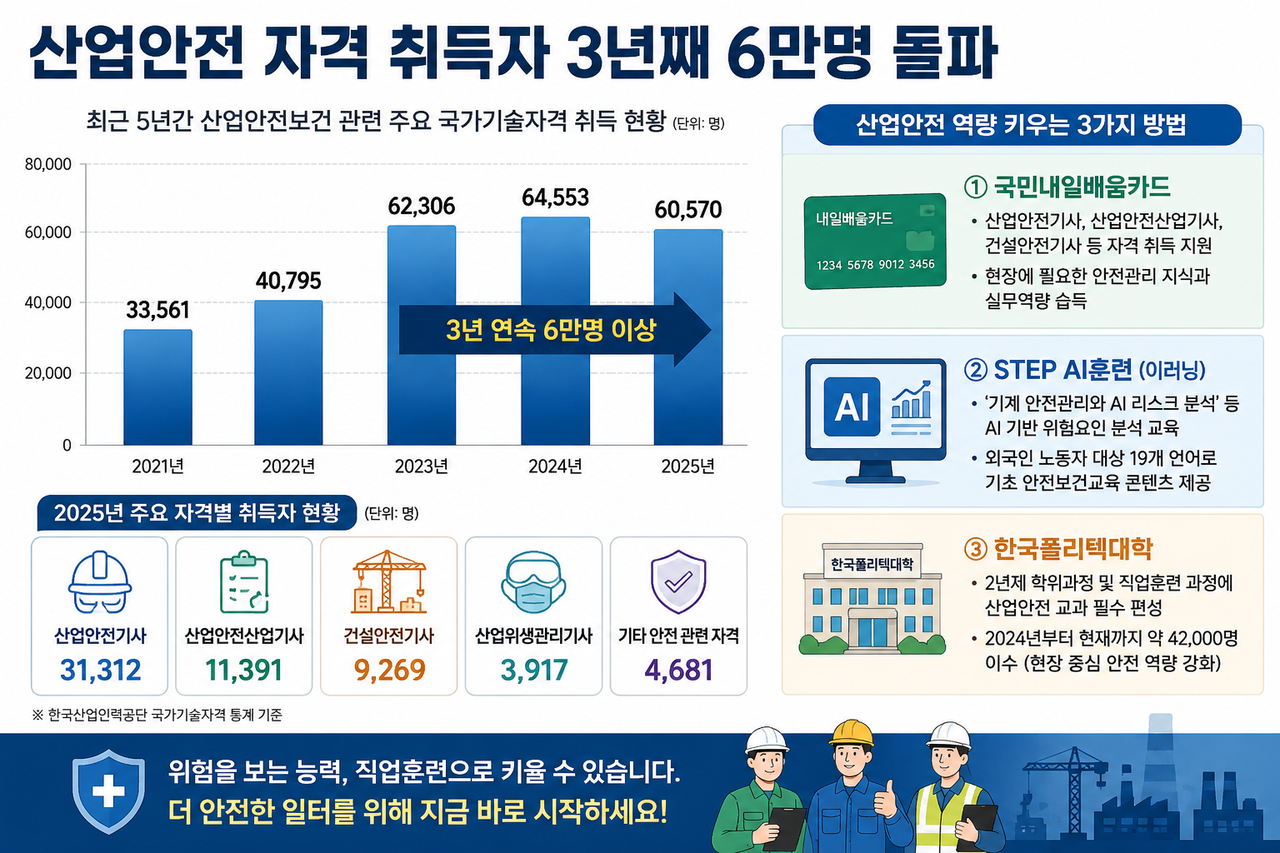
According to the Human Resources Development Service of Korea, the number of people obtaining major safety-related national technical qualifications — including industrial safety engineer, industrial safety technician, construction safety engineer and industrial hygiene management engineer — exceeded 60,000 for three consecutive years: 62,306 in 2023, 64,553 in 2024 and 60,570 in 2025. Among these, the industrial safety engineer qualification was the most popular, with 31,312 recipients last year.
The government supports training for qualifications such as industrial safety engineer and industrial safety technician through the National Tomorrow Learning Card. Trainees receive practice-oriented instruction covering hazard analysis for mechanical, electrical and chemical equipment, as well as safety management at construction sites.
AI-based industrial safety education is also being expanded. STEP, the online vocational training platform operated by the Ministry of Employment and Labor and the Korea University of Technology and Education's Online Lifelong Education Institute, is rolling out 24 e-learning courses this year to build AI literacy and job-specific AI skills. One course — covering machine safety management and AI risk analysis — uses AI and data-driven methods to analyze hazards in manufacturing processes and equipment, with the aim of strengthening accident-prevention capabilities.
Safety education for foreign workers is also being reinforced. STEP currently offers occupational safety and health content in 17 languages, including English, Vietnamese and Chinese, and plans to add Russian and Kazakh to bring the total to 19. New plain-language safety and health content will also be developed to improve comprehension.
Korea Polytechnic University has made industrial safety coursework mandatory across all two-year degree programs and vocational training courses since 2024. The curriculum is tailored to sector-specific characteristics in fields such as mechanical engineering, semiconductors and electrical work, enabling students to develop safe work practices alongside technical skills. About 42,000 trainees have completed the industrial safety coursework to date.
Pyeon Do-in, director general of the ministry's vocational competency policy bureau, said working safely is just as important as working productively. "We will continue to expand vocational training support so that workers can build not only job competencies but also the industrial safety skills needed to recognize hazards and prevent accidents," he said.
fact0514@heraldcorp.com





