
![[123RF]](https://wimg.heraldcorp.com/news/cms/2026/07/09/news-p.v1.20260709.68e6be5d45e94c6eb6bb723b782d8363_P1.jpg)
The government will prioritize building an emergency referral system, improving its crisis household detection system and encouraging reporting, as concerns grow over households falling into financial distress — including those victimized by illegal private lending.
The Ministry of Health and Welfare convened a cross-ministry task force on crisis household detection and support Thursday, chaired by First Vice Minister Hyeon Su-yeop, and unveiled a plan to strengthen the detection and support of financially distressed households.
President Lee Jae-myung called at a Cabinet meeting on June 2 for the government to identify additional vulnerable debtors struggling with debt and to step up outreach on debt restructuring options.
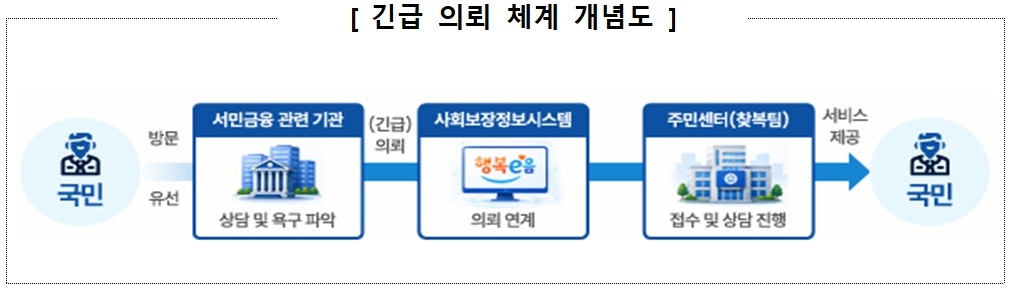
In response, the ministry — working with the Financial Services Commission and the Financial Supervisory Service — drew up the plan. A key element is expanding, by the end of this year, an emergency welfare referral system between microfinance institutions and local governments to ensure financially distressed households are quickly connected to welfare services.
Under the current system, the Korea Inclusive Finance Agency and the Credit Counseling and Recovery Service refer microfinance users in need of welfare support to local governments through an online system. Community health and welfare teams then conduct consultations and on-site checks before providing emergency welfare and other services.
The new plan adds the Illegal Private Lending Victim Relief Center and the Korea Legal Aid Corporation — both of which have frequent contact with high-risk individuals — to the network, enabling them to refer people in need directly to local governments.
To enable swift action, the Financial Supervisory Service will be allowed to temporarily access the Social Security Information System starting in October, with a direct inter-agency system link to follow from next year.
The government also plans to expand the financial crisis-related data fed into its big data-driven welfare blind-spot detection system, which identifies households at risk of slipping through the cracks.
The Ministry of Health and Welfare currently analyzes 47 types of crisis indicators — including utility disconnections — to flag about 1.2 million high-risk households each year, sharing that information with local governments so community health and welfare teams can conduct consultations and investigations.
To sharpen the accuracy of that screening, the ministry plans to add three new data streams: records of people who have suspended debt restructuring from the Credit Counseling and Recovery Service, information on vulnerable debtors among microfinance users from the Korea Inclusive Finance Agency, and data on illegal private lending victims from the Financial Supervisory Service.
Before the relevant enforcement decrees are amended, information on vulnerable debtors and illegal lending victims will be collected proactively with the consent of those involved, and local governments plan to conduct a coordinated survey directly in August.
Alongside this, the Financial Supervisory Service will establish guidance procedures for secondary financial institutions such as savings banks — which vulnerable debtors frequently visit — so that staff actively use a welfare crisis alert app when signs of distress emerge during debt counseling. Outreach on preventing and responding to illegal private lending will continue through online channels frequented by crisis households, including the Bokjiro welfare portal and the welfare membership service, as well as through city, county and district offices and community administrative welfare centers.
"What people in despair from overwhelming debt need most is hope that they can get back on their feet, and a concrete path to recovery," First Vice Minister Hyeon said. "We will make it widely known that the state will find and support people even amid complex financial debt crises, and all relevant ministries will join forces to ensure that not a single person is left behind and that everyone is swiftly connected to the welfare services they need."
thlee@heraldcorp.com





