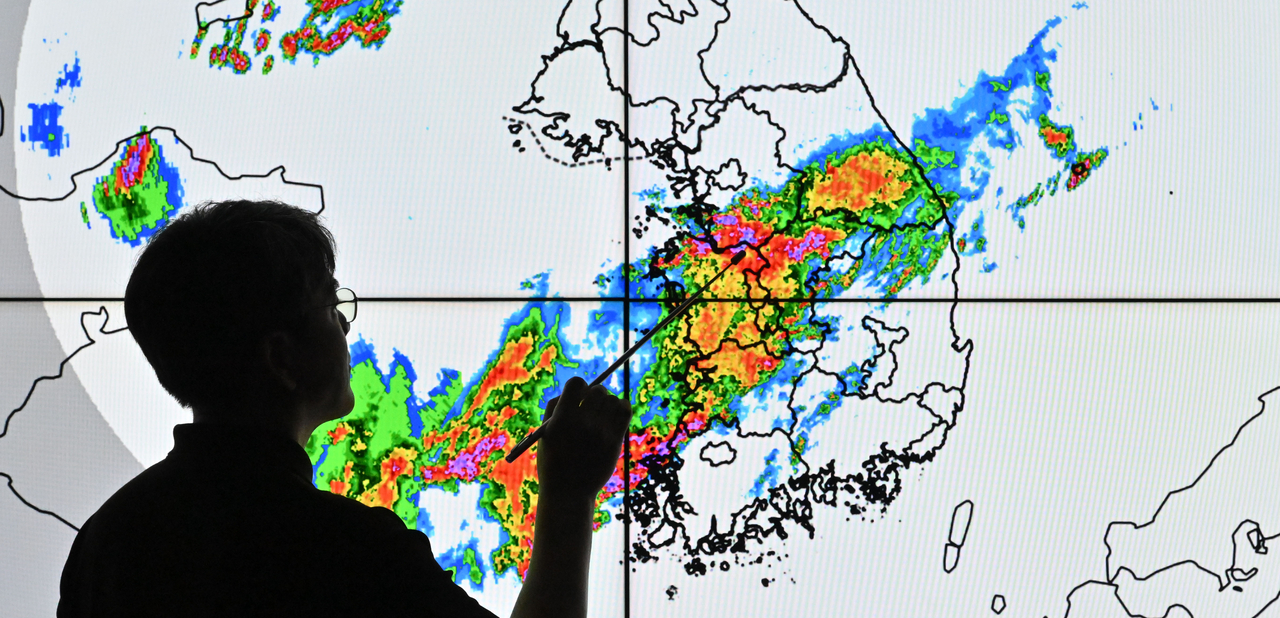
Strong monsoon rains are forecast to pound the Greater Seoul area and inland Gangwon Province again from Thursday night through early Friday morning. Once the rain clears, a dual high-pressure system — the North Pacific High and the Tibetan High — is expected to blanket the Korean Peninsula, bringing a nationwide heat wave.
The Korea Meteorological Administration said rainfall of up to 50 millimeters per hour drenched all of the Chungcheong provinces, southern Gyeonggi Province, and parts of North Jeolla and Gangwon provinces on Thursday morning. Very heavy rain of 20 to 80 millimeters per hour was forecast to continue through the afternoon across the central regions, North Jeolla Province, the western coast of South Jeolla Province, and the central and northern parts of North Gyeongsang Province.
From the afternoon, the North Pacific High is expected to expand, gradually pushing the stationary front northward. Rain in the Chungcheong and southern regions is forecast to mostly stop by nightfall, but precipitation will continue in the Greater Seoul area and Gangwon Province through Friday morning.
The KMA said cold, dry air moving south from the north overnight will collide with the warm, humid air of the advancing North Pacific High, causing rain clouds to develop rapidly. As a result, the Greater Seoul area — excluding the southern inland parts of Gyeonggi Province — can expect heavy rain of 20 to 30 millimeters per hour from Thursday night through early Friday morning, while the northern inland areas of Gangwon Province will see similar rainfall from late Thursday night through early Friday morning.
Heavy rain is also expected in North Korea, which could cause water levels in cross-border rivers — including the Imjin, Hantan and North Han rivers — to rise sharply. Residents in border areas are urged to exercise caution.
As of 11 a.m. Thursday, additional rainfall totals were forecast as follows: 50 to 100 millimeters for inland and mountainous areas of Gangwon Province, with more than 150 millimeters in some inland areas; 30 to 80 millimeters for the Greater Seoul area, the Chungcheong provinces, North Jeolla Province, the northwestern part of South Jeolla Province and the central western coast of South Jeolla Province, with more than 120 millimeters possible in parts of the Greater Seoul area, the Chungcheong provinces and western North Jeolla Province, and more than 100 millimeters in parts of northwestern and central-western South Jeolla Province; 30 to 80 millimeters for the central, northern and southwestern inland areas of North Gyeongsang Province; 20 to 60 millimeters for the five West Sea islands; 5 to 50 millimeters for the eastern Gangwon coast; 10 to 40 millimeters for Gwangju, most of South Jeolla Province, Daegu, the southeastern part of North Gyeongsang Province, the western inland areas of South Gyeongsang Province, Ulleungdo and Dokdo; 5 to 40 millimeters for mountainous areas of Jeju; and less than 5 millimeters for the rest of Jeju.
With heavy rain also forecast for North Korea, water levels in cross-border rivers — including the Imjin, Hantan and North Han rivers — could rise sharply, and residents in border areas should remain on alert.
As of 11 a.m. Thursday, additional rainfall of 50 to 100 millimeters was forecast for inland and mountainous areas of Gangwon Province, with more than 150 millimeters expected in some inland areas. The Greater Seoul area, the Chungcheong provinces, North Jeolla Province, and the northwestern and central western coastal areas of South Jeolla Province can expect 30 to 80 millimeters, with up to 120 millimeters or more in some locations. Central and northern inland areas of North Gyeongsang Province are forecast to receive 30 to 80 millimeters, while the five West Sea islands can expect 20 to 60 millimeters.
A heat wave will follow quickly once the rain ends. With both the North Pacific High and the Tibetan High covering the Korean Peninsula, a steady flow of hot, humid southerly winds is expected to push the heat index significantly higher.
Heat wave advisories currently in effect for the Yeongnam region are expected to expand to the central regions starting Saturday before spreading to most of the country.
Friday morning lows are forecast at 21 to 25 degrees Celsius, with afternoon highs of 28 to 34 degrees. Temperatures are expected to climb further on Saturday and Sunday, with highs of 30 to 36 degrees — likely the most intense heat of the summer so far.
The end of this round of rain does not mean the monsoon season is over, however. The KMA forecast another bout of rain around Wednesday and Thursday of next week, when cold air from the north is expected to push south again.
betterj@heraldcorp.com