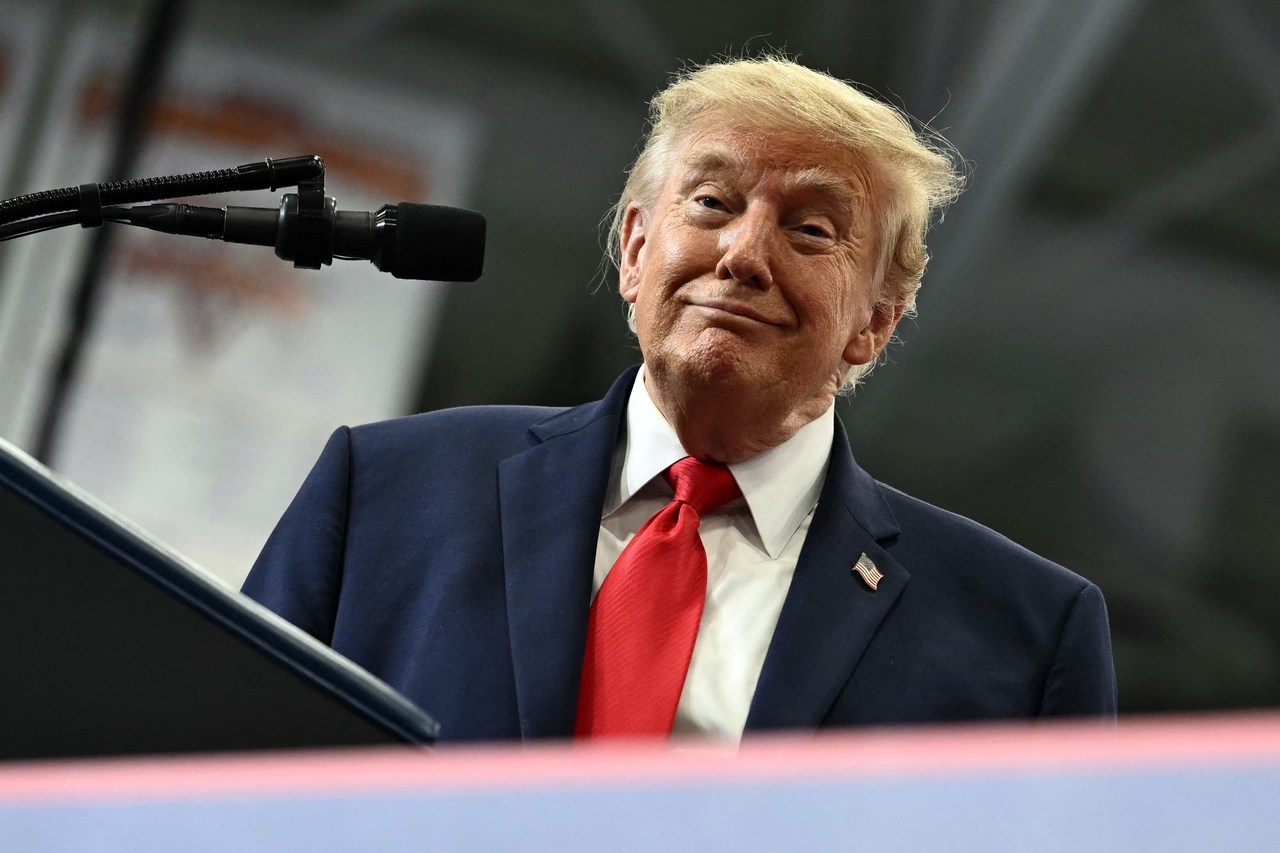
![SK Group Chairman Chey Tae-won speaks at a press briefing marking SK hynix's Nasdaq listing in New York on Friday (local time). [SK hynix]](https://wimg.heraldcorp.com/news/cms/2026/07/13/news-p.v1.20260713.ed4fb2c3d7aa438c8b8a69fd62b1ded0_P1.jpg)
SK Group Chairman Chey Tae-won said the memory chip market is still in the early stages of a "super momentum" cycle, arguing that the rise of AI has broken the industry free from its traditional boom-and-bust pattern. As the world moves toward artificial general intelligence, he said, memory demand will inevitably keep rising.
Customers Chey met ahead of SK hynix's Nasdaq listing ceremony were unanimous in pressing for more memory supply. Even after SK hynix announced plans to double its production capacity within five years, customers were asking for more.
After SK hynix completed its American depositary receipt listing on Friday (local time), Chey sat down with Korean correspondents and local media for a series of interviews.
Speaking to the Korean press corps, Chey said the gap between supply and demand is "enormously wide," adding that the pace of demand growth is far outstripping the pace of supply growth.
He attributed the shift largely to the growing scale of KV cache — the temporary memory space stored on GPUs that allows large language models to avoid recomputing previously read context. In an interview with Bloomberg TV, Chey said maintaining LLM performance requires vast amounts of KV cache memory. "In the PC and smartphone era, demand had its limits," he said. "But in the AI era, a single person could have hundreds of AI assistants — the scale of demand is on a completely different level."
He forecast that demand will climb even further once AGI — AI capable of learning and reasoning like a human — becomes a reality. "Today's AI is like a four- or five-year-old child," Chey said. "For AI to mature into AGI, it will need an enormous amount of learning. Even if a technological breakthrough reduces memory consumption, there is no way to stop demand from growing."
Before traveling to New York for the Nasdaq listing, Chey stopped in California to meet with customers. He said they all asked the same questions: how to secure memory supply and how SK hynix plans to ramp up output. He also said he does not expect the surge in demand to taper off within one or two years.
To meet that demand, SK hynix announced late last month a plan to invest 800 trillion won ($531 billion) across sites in Yongin, Cheongju and Gwangju. While some in the market have raised concerns about a potential oversupply, Chey dismissed those worries.
"We announced plans to double production capacity within five years, but our major customers are telling us that is not enough — they want us to expand five or six times," Chey told Bloomberg TV. "Strong demand momentum will not break until AGI is introduced and fully established," he said.
Still, he said long-term supply agreements, or LTAs, play an important role in addressing concerns about the memory industry's cyclical nature.
"It is not us asking for LTAs — customers who urgently need to secure supply are the ones proposing them," Chey said. "Once LTAs take hold, we can defend a certain volume and price even in a downturn, which fundamentally stabilizes the business model."
SK hynix is also drawing up US investment plans to reliably serve domestic customer demand, including a semiconductor factory and broader investments in the American AI ecosystem. The US AI company it established in February is expected to lead those efforts.
When a CNBC anchor asked whether SK hynix might build a semiconductor factory in the United States, Chey said the possibility exists but conditions must be right. "If stable power, clean water, sufficient site area, skilled workers and a supply chain ecosystem can all be met, there is no reason we cannot build in the US," he said.
He added that the company is eyeing tens of billions of dollars in US investment in AI, separate from its memory business. "We are reviewing large-scale investments across a range of AI projects — AI data centers, AI technology, startups and joint ventures with various partners," he said.
jeongwan@heraldcorp.com
go@heraldcorp.com