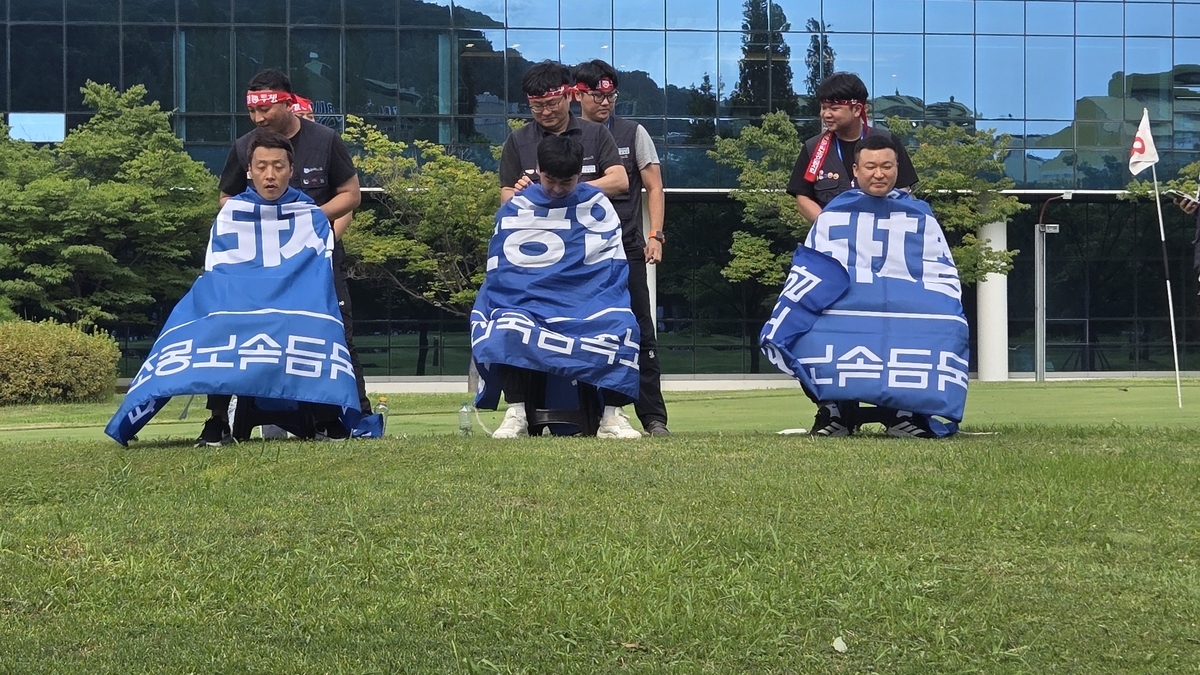
![Employment and Labor Minister Kim Young-hoon delivers opening remarks at the launch ceremony of a shipbuilding industry labor-management-government dialogue body at the Press Center in Jung-gu on Monday. [Yonhap]](https://wimg.heraldcorp.com/news/cms/2026/07/14/rcv.YNA.20260713.PYH2026071305110001300_P1.jpg)
The government is pushing to establish a new representative body called the "K-Labor Chamber" for non-traditional workers — including platform workers and freelancers — who are largely excluded from the protections of existing trade unions. The initiative aims to expand the social safety net based on the simple fact of working, rather than on the form of employment.
Employment and Labor Minister Kim Young-hoon proposed the chamber Monday at the National Fiscal Strategy Conference chaired by President Lee Jae Myung. "I am proposing the establishment of the K-Labor Chamber as an advocacy body for the many working people who cannot even form a union," Kim said. "This is the first step toward transforming a social safety net built around traditional employment relationships into a safety mat for all working people."
The government plans to first enact a basic law guaranteeing the rights of all labor providers — covering platform workers, freelancers and others — and then build the K-Labor Chamber on that foundation as a self-help mutual-aid system handling livelihood support, welfare and rights protection.
In addition, the government plans to overhaul the current Basic Act on Workers' Welfare into a Basic Act on Labor Welfare, broadening its scope to cover all labor providers regardless of whether they hold a formal employment contract.
"There are 8.69 million people earning income from personal service work through repeated provision of services," Kim said. "We must shift to a social safety mat based not on the form of employment or the way one works, but on the very fact of working itself."
The labor chamber concept is a policy President Lee has championed since his time as Gyeonggi Province governor and as a presidential candidate. However, the possibility of pushback from organized labor was also raised at Monday's meeting.
President Lee asked Kim whether there were objections to the labor chamber idea and said he was not confident the labor community would be easily persuaded.
Kim acknowledged that concerns had been raised — including fears that establishing the chamber could erode trade union membership rates — but argued the body was necessary. "Non-traditional workers in a wide variety of arrangements that cannot be explained by conventional employment relationships have emerged, and workers without an employer, such as freelancers, are not easy to organize through traditional unions," he said.
Kim added that overhauling the workers' welfare law would require a welfare delivery system for those outside traditional employment relationships, and pledged to "communicate and cooperate fully with the labor community."
President Lee responded by urging Kim to "persuade and consult well."
The government also decided to expand social insurance coverage for non-traditional labor providers. It plans to gradually extend employment insurance and industrial accident compensation insurance to about 1.6 million personal service income earners, and will pursue a program tentatively called "Hamkke Moa Gongje" — a retirement pension fund contribution support scheme for labor providers modeled on the small and medium-sized enterprise retirement pension fund.
The government also plans to introduce additional welfare measures for labor providers, including free legal aid, programs to encourage taking leave and the introduction of a childcare allowance.
fact0514@heraldcorp.com