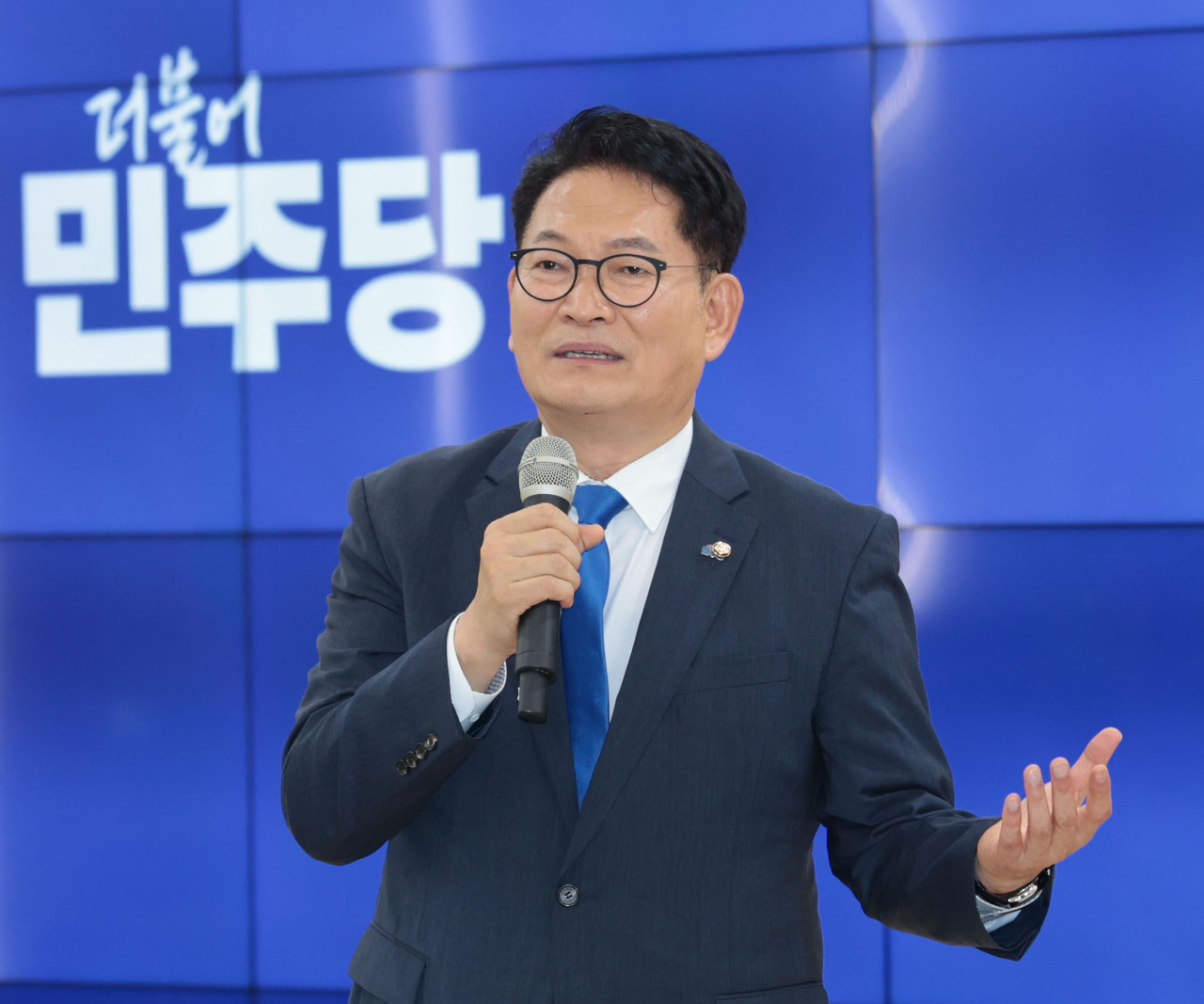
Song Young-gil, a Democratic Party of Korea lawmaker who has entered the race for the party's Aug. 17 leadership election, rebuffed rival Jung Chung-rae on Tuesday over criticism of his past departure from the party, saying his decision to leave was made to protect the Democratic Party.
Speaking on CBS Radio's "Park Sung-tae's News Show," Song said that during the controversy over Jung's remarks likening Haeinsa temple's cultural heritage admission fees to a con artist's scheme, the late Buddhist monk Jaseung had gone so far as to warn that "if Jung Chung-rae is not expelled from the party, the Buddhist community will officially oppose Lee Jae Myung as a presidential candidate." Song said Jung nonetheless "kept burdening the party and the candidate until the very end, refusing to offer a proper apology."
Song was referring to remarks Jung made in 2021, when Song was party leader, comparing the temple's fee collection to the tricks of "Bong-i Kim Seon-dal," a legendary Korean con artist. Song himself left the party in 2023 amid what became known as the "cash envelope distribution" allegations, but returned this year after being acquitted.
Song also took aim at Jung's formal declaration of his candidacy for party leader on Monday, in which Jung said he would not use the chairmanship as a springboard to run for president. "With four years left in this administration's term, even raising the subject of a presidential election is a bit out of nowhere — but saying you won't run for president in order to win the party chairmanship is completely off base and makes no sense," Song said.
He added that Jung "even during the last presidential election, used the presidential race as a pretext to live in the Honam region and campaign in advance for the party leadership, and lined up 800 of his close associates as local government candidates to prepare for a consecutive term." Song said Jung had been "thoroughly putting himself before the party, every step of the way."
Song went on to say that "it is the first time in constitutional history that the main topic in the media during a president's first year in office has been a clash between the party leader and the president," adding that "what is needed now is a ruling party leader who can join forces with the president to take the country to the next level and build a Korea that is irreplaceable."
On his own strengths as a candidate, Song said he is "the only one among the candidates who has served as the head of a metropolitan government," pointing to his tenure leading Incheon. "I take pride in having transformed Incheon — a city on the verge of bankruptcy, paying 1 billion won a day in interest — turning it into a surplus, attracting Samsung Bioepis to create the world's largest biosimilar complex, and bringing in semiconductor firms Amkor Technology and Stats ChipPAC Korea, the world's second- and third-largest back-end semiconductor companies, fundamentally reshaping Incheon's industrial base," he said.
"I decided to run because I believe this kind of leadership is what is needed right now," Song added. On the controversy over abolishing prosecutors' supplementary investigative powers, he said the powers should be abolished and replaced with a right to request supplementary investigation.
bigroot@heraldcorp.com