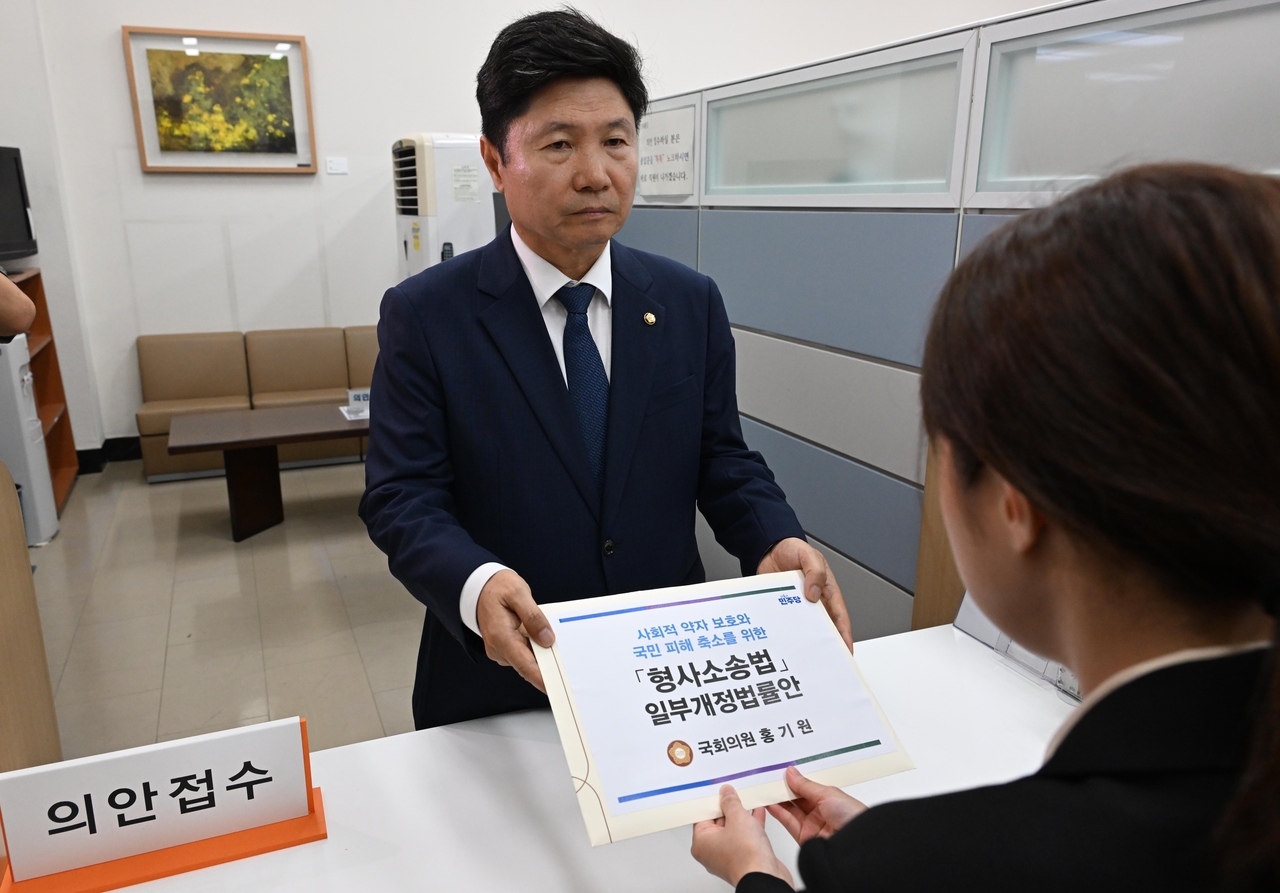
Divisions within the Democratic Party of Korea are deepening over a proposed Criminal Procedure Act amendment that would strip prosecutors of their supplementary investigation powers. The floor leadership has pushed a bill calling for the complete abolition of those powers, but calls from within the party to preserve them in exceptional cases show no sign of fading.
Political observers say the push for full abolition could lose momentum as the party continues to gather internal opinions and advance the bill through committee review.
Democratic Party lawmaker Hong Ki-won submitted a Criminal Procedure Act amendment bill to the National Assembly's bill-receipt office on Tuesday, with the preservation of limited prosecutorial supplementary investigation powers as its centerpiece.
Before filing the bill, Hong held a press conference to explain his rationale. "If supplementary investigations are banned outright, even simple fact-checking or document supplementation would have to go back to the police," he said. "That would slow case processing, and the greatest burden would fall on the victims." The bill was co-sponsored by lawmakers Ko Min-jung, Kwak Sang-eon, Kim Nam-hee, Mo Gyeong-jong, Min Hong-cheol, Park Gyun-taek, Park Hee-seung, Lee So-young and Joo Cheol-hyeon, listed in Korean alphabetical order.
The bill would grant prosecutors supplementary investigation powers in five categories of cases: those involving violent crimes and abuse of children, people with disabilities, the elderly, domestic violence and stalking; voice phishing, financial investment fraud and other crimes affecting everyday livelihoods; cases with pressing deadlines, such as those involving detained suspects or imminent statutes of limitations; cases requiring consolidated investigations or where victims have filed objections; and cases too minor to handle through a formal supplementary investigation request.
The bill also includes safeguards against prosecutorial overreach: coercive investigations would require approval from a regional prosecution office chief, a case review committee under the prosecution office would assess the appropriateness of supplementary investigations, and direct investigations into unrelated criminal charges would be prohibited.
On Monday, Democratic Party lawmakers Kim Nam-hee and Kim Dong-a, along with Progressive Party lawmaker Son Sol, called on the Criminal Procedure Act amendment to guarantee the rights of socially vulnerable groups and sexual violence victims. At a press conference held with six women's rights organizations — including the Korean Bar Association's Women's Rights Committee, Korea Women's Hotline and Korea Women's Associations United — they said: "Since the 2021 adjustment of investigative authority between prosecutors and police, victims of criminal cases involving people with disabilities, women and children have suffered greatly from delayed investigations and repeated questioning. There are growing calls that the current Criminal Procedure Act amendment must not make that situation any worse."
Meanwhile, with the party's Aug. 17 leadership convention approaching, the Democratic Party's Criminal Procedure Act reform task force — led by the floor leadership, the policy committee, and the National Assembly's Legislation and Judiciary Committee and Public Administration and Security Committee — filed its own amendment bill on July 9 as the push for full abolition gained traction among the party's more vocal base.
The TF bill's core provisions would block prosecutors from conducting direct investigations entirely while strengthening the right to demand re-investigations, supplementary investigations and corrective measures. It also includes steps to tighten oversight of investigative agencies, such as replacing judicial police officers or requesting case transfers to other agencies.
Internal caution has not subsided since the TF filed its bill. Hong told reporters that some lawmakers had declined to co-sponsor it, citing concerns about their party positions or the potential impact on the upcoming convention. "There are more lawmakers who agree with the bill beyond the 11 who co-sponsored it," he said.
A Democratic Party lawmaker on the Legislation and Judiciary Committee voiced frustration. "If the general assembly today ignores all dissenting views and adopts full abolition as the party line, further discussion will be very difficult," the lawmaker said. "Citizens' rights are at stake, and the party is moving in the opposite direction from majority public opinion — this is not something we can just sit back and watch."
The Democratic Party is expected to hold an open debate at Tuesday's general assembly without reaching a predetermined conclusion. The party plans to set its official position after internal discussion and Legislation and Judiciary Committee review.
As internal disagreement persists, signs of a push to slow the pace of the discussions are also emerging. Park Sang-hyeok, a member of the Criminal Procedure Act reform TF, appeared on SBS Radio on Tuesday and said a range of views would likely surface at the general assembly. "There is room for those views to be fully reflected in future Legislation and Judiciary Committee debates," he said, adding that the floor leadership was likely to be receptive to the diverse opinions.
Park said the TF had drafted the bill around the government's and party's basic positions, with victim protection provisions added on top. "A baseline bill was needed for discussion ahead of the planned October launch of the Serious Crimes Investigation Agency and the prosecution office," he added.
addressh@heraldcorp.com