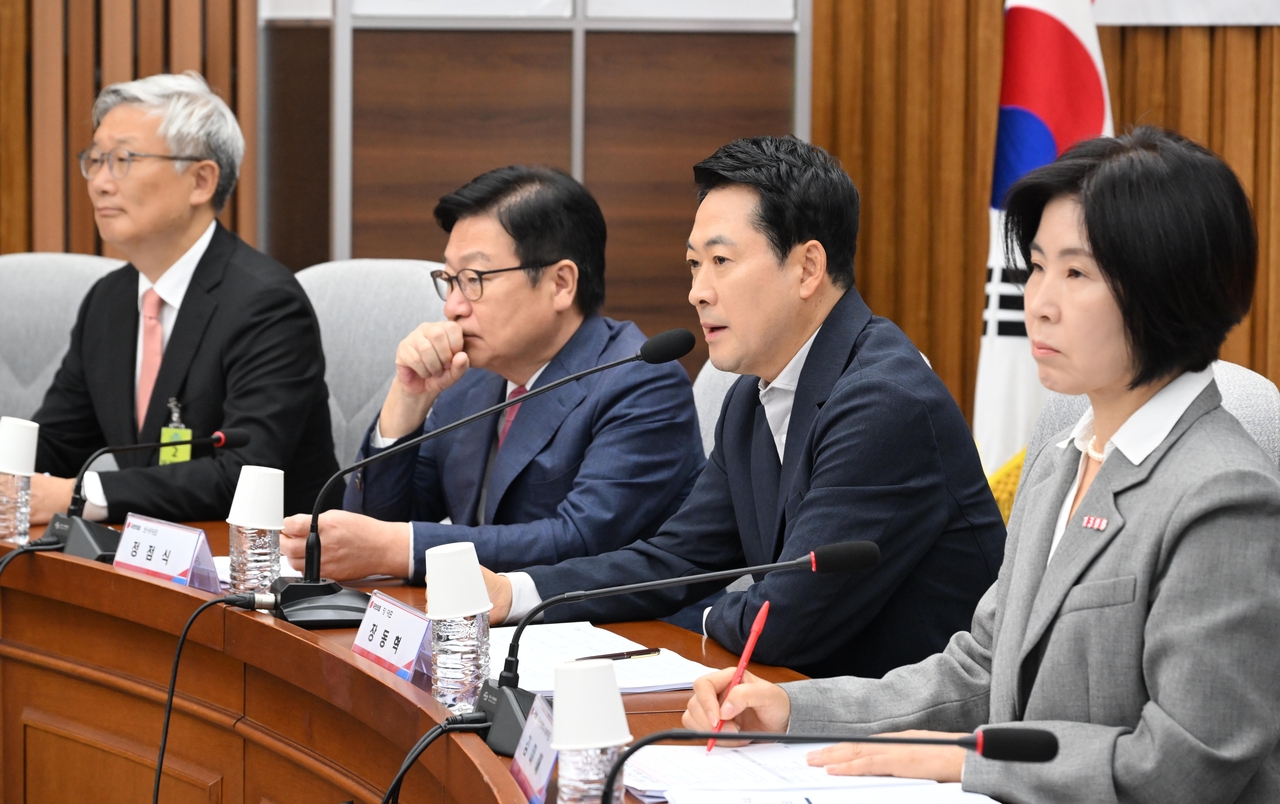
People Power Party leader Jang Dong-hyeok said Tuesday that the Jang Yun-gi case shows "it is not only impossible to expect police to conduct a proper investigation based on goodwill — it actually leads to the conclusion that what is needed now is police reform," adding that the case "tells us that someone must check and control the enormous power of the police."
The People Power Party held a forum Tuesday on prosecutors' supplementary investigative powers, arguing that those powers should be retained. Jang said "handing all investigative powers over to the police will create a monster police force," and that "eliminating supplementary investigative powers entirely is particularly unacceptable. This is not a gift that can simply be handed over for the sake of one person or to please a hardcore base."
Floor leader Jeong Jeom-sik said the case was one "in which police, who should have uncovered the truth, instead turned away from it, concealed evidence and betrayed the public," warning that abolishing prosecutors' supplementary investigative powers under such circumstances "could neutralize the last remaining check against shoddy police investigations and abuse of investigative authority."
Kim Mi-ae, the party's senior floor policy deputy leader and organizer of the forum, said recent events had prompted her to ask a fundamental question about why the state exists. "For the past 80-plus years, the criminal justice system has protected victims and served justice through mutual cooperation and checks between prosecutors and police — so why is that system now being dismantled?" she said.
The forum was also attended by Kim Jin-ju (a pseudonym), the victim in the Busan spinning-kick case, along with attorneys Kim Jong-min of law firm MK, Choi Chang-ho of Jeongron, Kim Jae-ryeon of Onsesang and Kim Se-hee of The Kim Law Firm, all of whom argued for retaining supplementary investigative powers.
Attorney Kim Jong-min criticized the Democratic Party's push to abolish supplementary investigative powers despite the Jang Yun-gi case as a display of "arrogance and self-righteousness," adding: "How do you tell doenjang from something foul? An expert should know at a glance."
Kim Jin-ju said her case "was initially filed as a simple assault case, and even within the police it was only sent to prosecutors as grievous bodily harm after I submitted a disability diagnosis." She said neither side was inherently deficient, but that "because each institution views a case from a different position, the errors each catches are different — which is why having another agency verify judgments made at the investigative stage should not be optional but mandatory."
mp1256@heraldcorp.com