![Headquarters of Korea's three major battery makers — LG Energy Solution (left), SK On and Samsung SDI [Provided by each company]](https://wimg.heraldcorp.com/news/cms/2026/07/16/9/news-p.v1.20250814.a052ba57491940eeaf88ca2cc38b3a7c_P1.png)
The government's formal announcement of a Korean version of the Inflation Reduction Act — a production-linked tax credit scheme — has drawn a mixed response from industry: broadly welcomed for extending tax support beyond research and facilities investment to actual production, but criticized for leaving out direct refunds and third-party credit transfers that would allow loss-making companies to convert credits into cash.
According to the government's "Second-Half 2026 Economic Growth Strategy" released Thursday, Seoul plans to introduce a domestic production tax credit that reduces corporate and income taxes based on output volumes for strategically important items in economic security and green transition. Specific eligible products, per-unit credit rates and support mechanisms for loss-making companies are expected to be outlined in a tax code revision bill due later this month.
Industry observers expect Hyundai Motor and Kia — both profitable and equipped with domestic electric vehicle production facilities — to be the first beneficiaries if EVs are included among eligible products.
Battery companies, by contrast, are still running losses from heavy upfront investment and the EV demand slowdown, and industry officials say they will need separate cash-conversion mechanisms such as direct refunds before the policy delivers any real benefit.
"Including batteries in the production tax credit is welcome, but companies still in the red have no corporate tax liability to offset, making it hard to use the benefit," a battery industry official said. "Credits will just keep piling up while we remain unprofitable, so the government needs to phase in practical cash-support options — direct refunds, third-party transfers or subsidies."
Profitable Hyundai Motor gets immediate tax relief; loss-making battery firms just accumulate credits
The production tax credit works by multiplying domestic output volumes by a product-specific unit rate and deducting the resulting amount from corporate or income tax.
For example, if a company generates 10 billion won ($6.72 million) in production tax credits, a firm with a 15 billion won corporate tax bill would need to pay only 5 billion won.
A company with no taxable income, however, cannot immediately use the same 10 billion won credit. Even if unused credits can be carried forward, no actual financial benefit materializes until the company returns to profitability.
That dynamic is expected to favor Hyundai Motor and Kia if EVs are included. Both companies have domestic EV production facilities and are profitable in their automotive businesses, allowing them to apply credits right away.
Whether EVs will be included has not yet been decided. Another open question is whether vehicles produced domestically and then exported will qualify — if only domestic sales count, the actual benefit for Hyundai Motor and Kia, which export heavily, could be significantly limited.
![An employee inspects the battery production line at LG Energy Solution's factory in Holland, Michigan. [File photo provided by LG Energy Solution]](https://wimg.heraldcorp.com/news/cms/2026/07/16/news-p.v1.20260716.aa054d5dd7ff496d8b1105a0d8c0e532_P1.jpg)
US AMPC is also a tax credit — but it delivers cash even to loss-making firms
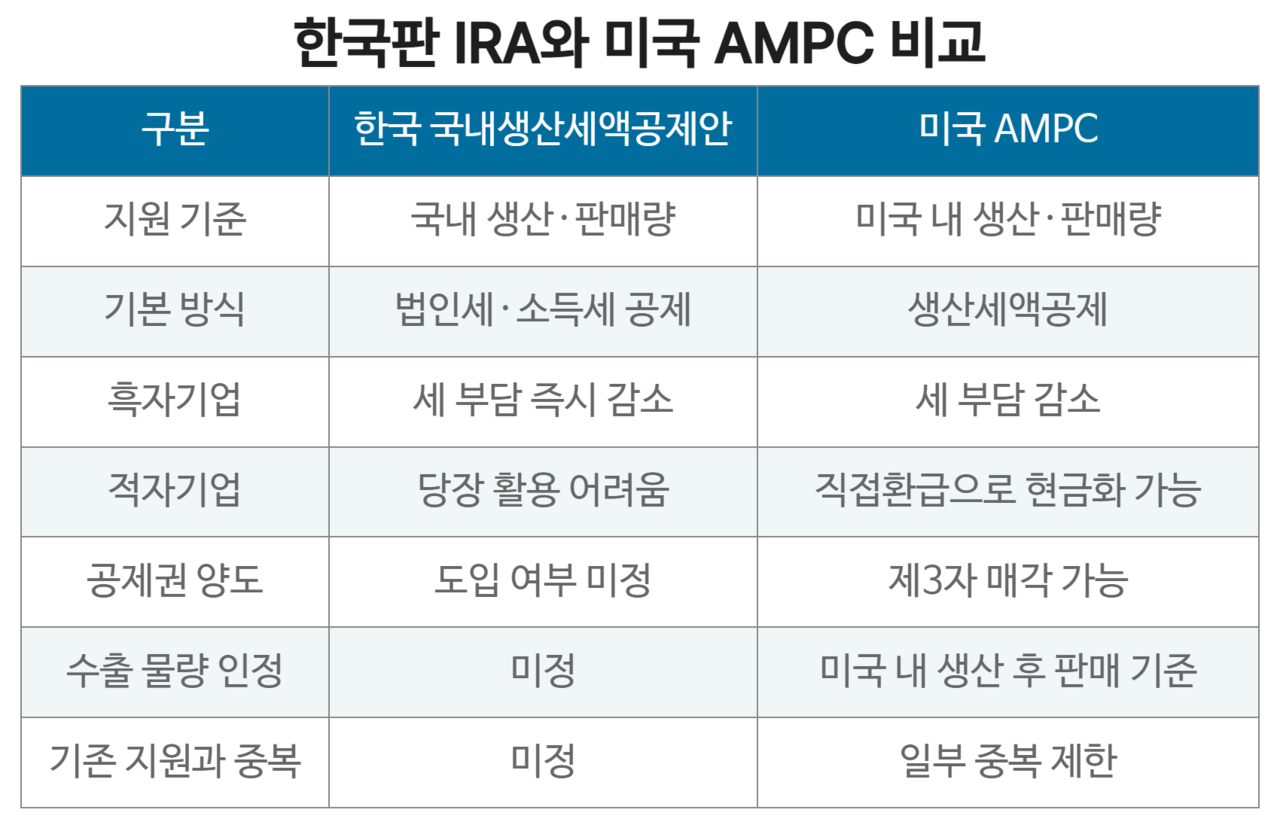
What the domestic battery industry has been calling for is not simply a new cash subsidy program — it is closer to a request that production-based tax credits be made cashable for loss-making companies, much like the Advanced Manufacturing Production Credit (AMPC, Section 45X) under the US IRA.
The US AMPC is legally a tax credit, not a subsidy. Companies that produce and sell eligible products in the United States — battery cells and modules, electrode active materials, critical minerals and the like — receive credits calculated on output volumes or production costs.
The difference lies in the cash-conversion mechanism. The United States allows "elective pay," commonly called direct pay, which lets companies treat credits as if they had prepaid taxes and receive a refund for any amount exceeding their tax liability — even if that liability is zero.
A company with no corporate tax liability but 10 billion won in AMPC credits, for instance, can receive the full 10 billion won as a refund. The actual payment comes after tax filing and review, but the effect for the company is a cash inflow proportional to production.
Credits can also be sold to other companies for cash. A battery maker with no tax liability could sell 10 billion won in credits at a discount to a company with a large tax bill — the battery maker gets immediate cash, and the buyer reduces its taxes. This is known as third-party transfer or credit trading.
The direct refund mechanism the domestic battery industry is seeking works on the same principle: rather than stopping at calculating a credit based on domestic output, the government would return that amount in cash to companies that have no corporate tax to offset.
![A mock-up of Samsung SDI's all-solid-state battery [Provided by Samsung SDI]](https://wimg.heraldcorp.com/news/cms/2026/07/16/news-p.v1.20251031.7a457edb893a46e4a01e765ce56d544d_P1.jpg)
Direct refunds seen as gradual process; exports, credit trading and overlap with existing incentives are the three key hurdles
The government is understood to be leaning toward launching the domestic production tax credit first and then phasing in support measures for loss-making companies — such as direct refunds and third-party transfers — as a follow-on step, with the intent of gauging how much credit is generated from actual output before designing the scale of any refund or transfer system.
Direct refunds or cash subsidies are therefore unlikely to be introduced as early as next year. Resistance within the government is strong, with officials cautioning that paying out cash to companies with no tax liability could undermine the foundations of the corporate tax system, while revenue losses and fiscal pressure add further obstacles.
Industry officials agree that simply extending the carryforward period for unused credits would not be enough to make the production tax credit effective in practice. Battery companies have already accumulated substantial unused credits from R&D and facilities investment but have been unable to apply them because of persistent losses.
The government has also set "domestic production and sales volume" as the credit benchmark without clarifying whether exports are included. Industry argues that any product made in a domestic factory should qualify regardless of where it is ultimately sold.
Whether the new production credit can be stacked with existing investment tax credits and production subsidies is another open question. Industry contends that some overlap should be permitted, since investment incentives and production incentives serve different policy purposes — encouraging factory construction and encouraging factory operation, respectively.
![The European headquarters of Chinese EV battery maker CATL, located in Arnstadt, Germany. [Getty Images]](https://wimg.heraldcorp.com/news/cms/2026/07/16/news-p.v1.20260309.c6c5c9b7ed264471903725bceacc20ba_P1.jpg)
China offers sweeping fiscal and financial support; tax credits alone seen as insufficient to compete
Underlying the push for direct refunds is a subsidy race with China. Beijing has designated EVs and batteries as strategic industries and sustained comprehensive support spanning fiscal policy, tax incentives, financing, infrastructure, research and development, and workforce development.
Chinese companies, led by their lithium iron phosphate battery lineup, have been expanding their foothold not only in the EV market but also in the energy storage system (ESS) segment on the strength of price competitiveness. As Chinese EVs and batteries make deeper inroads into the domestic market, Korean companies face a double burden: relocating production to North America and elsewhere to qualify for foreign subsidies while simultaneously defending the home market against Chinese low-cost competition.
"Chinese companies have scaled up rapidly on the back of sweeping government support and are now widening their market share on price," a battery industry official said. "Korean companies cannot keep pace through self-help alone, so the production tax credit needs to be strengthened into a mechanism that delivers real cash support."
kwater@heraldcorp.com