![Labor groups demanding a higher minimum wage (left) and small-business associations opposing any increase. Next year's minimum wage has been set at 10,700 won per hour. [The Herald Business DB]](https://wimg.heraldcorp.com/news/cms/2026/07/16/news-p.v1.20260716.df351c839f5542c88d7fb0f33ab8ec21_P1.png)
Next year's minimum wage has been set at 10,700 won ($7) per hour — a 380-won, or 3.7 percent, increase from this year — but the decision has left virtually no one satisfied.
Labor groups say the raise is far too small to offset the cumulative erosion of real wages, while small-business owners say they are already cutting part-time hours or considering shutting down altogether under the weight of rising labor costs.
What was once framed as a straightforward clash between workers and employers has evolved into something more fraught: a conflict between low-wage workers struggling to make ends meet and small self-employed operators crushed by payroll costs — a fight among the vulnerable on both sides.
The Minimum Wage Commission announced Friday that next year's rate would be 10,700 won per hour, up 380 won, or 3.7 percent, from this year's 10,320 won. Labor representatives proposed 10,730 won, a 4.0 percent increase, while management representatives proposed 10,700 won, or 3.7 percent, as their final positions. In a vote, the labor proposal received 11 votes and the management proposal 15, making the management figure the final decision.
With the conflict recurring year after year, the government has moved to overhaul a minimum wage system that has remained largely unchanged for nearly four decades. Discussions are expected to begin in earnest — going beyond simply setting an annual rate to redesigning how the wage applies to platform workers, whether it should vary by industry, and how the determination criteria and deliberation process should work.
'The minimum wage protects neither livelihoods nor businesses'
![The Ministry of SMEs and Startups released the results of a business closure statistics analysis and survey of self-employed operators who had shut down on June 30. More than 970,000 businesses in food service, personal services and other sectors closed last year, with a closure rate reaching 9 percent. Some 68.5 percent of those who closed carried debt at the time, with average debt of 85.31 million won. The most commonly cited reason for closing was deteriorating profitability and sluggish sales due to declining customer numbers. Pictured is a restaurant-supply street in Jung-gu, Seoul, on June 30. [Yonhap]](https://wimg.heraldcorp.com/news/cms/2026/07/16/rcv.YNA.20260630.PYH2026063009900001300_P1.jpg)
Labor groups argue that the increase is insufficient to protect the livelihoods of low-wage workers given soaring prices and the accumulated decline in real wages. The Korean Confederation of Trade Unions said the raise "barely exceeds the recent rate of inflation and falls far short of recovering the loss in real wages."
Small-business owners, meanwhile, say they have no room left to absorb further costs. In an unusual move during this year's commission deliberations, employer representatives speaking for small-business owners walked out midway, saying they could not accept any further increase. The Korea Federation of Micro Enterprise said that when weekly holiday pay is included, the actual labor cost burden reaches roughly 12,840 won per hour, and warned that the financial strain on small businesses would grow significantly.
Signs of hiring cutbacks are already emerging on the ground.
A convenience store owner running a 24-hour outlet in Daejeon said he is considering reducing part-time workers' hours and taking on more shifts himself to keep labor costs down. The head of a meat-processing company in Chuncheon, Gangwon Province, said, "If delivery prices stay the same but labor costs keep rising, we have no choice but to hire fewer people." At a cafe in Ulsan, talk of reducing staff in line with the minimum wage increase has left part-time workers anxious about their hours.
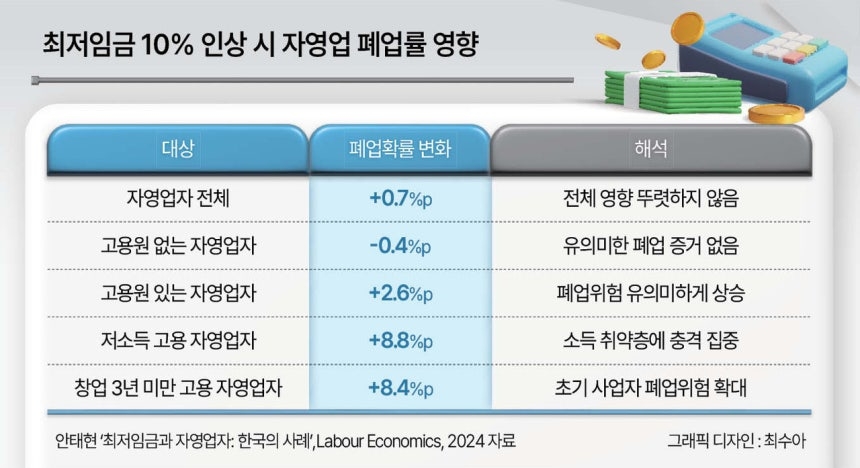
Research confirms that the burden of minimum wage increases falls disproportionately on certain groups.
An analysis by Ahn Tae-hyun, a professor at Sogang University's Department of Economics, using the Korea Labor and Income Panel Study and regional employment surveys found that a 10 percent minimum wage increase raises the overall closure probability for self-employed people by just 0.7 percentage points. For those who employ staff, however, the figure jumps to 2.6 percentage points.
Particularly vulnerable are self-employed employers who have been in business for less than three years, whose closure risk rises by 8.4 percentage points, and low-income self-employed employers, whose risk climbs by 8.8 percentage points. The accommodation and food service sector has the highest share of workers affected by the minimum wage at 45.4 percent, followed by wholesale and retail trade at 22.3 percent.
"In an economy like South Korea's, where self-employment accounts for a large share of the workforce, minimum wage increases can end up pitting workers trying to make a living against small-business owners trying to keep their shops open — a fight among the vulnerable," Ahn said. "We need to move beyond the binary of whether to raise the minimum wage or not, and think simultaneously about protecting low-wage workers and supporting small self-employed operators."
Piece-rate pay, industry-specific tiers: a 40-year system faces its biggest test
These concerns are now feeding directly into government discussions on reforming the system.
![Minimum Wage Commission Chairman Kwon Soon-won speaks after next year's minimum wage was finalized at 10,700 won per hour at the commission's 14th plenary session at Government Complex Sejong on Tuesday. [Yonhap]](https://wimg.heraldcorp.com/news/cms/2026/07/16/rcv.YNA.20260714.PYH2026071420520001300_P1.jpg)
The Minimum Wage Commission's public-interest members formally recommended to the Ministry of Employment and Labor, upon concluding this year's deliberations, that a dedicated task force be established to reform the minimum wage system. The intent is to comprehensively review who the minimum wage applies to, how it is applied, and how it is determined — in step with labor market changes driven by the spread of AI and the growth of platform work.
Next year, the key flashpoints are expected to go beyond the wage level itself to include a piece-rate minimum wage and differentiated rates by industry and business size. A piece-rate minimum wage would guarantee a floor income for workers paid per job rather than by the hour — such as delivery drivers and other platform workers.
Differentiated rates by industry are a management-side demand to set separate minimum wages for sectors with limited ability to pay, such as convenience stores and restaurants. Labor groups support introducing a piece-rate minimum wage to protect platform workers but oppose industry-specific differentiation, arguing it would undermine the principle of equal pay for equal work.
The method for determining the minimum wage is also under review. Under the current structure, labor and management submit wide-apart opening proposals and narrow the gap through successive revisions; if no agreement is reached, public-interest members propose a recommended range and the final figure is set within it.
This process has drawn repeated criticism that "in practice, it is the public-interest members who set the minimum wage." Experts say that establishing an objective, predictable formula reflecting economic growth, inflation, labor productivity and sector-specific ability to pay would also reduce the draining social conflict the annual process generates.
Reform discussions have begun in the political arena as well. People Power Party lawmaker Kim So-hee has introduced a bill to amend the Minimum Wage Act that would factor employers' ability to pay wages and the impact on job retention into the determination criteria, and allow the minimum wage to be set differently not only by industry but also by business size and region.
"Na Yu-jeong" is a series that explains useful policy information in plain language. Each installment examines the background behind a policy proposal, what the change means, and who can use it, when and how.
fact0514@heraldcorp.com