
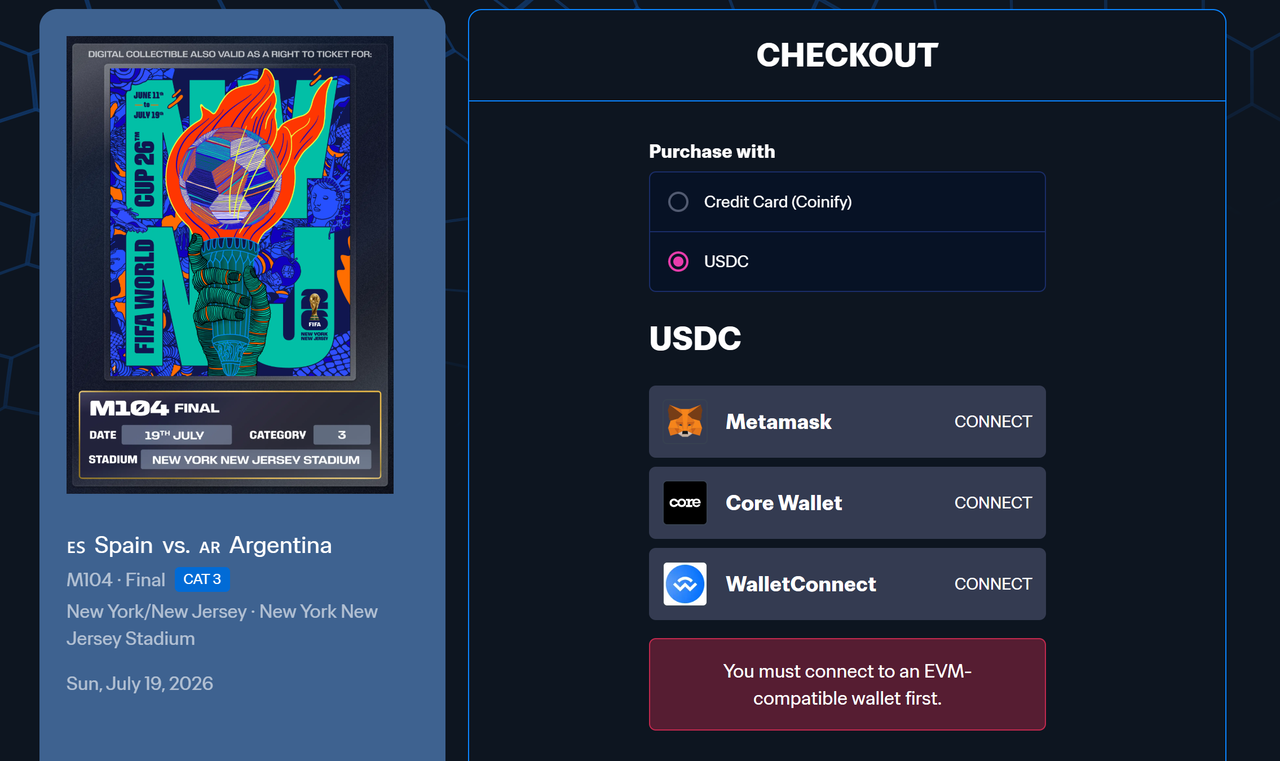
Asking prices for non-fungible tokens (NFTs) redeemable for tickets to the 2026 North and Central America World Cup final soared to $35,000. FIFA issued the rights to receive tickets as NFTs tradeable on its official platform. While some say the system brings the gray market for scalped tickets into a regulated space, others criticize FIFA for directly opening a high-priced resale market to pocket the proceeds.
On FIFA's official digital collectibles platform, FIFA Collect, Right-to-Ticket (RTT) tokens for the 2026 World Cup final have been available for trading. The final, pitting Spain against Argentina, kicks off at 4 a.m. Sunday at MetLife Stadium in New York.
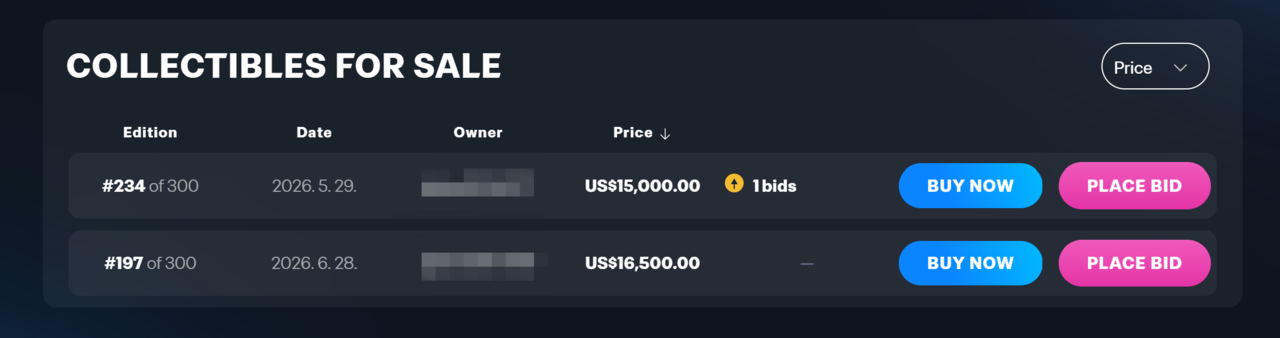
On Thursday, four days before the match, asking prices for final RTTs listed on FIFA Collect ranged from $7,700 to $35,000. By Friday, three days before the match, only two RTTs remained for sale, listed at $15,000 and $16,500 respectively. These prices are not the official face value of standard tickets but the sale prices set by RTT holders on the FIFA Collect marketplace.
An RTT represents the right to receive an official ticket for a specific match and seat rating. To enter the stadium, an RTT holder must assign an attendee within a designated period and convert the NFT into an actual mobile entry ticket through a token-burning process. Before conversion, the RTT can be resold to other users.
FIFA began selling Right-to-Buy (RTB) tokens — pre-purchase rights to tickets — as early as 2024, before the World Cup draw was finalized. Under the system, when 10,000 tickets for a given match are released, FIFA reserves a portion in advance and sells them as pre-purchase rights. Users can trade RTBs on the secondary market and, once the matchups are confirmed, pay the ticket price to convert them into RTTs.
FIFA also supported payment by both credit card and USDC, a dollar-pegged stablecoin. Industry observers say the key innovation was not requiring consumers to use digital assets. Rather, the significance lies in keeping familiar payment methods intact for users while shifting the issuance, transaction records and settlement of ticket rights onto a blockchain infrastructure.
FIFA Collect runs on FIFA's own blockchain, built on the Avalanche layer-1 network. Web3 firm Modex participated in developing and operating the platform. FIFA cited a shift in how football fans consume the sport as the rationale for the project, saying it aimed to broaden access so fans could own World Cup moments and players' historic milestones as digital assets.
The platform has also drawn attention for bringing the previously underground scalper market into an official venue. Real transaction prices and ownership transfers were difficult to track in the traditional gray market, but FIFA Collect allows asking prices and bids to be monitored in real time.
An Avalanche Korea official described RTBs and RTTs as "a real-world asset case that tokenizes scalped tickets," adding that the system "repriced the value of tickets that had been confined to unofficial markets within an official platform."
Trading volume grew rapidly. Avalanche announced on June 26 that cumulative trading volume for World Cup-related RTBs and RTTs had surpassed $25 million. Industry observers estimate the current cumulative total has reached around 50 billion won, noting that the tournament was still in the round-of-32 stage at the time of that announcement. FIFA also secured revenue by charging both sellers and buyers a 15 percent transaction fee on secondary-market RTB and RTT sales.
Market experts said the FIFA-Avalanche collaboration demonstrated blockchain's potential as price-discovery infrastructure and a trading backbone. Cho Jae-woo, director of the Blockchain Research Institute at Hansung University, said: "In the past, scalpers named their own price, but when supply and demand are made public in a real-time trading environment, a fair price can emerge."
Cho also said blockchain "has the advantage of fewer cross-border restrictions and the ability to handle payment and settlement in a single step," predicting that "products using blockchain for intermediate settlement will naturally become more common going forward."
Experts also raised the possibility of expansion beyond sports into performance and retail sectors. Yoon Seung-sik, head of research at Tiger Research, said retail transactions "are more direct for users than financial products and occur more frequently," adding that "with more consumers and businesses involved than in financial markets, the scope for blockchain applications could be broader."
Yoon added that "what matters is how effective the FIFA Collect experiment was at eliminating scalping and how much it reduced costs compared with conventional methods," saying that "if blockchain's utility is confirmed, its application could expand to other sports and performance sectors."
kyoung@heraldcorp.com





