![A construction site. This photo is unrelated to the article. [Yonhap]](https://wimg.heraldcorp.com/news/cms/2026/07/21/news-p.v1.20251031.e94a7bdb657d410aa003695c2638f40e_P1.jpg)
As workforce shortages and aging deepen at construction sites across the country, the government is preparing a sweeping statutory initiative — a "Basic Plan for National Development of Young Construction Engineers" — to cultivate talent capable of building and maintaining the nation's critical infrastructure, from recruitment through an entire career lifecycle.
Youth engineer development plan kicks off: 'Full lifecycle support needed'
According to government sources Tuesday, the Ministry of Land, Infrastructure and Transport recently held a kickoff meeting with the Korea Construction Engineers Association, the Korea Research Institute for Construction Policy, the Korean Society of Civil Engineers and the Korean Institute of Architects to begin drafting the plan. The ministry plans to meet regularly with these organizations to develop the statutory framework for nurturing construction engineering talent.
Under relevant laws including the National Technical Qualifications Act, a construction engineer is defined as a person who holds qualifications, academic credentials or work experience in construction or construction engineering. Those eligible include holders of a national technical qualification certificate, graduates of construction-related university departments designated by the minister of land, infrastructure and transport, and those with a certain period of practical experience in construction or engineering.
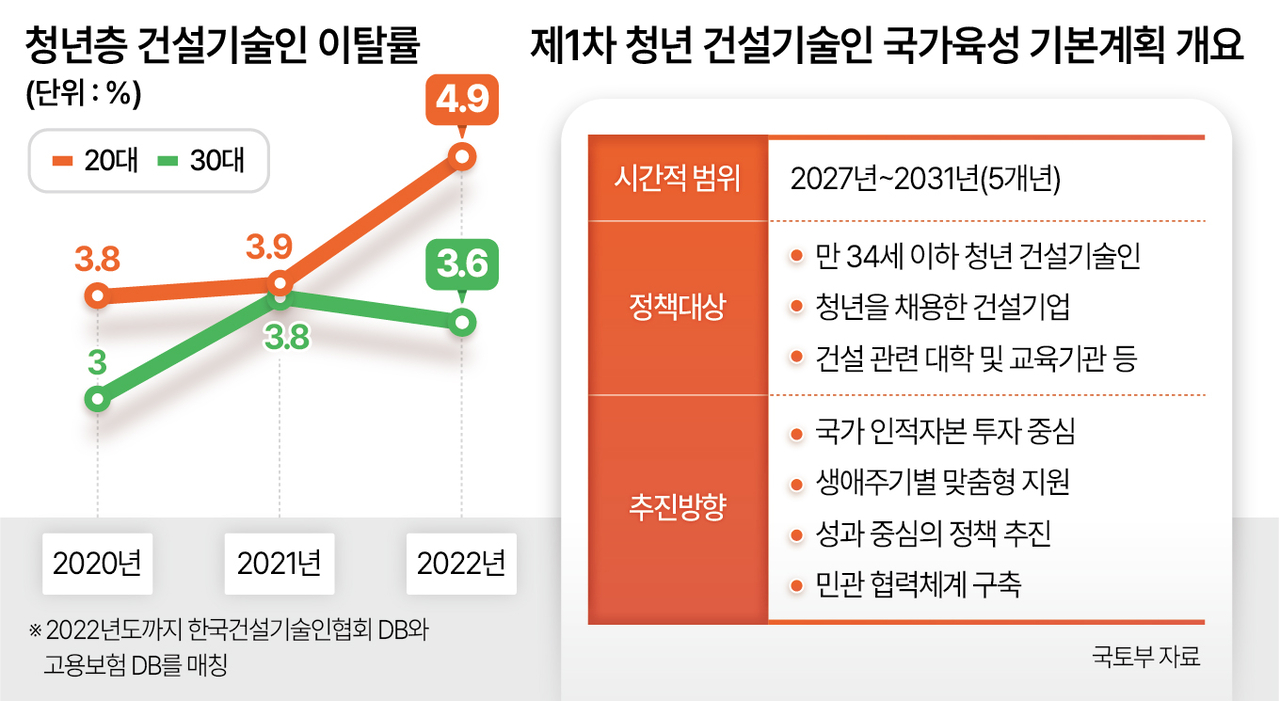
The government has grown increasingly alarmed as young construction engineers leave the industry in growing numbers, eroding the pool of workers needed to build, maintain and manage the country's key infrastructure. The Ministry of Land, Infrastructure and Transport plans to respond with strong government support starting at the curriculum level to draw more young people into the field.
Specific details have yet to be finalized, but the plan is expected to draw on the "Basic Plan for Nurturing and Supporting Science and Technology Talent" — a five-year program that ran from 2021 to 2025 — as a benchmark. The initiative is expected to roll out in stages, strengthening support for young construction engineers' career growth, bolstering lifelong learning systems and enhancing the capabilities of science and engineering university students.
The plan also aligns with the policy direction of Cheong Wa Dae, which has established a new "Youth Future Secretary's Office" to address young people's challenges and present a future vision. Through this five-year plan, the Ministry of Land, Infrastructure and Transport aims to go beyond simple youth employment support or welfare policy, providing long-term settlement assistance and systematic career development to support young construction workers across their entire career lifecycle.
Six in 10 construction site workers are in their 50s or older — and workers in their 20s and 30s are leaving fast
The situation has grown severe enough that industry insiders say it is nearly impossible to find young workers at construction sites. According to the Construction Workers Mutual Aid Association's construction workforce trends report, the number of employed construction workers stood at about 1.308 million as of last May, down 4.1 percent from the same month a year earlier. Workers in their 50s accounted for 33 percent of the total — some 438,000 people — while those in their 60s and older numbered 385,000, or 29.4 percent of the total. In other words, six in 10 construction site workers are aged 50 or above.
![A construction site in South Korea. [Newsis]](https://wimg.heraldcorp.com/news/cms/2026/07/21/news-p.v1.20260219.d2e93a4d428d4f8a84b4f797f4222861_P1.jpg)
The primary driver of this aging trend is the exodus of workers in their 20s and 30s. An analysis by the Ministry of Land, Infrastructure and Transport matching the Korea Construction Engineers Association database with employment insurance records found that the attrition rate among construction engineers in their 20s had been declining through 2021, but reversed course after that, reaching 4.9 percent in 2022. The attrition rate for those in their 30s also trended upward overall, at 3 percent in 2020, 3.8 percent in 2021 and 3.6 percent in 2022.
For both age groups, the steepest drop in the average retention rate occurred in the second year after entering the industry — the sharpest decline across the entire career lifecycle. Among workers in their 20s, the retention rate fell for three consecutive years: 75.5 percent in the first year, 67.6 percent in the second and 63.4 percent in the third. Those in their 30s saw a similarly sharp decline over the same period, from 81.1 percent to 72.4 percent to 70.2 percent.
Those working in the field say they feel the youth drain firsthand. "When the construction market was booming, science and engineering graduates actively sought jobs at construction companies," one industry official said. "Now, with the semiconductor and battery sectors thriving, job seekers are shying away from construction firms."
A ministry official said the construction industry, despite being a strategic sector responsible for the nation's infrastructure, has lacked a comprehensive national support system tailored to the long-term settlement and career growth of young construction engineers. "The goal is to nurture specialized technical professionals who will be responsible for the nation's future infrastructure," the official said.
hss@heraldcorp.com