![A job information board at an employment center in Seoul [Yonhap]](https://wimg.heraldcorp.com/news/cms/2026/07/22/rcv.YNA.20260715.PYH2026071508020001300_P1.jpg)
A labor market mismatch is widening in South Korea, where young people struggle to find work even as companies cannot fill open positions.
The number of unfilled vacancies snapped a 39-month streak of declines in April and continued rising in May, with most of the increase concentrated at firms with fewer than 300 workers. Yet youth employment has shown little sign of recovery, widening the gap between employers seeking workers and job seekers looking for work.
The Ministry of Employment and Labor said Wednesday there were 153,000 unfilled vacancies in May, up 7,000 from 146,000 in April and 4.2 percent higher than the same month last year. On a year-on-year basis, vacancies had fallen for 39 consecutive months from January 2023 through March before turning positive in April — the first increase in 40 months — and extending that gain into May.
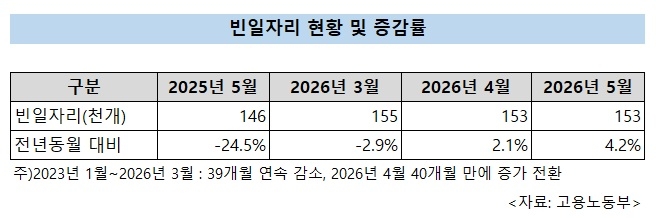
A job vacancy, as defined in the survey, is a position for which a company is actively recruiting and that could be filled within one month of the reference date. It represents a post a company wants to fill but cannot, making it a key indicator of labor market mismatch.
Small and medium-sized enterprises drove most of the increase in vacancies. Firms with fewer than 300 workers posted 144,000 vacancies in May, up 6.9 percent from a year earlier, while those with 300 or more workers recorded 9,000 vacancies, down 1.8 percent. About 94 percent of all vacancies were at firms with fewer than 300 workers.
By sector, health and social welfare services and the lodging and food service industries led the rise in vacancies. The results reflect chronic labor shortages in the health and welfare sector — where low wages and poor working conditions make it hard to recruit staff despite growing demand for care driven by an aging population — as well as in lodging and food service, where long hours and shift work are common.
The employment situation for young people has still not improved.
According to the Ministry of Statistics' June employment trends, the employment rate for youth aged 15 to 29 stood at 43.9 percent, down 1.7 percentage points from a year earlier. The number of workers in manufacturing fell by 97,000 and in construction by 67,000. Analysts say the labor market mismatch is persisting as companies cannot find workers while young people cannot find jobs.
Experts say the mismatch cannot be resolved through economic recovery or fiscal support alone.
Choi Young-ki, a visiting professor at Hallym University and former head of the Korea Labor Institute, said the government needs policies to help young people enter the labor market, but added that additional fiscal support alone will not solve the vacancy problem given that support programs for employment at small and medium-sized enterprises are already substantially in place. "What is needed is an approach that reduces the labor market mismatch through better wages and working conditions and stronger vocational training," he said.
Analysts also point to the recent expansion of semiconductor and AI investment as drawing workers toward specific industries and deepening labor shortages in others, while the widening gap in wages and working conditions is further aggravating the hiring crunch.
The government plans to draw up a youth employment recovery package in the third quarter and announce measures to develop specialized talent for advanced industries and identify higher-quality job opportunities.
fact0514@heraldcorp.com