272,337 babies born in 2020 — fewer than this year's 301,442 enrollees
Early 2030s could see enrollment drop to low 200,000s as regional schools face closures
Shrinking workforce and rising elderly dependency pose long-term economic risks
Next year's elementary school enrollment is projected to fall below 300,000 for the first time in history — just three years after the 400,000 mark was broken in 2024. The decline, driven by South Korea's low birth rate, is accelerating the downsizing and consolidation of schools outside major cities, while raising concerns about a long-term contraction of the workforce and a growing burden of supporting an aging population.
According to data from the Korean Statistical Information Service (KOSIS) and the Korea Educational Development Institute released Sunday, the number of babies born in 2020 — the cohort set to enter elementary school next year — stood at 272,337. That is 10.0 percent fewer than the 302,676 born in 2019, and marked the first time since records began in 1970 that annual births fell below 300,000.
This year's elementary school enrollment came to 301,442, the lowest since enrollment records began in 1964. With the eligible age group itself shrinking sharply, sustaining the 300,000 threshold next year appears unlikely. The number of enrollment notices to be sent out starting next month is also expected to remain in the 200,000s.
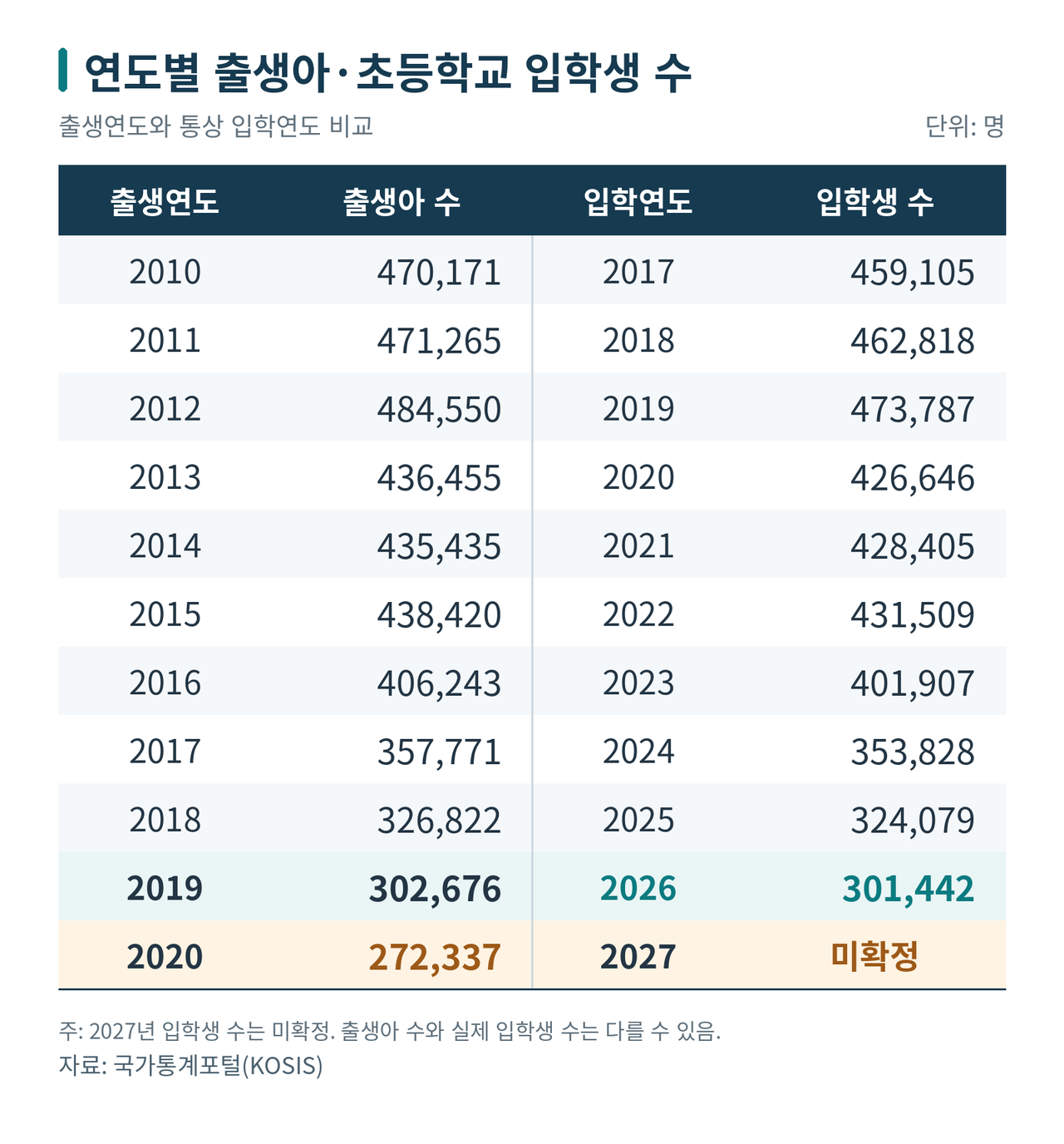
Birth figures do not translate directly into enrollment numbers. Early enrollment, time spent abroad, deaths and foreign children residing in South Korea all affect the final count. In recent years, however, the gap between the two figures has been small.
This year's enrollment was 1,234 fewer than the number of babies born in 2019, while last year's enrollment of 324,079 was 2,743 fewer than the 2018 birth cohort. Over the past two decades — from 2007 to 2026 — enrollment has consistently fallen short of the corresponding birth cohort each year, with an average gap of 12,438, or 2.6 percent.
The pace of decline has steepened in recent years. Enrollment peaked at about 1.06 million in 1968 and still reached 610,769 as recently as 2007. It then dropped to 540,799 in 2008 and 469,592 in 2009, before broadly holding in the 400,000s for some time.
The 400,000 threshold finally gave way when enrollment fell from 401,907 in 2023 to 353,828 in 2024, entering the 300,000s for the first time. It has since declined to 324,079 last year and 301,442 this year, and is expected to slip into the 200,000s next year. If next year's enrollment tracks the size of the eligible birth cohort, it would amount to roughly one-quarter of the 1968 peak — 59 years later.
The downward trend is likely to persist for now. The 2017 birth cohort fell 11.9 percent from the prior year to 357,771, the first time annual births entered the 300,000s, and by 2020 they had dropped into the 200,000s. Births in 2023 shrank further to 230,028. When that cohort reaches school age in 2030, first-year elementary enrollment is expected to fall to the low 200,000s.
Although births have recently begun to recover, it will take years before that rebound translates into higher enrollment. Annual births rose to 238,317 in 2024 and 254,341 last year, and 193,784 babies were born through August this year. Children born in 2024 are typically expected to start elementary school in 2031.
The impact of a shrinking school-age population is likely to be felt most acutely outside the greater Seoul area. Smaller schools offer fewer opportunities for peer interaction and make it harder to run diverse educational programs. There are concerns that deteriorating educational conditions could prompt families with school-age children to relocate to the metropolitan area, further reducing student numbers in the regions and creating a vicious cycle.
Pressure to merge or close schools is also expected to grow. As the current enrollment decline works its way through middle and high schools and eventually reaches universities, regional institutions of higher education could face mounting difficulties attracting incoming students and sustaining their operations.
For the broader economy, the country faces a simultaneous contraction of the future workforce and an expansion of the elderly dependency burden. Based on OECD population projections, South Korea's old-age dependency ratio — the number of people aged 65 and older per 100 working-age people between 15 and 64 — is forecast to rise from 31.3 this year to 103.3 by 2070. In the long run, the elderly population would outnumber the working-age population. A shrinking labor supply could also weigh on the country's potential growth rate.
The government is pushing to overhaul how education funding is allocated in response to demographic shifts. The plan would scrap the current system that ties local education grants to domestic tax revenue and instead calculate grants based on economic growth and changes in the school-age population. The funds freed up by the restructuring would be redirected toward early childhood, higher education and lifelong learning.
Alongside the fiscal overhaul, experts say measures are needed to offset the shrinking workforce and raise labor productivity. Kim Kwang-seok, head of the economics research division at the Korea Economic and Industrial Research Institute, said the country needs to "turn the entire population into talent" by increasing per-capita spending on education and training to raise the quality of labor. "The labor market needs to be made more flexible so that economically inactive groups — women and older workers — can enter the workforce," Kim said, "and AI should be actively introduced for jobs that young workers do not want to take."
fact0514@heraldcorp.com