Ministry of Finance and Economy gives 57 million won in special bonuses to 53 staff
'Resting' youth decline cited as policy achievement for 9 consecutive months
Ministry of Statistics flags part-time job losses, rise in students as key factors
Youth economically inactive population actually grew by 72,000
Award criteria must be matched by real employment outcomes
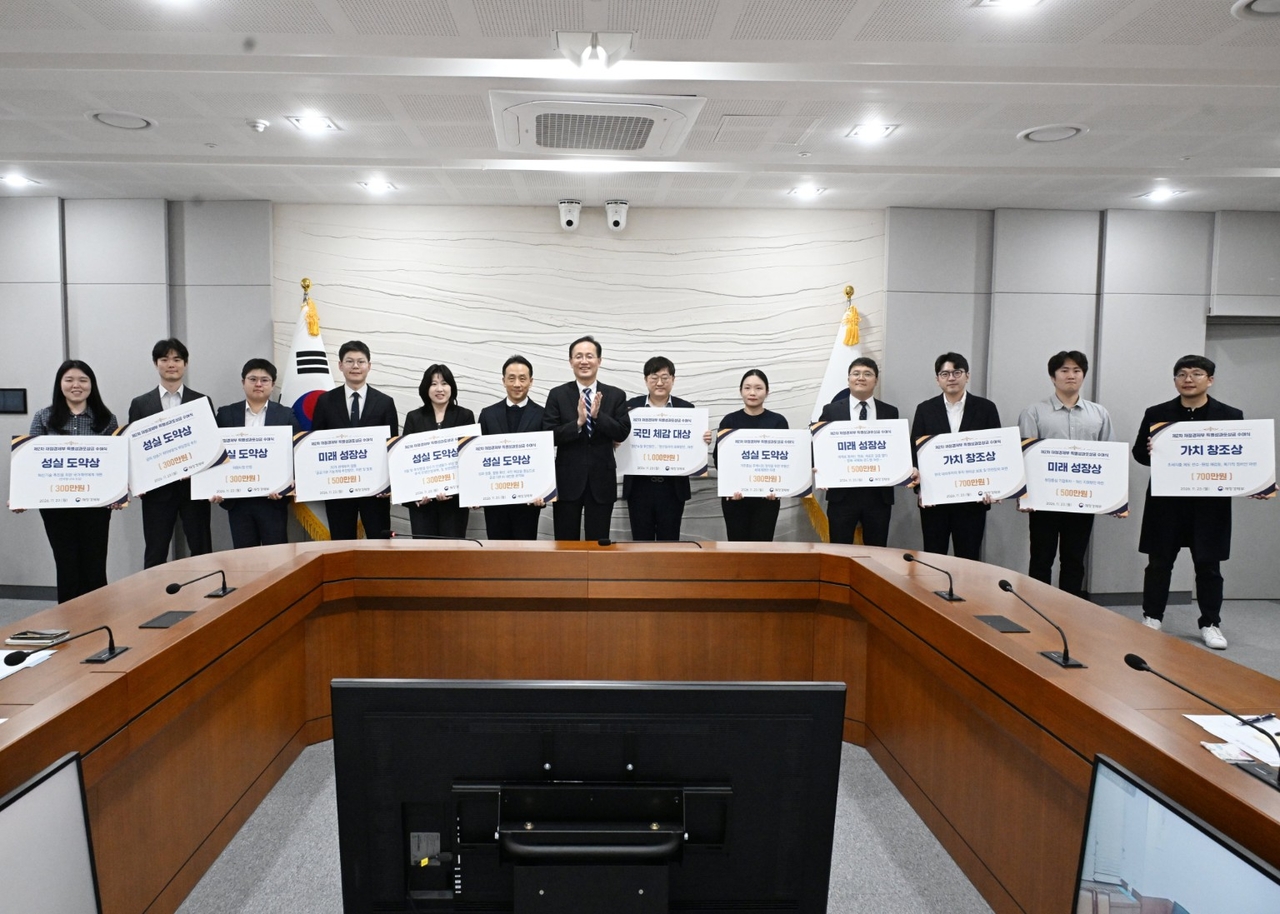
"I will make sure employees who deliver results for the people are properly rewarded."
That was the headline of a social media post by Deputy Prime Minister and Minister of Finance and Economy Lee Hyung-il. The Ministry of Finance and Economy awarded its top prize — the "Public Impact Award" — along with a 10 million won ($7,450) bonus to staff who developed youth employment measures, citing a nine-consecutive-month decline in the number of young people classified as "resting" as a key achievement.
Yet the Ministry of Statistics, which compiles the official employment data, offered a more nuanced reading of the same figures. Its analysis pointed to structural shifts within the economically inactive population — notably a drop in part-time work among young people driving an increase in those enrolled in school or training programs.
While the number of "resting" youth fell, the total youth economically inactive population actually grew. With youth employment declining for 48 consecutive months, questions arise over whether it was appropriate for the Finance Ministry to present the drop in "resting" youth as a policy success worthy of its top award.
Finance Ministry awards 10 million won for 'resting' youth decline — but Statistics Ministry tells a different story
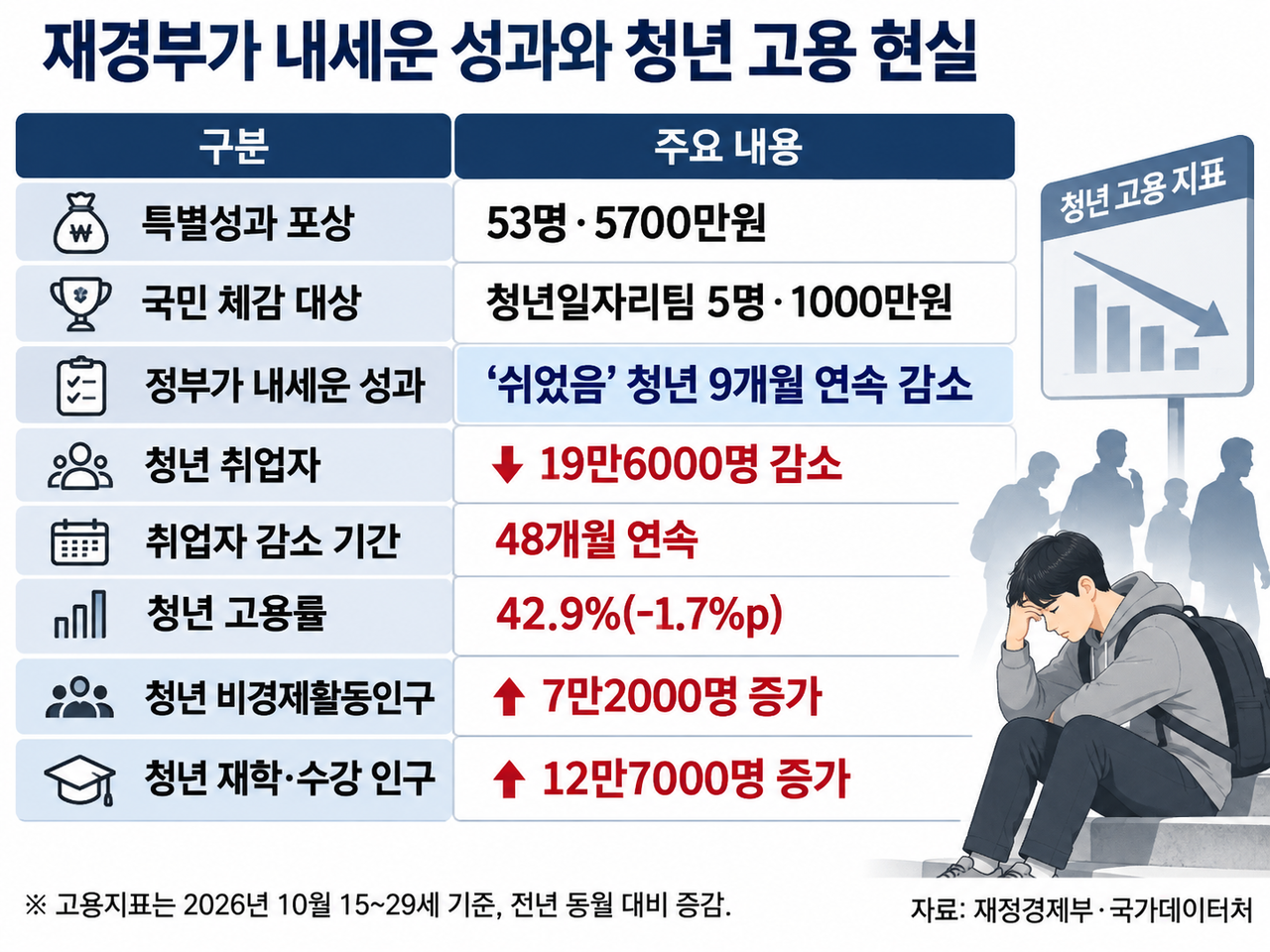
The Finance Ministry said Sunday that at its second Special Performance Awards ceremony, held Monday at an expanded senior staff meeting chaired by Deputy Prime Minister Lee, 53 employees received a combined 57 million won in bonuses.
The top "Public Impact Award" went to five staff members in the human resources policy and youth employment policy divisions. They were recognized for developing the Youth New Deal plan in April and the Youth Employment Recovery plan in August, and for running a vice-minister-level employment task force to coordinate a pan-government response.
In its press release on the awards, the ministry cited the nine-consecutive-month decline in "resting" youth — from February through October this year — as a key achievement. It also highlighted an increase in young people attending vocational training institutes and programs since July, when job training efforts intensified.
The Ministry of Statistics, however, had already offered a more complex interpretation of the decline in "resting" youth at its Nov. 11 employment briefing — 12 days before the awards ceremony.
At that briefing, a reporter asked how the Ministry of Statistics interpreted the Finance Ministry's repeated emphasis on the drop in "resting" youth.
The director of social statistics at the Ministry of Statistics said the economically inactive youth population was itself growing as youth employment conditions deteriorated. The director drew particular attention to cases in which university students who had been working part-time — especially in the accommodation and restaurant sector, where hiring has been weak — were leaving their jobs and returning to full-time student status.
The director said the composition of the economically inactive youth population was shifting, with increases in both students enrolled in school or training programs and those actively preparing for employment.
In effect, while the Finance Ministry framed the decline in "resting" youth as evidence that its policies were drawing young people back into the labor market, the Ministry of Statistics said the broader shift in the composition of the economically inactive population — driven by weak youth employment — also needed to be examined.
'Resting' youth down 38,000 — but economically inactive youth up 72,000
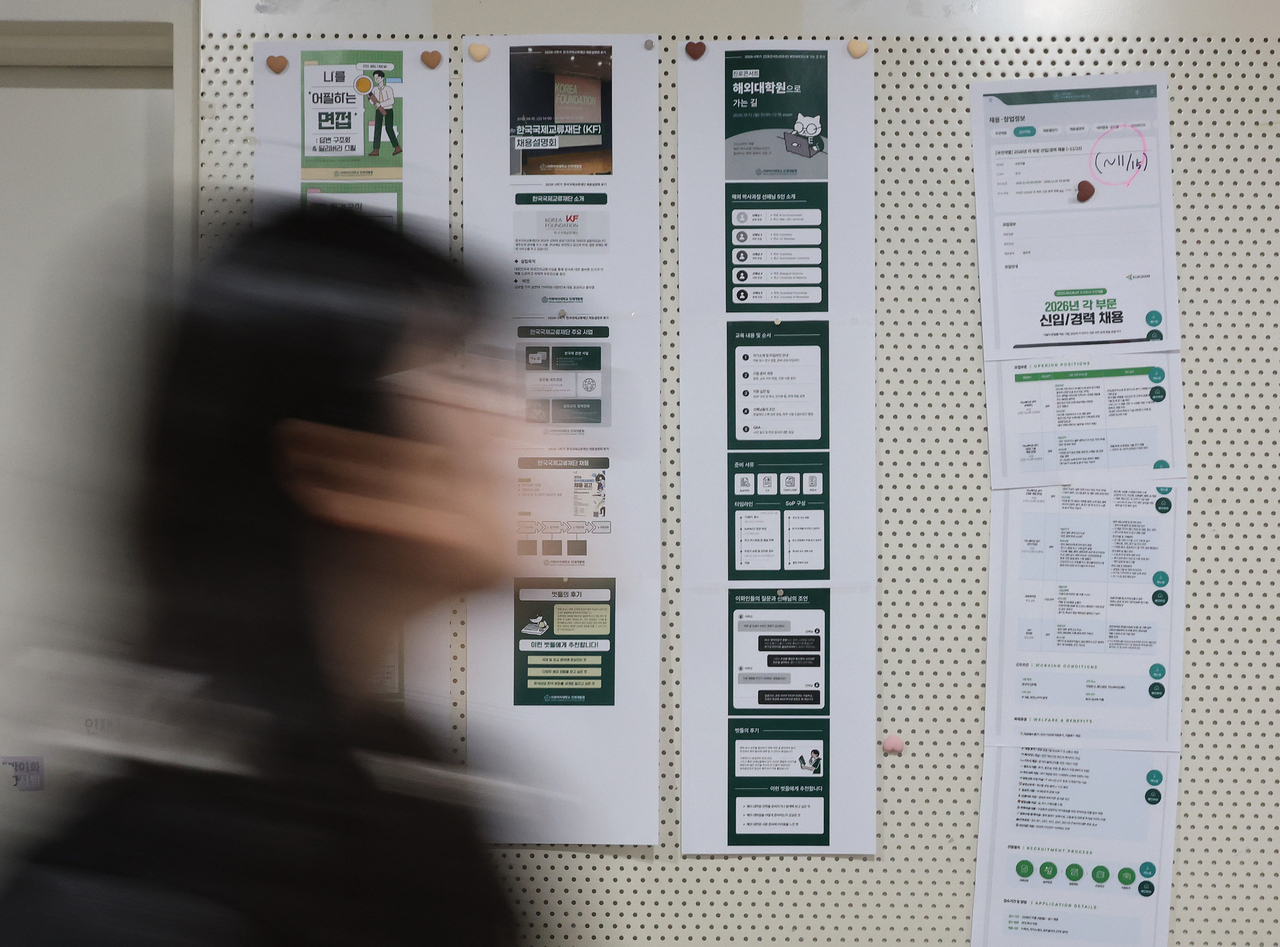
The employment data bear out the Ministry of Statistics' more cautious reading.
Last month, the number of young people aged 15 to 29 classified as "resting" stood at 371,000 — down 38,000 from a year earlier. At the same time, the total economically inactive population in the same age group rose by 72,000 to 4,246,000.
Within that economically inactive group, those enrolled in school or training programs increased by 127,000, and those actively preparing for employment rose by 10,000.
In other words, while fewer young people were labeled "resting," the number of young people who were neither employed nor unemployed actually grew.
Conditions in the accommodation and restaurant sector — where young workers are disproportionately concentrated — also worsened. Employment in that sector fell by 137,000 last month compared with a year earlier.
The Ministry of Statistics noted that beyond the sector's weak performance, the spread of automation, unmanned systems and kiosks may also be reducing employment opportunities for young people.
When a university student who was working part-time while studying loses that job, the statistics record a shift from employed to economically inactive — specifically into the school or training enrollment category. That is why it is difficult to interpret the entire increase in that category as a positive outcome driven by the government's expansion of vocational training.
Aggregate data of this kind cannot track where individual young people who left the "resting" category ended up. But that is precisely why attributing the decline in "resting" youth to employment policy success requires caution.
Youth employment down for 48 months — and 'resting' youth were already falling before policies launched
Other youth employment indicators remain weak.
Last month, the number of employed people aged 15 to 29 stood at 3,325,000 — down 196,000 from a year earlier, marking a 48th consecutive month of decline. The youth employment rate fell to 42.9 percent, down 1.7 percentage points from a year ago, extending a 30-month losing streak and hitting its lowest level for October since 2020.
Even when the youth age bracket is widened to 15 to 34, employment fell by 131,000 and the employment rate dropped 0.6 percentage points to 55.4 percent. That suggests the recent employment slump cannot be explained by demographic decline alone.
The Ministry of Statistics acknowledged that government youth employment policies may have offset some of the job losses. However, it assessed that overall youth employment conditions remain poor as private-sector hiring has deteriorated.
The ministry's "Wage and Salary Employment Trends for the Second Quarter of 2026," released Saturday, confirmed the same pattern of youth exclusion from the labor market.
Total wage and salary jobs in the second quarter grew by 406,000 from a year earlier, but jobs held by workers in their 20s and younger fell by 56,000 — the only age group to record a decline. By contrast, jobs held by workers in their 60s and older increased by 277,000, accounting for 68.2 percent of the net gain.
Jobs for workers in their 20s and younger fell by 28,000 in manufacturing and by 15,000 in the information and communications sector. Even in the professional, scientific and technology fields, where total employment rose by 43,000, jobs for that younger cohort fell by 3,000.
The data underscore that beyond encouraging young people to seek work and participate in training programs, securing actual jobs that young people can enter is essential.
The timing of the "resting" youth decline that the Finance Ministry cited as an achievement also warrants scrutiny.
The number of "resting" youth began falling in February this year. The two policies cited as the main basis for the award — the Youth New Deal plan and the Youth Employment Recovery plan — were announced in April and August, respectively.
Presenting nine consecutive months of decline as a policy achievement, without distinguishing how much of the trend that predated those policy announcements can actually be attributed to government action, falls short as a method of evaluating policy effectiveness.
24 outside reviewers assessed the awards — but what did 'public impact' actually measure?
The awards were selected from 40 policy achievements announced between January and October this year, with 12 chosen for recognition. The selection process involved a first-round review by 24 external civilian committee members, followed by a second round conducted by a bonus screening committee chaired by the Finance Ministry's second vice minister.
The press release on the awards did not include the names or affiliations of the external civilian reviewers, nor a breakdown of scoring criteria by category. It is also unclear how the Ministry of Statistics' analysis of the youth employment deterioration and the factors behind the "resting" youth decline was considered during the review.
It would not be appropriate to evaluate civil servants' policy efforts and the results of individual projects solely on the basis of overall employment indicators. Many variables — economic conditions, industrial structure, corporate hiring practices — lie beyond the control of policy officials.
Encouraging young people who had been "resting" to participate in vocational training and prepare for employment is itself a meaningful policy outcome.
However, to live up to the name "Public Impact Award," the ministry should also present data on how many of the program's beneficiaries actually found jobs, and how stably they have maintained employment afterward. The press release included no such figures on job conversion rates or employment retention rates.
Deputy Prime Minister Lee said through social media that he would ensure "the effort and dedication of each civil servant translates into better policy and, ultimately, into the fruits of growth shared by all people."
Rewarding hard-working civil servants appropriately is commendable. But the standard for evaluating policy outcomes should be set by the people who are supposed to feel the impact — not by those who design the policies.
Even the government agency that compiles the statistics is explaining the compositional shift in the economically inactive population as a consequence of weak youth employment. If the ministry responsible for policy wants to hold up the decline in "resting" youth as an achievement, it must present evidence to match that claim.
The measure of a youth employment policy's success that young people can actually feel is not simply moving out of the "resting" category in a statistical table. It lies in securing real jobs and stable income.
[Sejong Backbrief] is a series by The Herald Business's Sejong-based correspondent covering informal background briefings on government policy announcements, as well as the context behind policy decisions and inside stories from the government district. The series aims to deepen readers' understanding of policy and share news from the civil service community.
fact0514@heraldcorp.com