Dependents per 100 working-age people to rise from 45.4 this year to 117.3 by 2070
South Korea to surpass Japan in old-age dependency ratio by 2045; working-age population to fall 51.8% by 2070
Welfare mandatory spending to exceed 250 trillion won by 2030; parliamentary budget office projects even higher figure
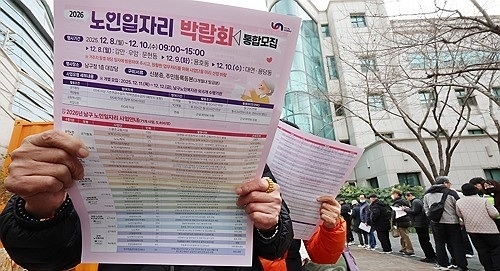
South Korea's demographic dependency burden — currently the lightest among OECD member states — is projected to become the heaviest within 22 years, driven by a low birth rate and rapid aging. By 2070, the working-age population is expected to shrink to less than half its current size, while the number of young and elderly dependents per 100 working-age people is forecast to reach 117. Mandatory welfare spending on pensions and care is also set to surpass 250 trillion won ($186 billion) by 2030, deepening fiscal pressure.
Based on OECD population projections, South Korea's total dependency ratio — the number of dependents per 100 people aged 15 to 64 — stands at 45.4 this year, the lowest among the OECD's 38 member states. That figure is expected to climb to 90.2 by 2048, overtaking Greece (90.1) to become the highest in the group.
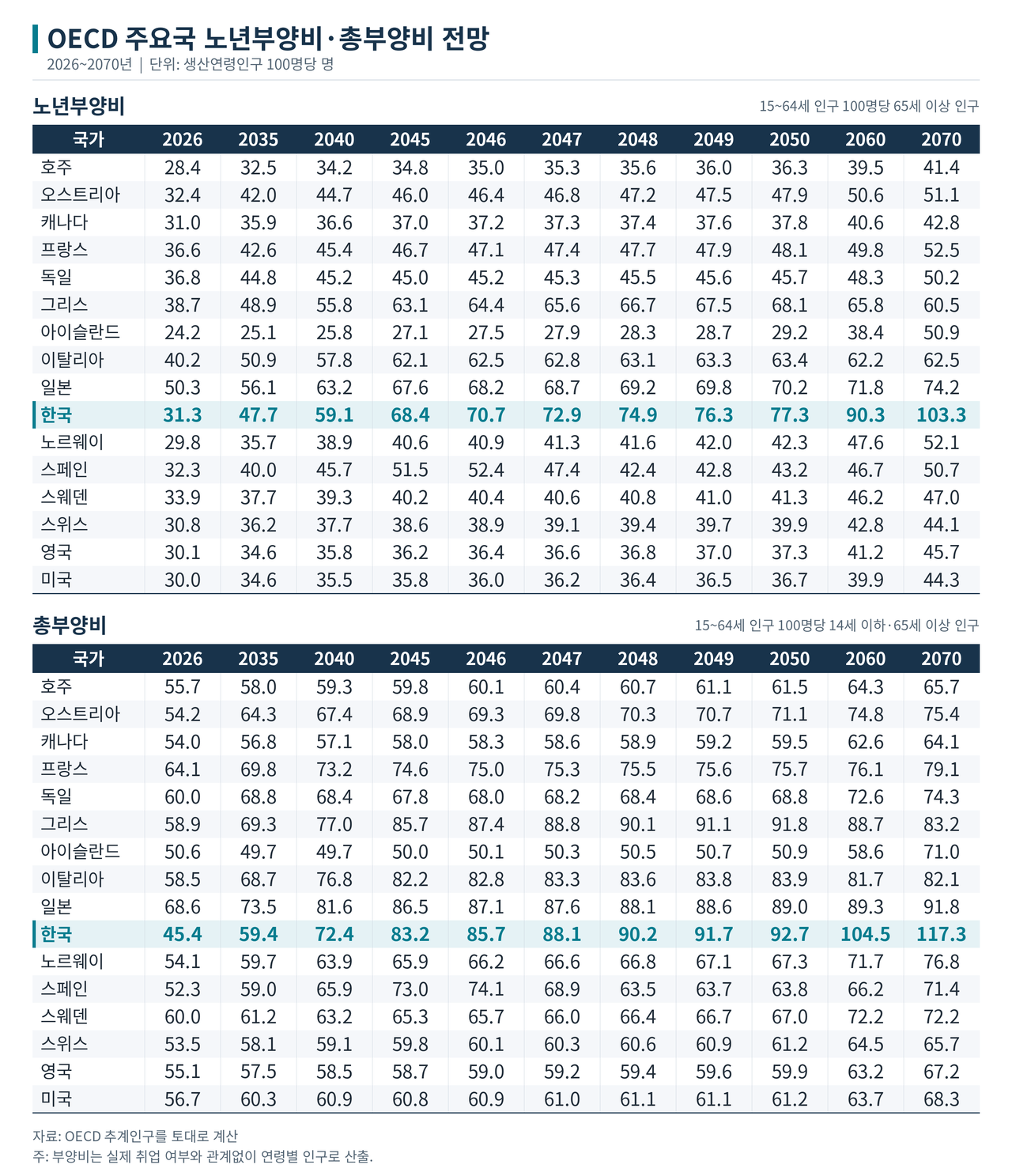
The total dependency ratio counts the number of people aged 14 and under and 65 and older for every 100 people in the 15-to-64 working-age bracket. South Korea's ratio is projected to rise to 92.7 by 2050, 104.5 by 2060 and 117.3 by 2070 — 2.6 times this year's level and the largest increase of any OECD country over that period.
The ratio does not, however, reflect actual employment levels or income. People aged 15 to 64 who are not working are still counted as part of the working-age population, while those aged 65 and older who remain employed are classified as dependents. The real burden of dependency can therefore vary significantly depending on the economic activity of older people and the employment situation of younger generations.
Behind the rising dependency ratio is a sharp decline in the working-age population. The number of South Koreans aged 15 to 64 is projected to fall 51.8 percent — from about 35.49 million this year to about 17.11 million by 2070. Over the same period, the population aged 65 and older is expected to grow from about 11.13 million to about 17.68 million. The elderly share of the total population will rise from 21.6 percent to 47.5 percent, meaning that by 2070 the number of older people will exceed the number of working-age people.
The old-age dependency ratio — which counts only the elderly — is on track to reach the top of the OECD rankings even sooner than the total dependency ratio. South Korea's old-age dependency ratio currently stands at 31.3, the 18th lowest among the 38 OECD members. Although that is well below Japan's current ratio of 50.3 — the highest in the group — South Korea is projected to surpass Japan in 2045, when its ratio reaches 68.4 against Japan's 67.6.
South Korea is then expected to maintain the highest old-age dependency ratio among OECD members for which population projections are available through 2070. By that year, the ratio is forecast to reach 103.3 — 3.3 times this year's level — meaning more than 103 elderly people for every 100 working-age people. Japan's projected ratio for the same year is 74.2.
South Korea's old-age dependency ratio is projected to rise by 72.0 points between 2026 and 2070, the largest increase among OECD countries. Costa Rica ranks second, with its ratio expected to climb 54.2 points over the same period, from 17.6 to 71.8.
The demographic shift is translating directly into higher welfare spending. Under the national fiscal management plan for 2026 to 2030, which the government submitted to the National Assembly in September, mandatory spending on elderly programs — including the basic pension and long-term care insurance — is set to rise from 25.72 trillion won this year to 33.11 trillion won by 2030, an increase of 7.39 trillion won, or 28.7 percent, over four years.
Total mandatory welfare spending, which covers elderly programs and the four major pension schemes, is projected by the government to reach 256.66 trillion won by 2030, up 60.38 trillion won, or 30.8 percent, from this year.
The National Assembly Budget Office puts the figure even higher. The office projects mandatory welfare spending will rise from 199.9 trillion won this year to 273.8 trillion won by 2030 — an increase of 73.9 trillion won, or 37.0 percent. That is about 17.1 trillion won above the government's own 2030 projection.
Over the longer term, mandatory spending as a share of the economy is also expected to grow substantially. In the long-term fiscal outlook for 2025 to 2065 that the government submitted in September last year, mandatory spending as a share of GDP was projected to rise from 13.7 percent in 2025 to 23.3 percent by 2065. The budget office, in its own long-term fiscal outlook for 2025 to 2072 released in February last year, projected the ratio would climb from 13.9 percent in 2025 to 21.6 percent by 2072.
The pipeline of future workers is far thinner than in previous generations. Annual births reached about 1.02 million in 1971 but fell below 500,000 in 2002 and last year totaled 254,341.
The effects are already visible in schools. Elementary school enrollment notices are set to go out next month, and the number of first-graders entering elementary school next year is projected to fall below 300,000 for the first time since records began in 1964. The cohort due to enroll next year — those born in 2020 — numbered 272,337.
By 2050, when that generation turns 30, the old-age dependency ratio is projected to reach 77.3 and the total dependency ratio — including young dependents — 92.7. The decline in births is thus feeding a chain reaction that extends well beyond shrinking school rolls, compounding the pressures on the labor market and public finances alike.
fact0514@heraldcorp.com