

"Hyundai Motor Group has committed to investing in Saemangeum, and there will be challenges along the way. I hope everyone will press ahead with trust and wisdom, and the government will provide maximum support. I also believe it would be good for many local companies to participate as development moves forward."
Minister of Land, Infrastructure and Transport Kim Yun-deok made the remarks Wednesday at a business roundtable at the Grand Hilston hotel in Jeonju, saying the government would push ahead with Saemangeum — one of three national mega-projects — while ensuring the gains from development circulate back to the region.
Kim expressed confidence in the anchor investors, including Hyundai Motor Group, that have committed to the zone. He said that when the three mega-projects were announced, "the president bowed deeply to the two chairmen," referring to the heads of Hyundai Motor Group and SK Group, drawing wide attention to the central role of private enterprise. "In the past, the government used to call all the shots for businesses," he said. "Now I believe what matters is cooperating with companies and helping them with what they need, when they need it."
Along those lines, Kim said the Saemangeum Development Authority had been staffed with officials who have extensive experience building cities. "The role of anchor companies is paramount, but it is also necessary to create good living conditions in the industrial complex," he said. "The Ministry of Land, Infrastructure and Transport and the Saemangeum Authority will move as one to ensure that transportation infrastructure — roads and railways — is put in place."
Kim also said the government would pay close attention to expanding local companies' participation as ground-breaking gets underway next year. He made clear that the roundtable was meant to lay the groundwork for turning the government's mega-project into a virtuous cycle for regional economic development.
When attendees — including Kim Sang-yong, president of Seonjin Industrial — called on the government to institutionalize a mutual-cooperation program with anchor companies and actively foster a local business partnership ecosystem, Kim replied, "We will make every effort," drawing applause from the room.
On ways to involve local firms by sector, Kim promised to "work with the Korea Agency for Infrastructure Technology Advancement, which oversees the ministry's research and development programs, to find ways for local companies to participate in R&D projects."
Moon Seong-yo, commissioner of the Saemangeum Development Authority, said the zone would "leap forward as a value-chain hub for the robot and hydrogen industries, centered on the three anchor companies — Hyundai Motor Group, LSL&F Battery Solution and Futuregraph." He added that the authority would "actively support a virtuous cycle of growth and job creation together with local companies, which form one pillar of the ecosystem," and expressed hope that the gathering would mark "a meaningful starting point for large and local companies to advance together onto the global stage." Yun Jin-hwan, director of the authority's development strategy bureau, said the authority would "actively support stronger industry-academia-research ties among the Saemangeum national industrial complex, Jeonbuk National University and Jeonbuk Technopark, so that Saemangeum's growth does not end with large companies alone but extends to the growth and job creation of small and mid-sized local firms."
Kim also promised to hold follow-up sessions so that the roundtable would not become a one-off formality, and to share how participants' proposals are being reviewed and acted upon. "Around Sept. 20, we will hold a session to take stock of two months of effort," he said, signaling strong commitment to driving the Saemangeum development forward.
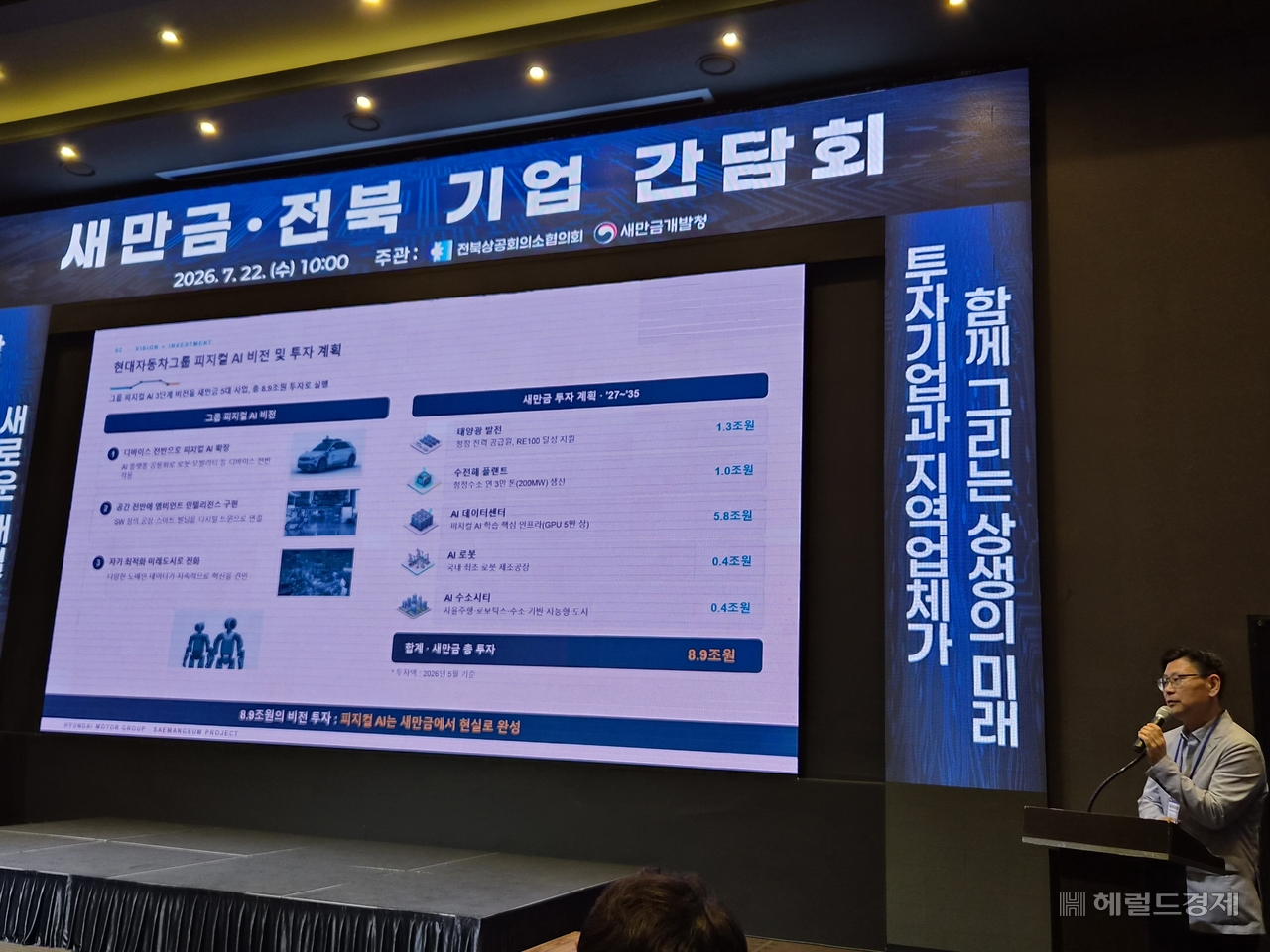
Choi Seo-ho, executive vice president of Hyundai Motor Group, presented the group's Saemangeum investment plan, saying: "The investment is currently estimated at 8.9 trillion won ($6.03 billion), but once ground-breaking begins next year, we expect the final figure to exceed 9 trillion won. At the robot factory we are about to break ground on, we need manufacturing that can ensure quality — we plan to build the facility drawing on our automotive expertise."
The roundtable was attended by Minister Kim Yun-deok, Saemangeum Development Authority Commissioner Moon Seong-yo, Jeonbuk Chamber of Commerce and Industry Council Chairman Kim Jeong-tae, Hyundai Motor Group Executive Vice President Choi Seo-ho, LSL&F Battery Solution CEO Jeong Gyeong-su, Futuregraph President Kim Jeong-hun, Jeonbuk National University Industry-Academia Cooperation Foundation Director Baek Gi-tae, and Jeonbuk Construction Organizations Federation Chairman So Jae-cheol.
smh@heraldcorp.com





