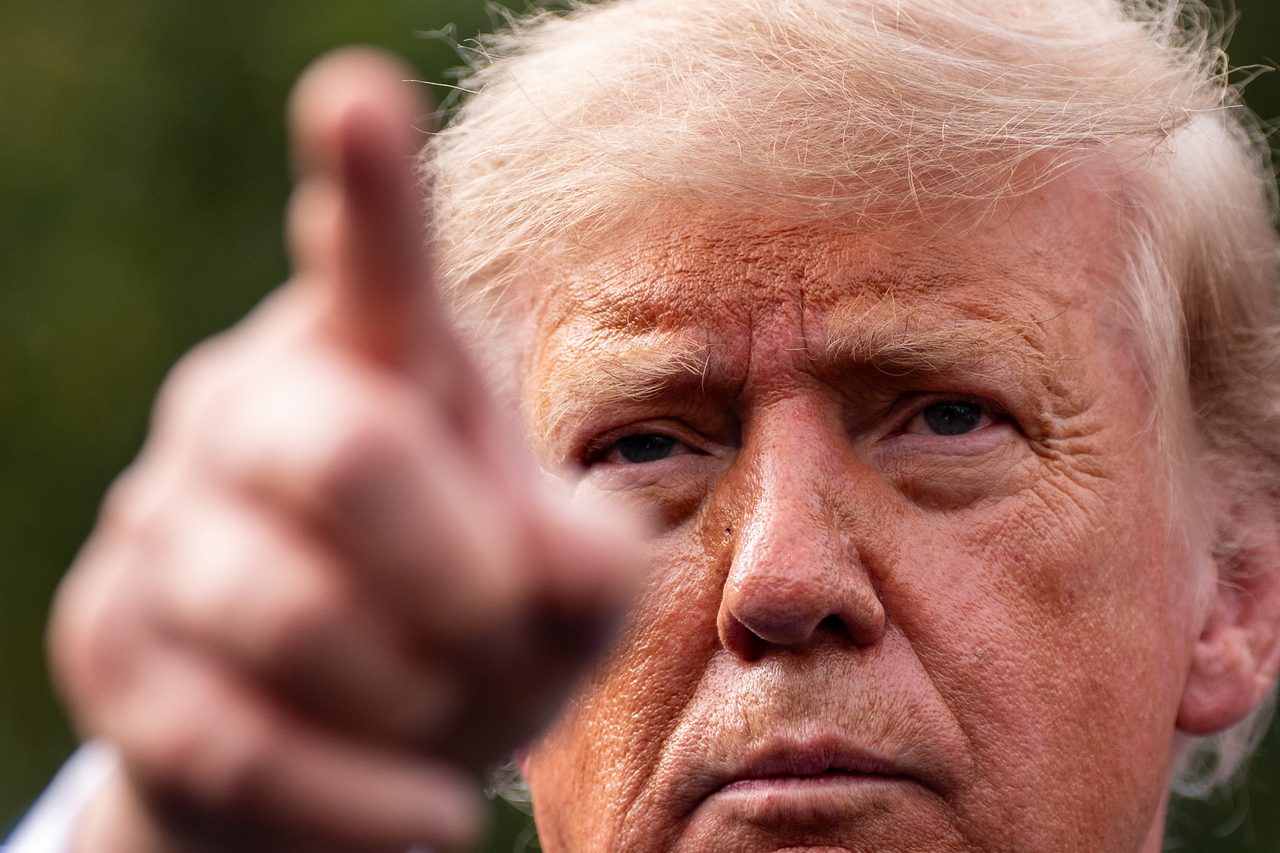
![US President Donald Trump addresses the nation from the East Room of the White House on Thursday (local time). [Getty Images]](https://wimg.heraldcorp.com/news/cms/2026/07/22/news-p.v1.20260722.21891c57a5f94dfcb797a430e6f56f0b_P1.jpg)
President Donald Trump has officially approved a "landmark" nuclear cooperation agreement that would potentially allow Saudi Arabia to enrich uranium on its own soil, the Wall Street Journal reported Tuesday (local time).
Citing US officials, the Journal said the agreement — a so-called 123 Agreement governing the construction of nuclear power plants in Saudi Arabia — includes a provision under which American companies would build uranium enrichment facilities inside Saudi territory if a joint US-Saudi study determines the approach is feasible. Under the deal, the two countries will conduct a two-year joint study examining the merits of uranium enrichment, including whether domestic enrichment is commercially viable as an alternative to importing nuclear fuel.
If the study concludes that domestic enrichment is feasible, the United States would build the facilities using a secretive "black box" method designed to prevent the transfer of sensitive enrichment technology. If the conclusion goes the other way, Saudi Arabia would be barred for 10 years from pursuing uranium enrichment independently or with any other foreign partner.
It is extremely rare for the United States to permit spent nuclear fuel reprocessing or uranium enrichment through a 123 Agreement. The handful of exceptions include major European nations such as France, Germany and the United Kingdom, as well as Japan — all subject to rigorous International Atomic Energy Agency inspections.
Trump gave his final approval to the agreement late last week, the Journal added, and the signing ceremony was set for Wednesday with the energy ministers of both countries in attendance.
US officials argue the deal would give Washington leverage over Saudi Arabia's nuclear industry and help prevent its nuclear program from being diverted to military purposes, the paper said. The agreement is expected to be submitted to Congress for review within days.
However, the Journal reported that lawmakers are unlikely to be able to block the deal, as doing so would require passing a joint resolution of both chambers and mustering a two-thirds majority to override a potential presidential veto.
Reuters reported Wednesday that the energy ministers of both countries had already signed the agreement, and noted that it does not include safeguards — measures the US government has long said are necessary to prevent nuclear materials from being diverted to weapons programs. The deal complies with IAEA inspection requirements but relaxes the stricter controls on nuclear fuel reprocessing and enrichment that US nuclear law had previously imposed.
Despite the feasibility conditions and the requirement that enrichment be carried out by American firms, critics warn that the deal, once in force, could fuel a nuclear arms race in an already militarily volatile Middle East and pose a serious challenge to the global nonproliferation regime.
Robert Einhorn, a former State Department official who advised the US government on nonproliferation, said the deal could help keep Russia and China out, but warned that "the proliferation risks in the Middle East and beyond could grow if enrichment and other sensitive activities are not properly safeguarded." Henry Sokolski, executive director of the Nonproliferation Policy Education Center, was more blunt, saying "the UAE, Turkey and Egypt will follow where Saudi Arabia leads" and calling the notion of a happy ending "delusional."
The UAE, which built its nuclear power plants with South Korean assistance, signed its own 123 Agreement with the United States in December 2009. At the time, the UAE agreed to a "gold standard" that strictly prohibits both nuclear fuel reprocessing and uranium enrichment.
Saudi Arabia is understood to have demanded the right to enrich uranium as a condition for normalizing relations with Israel — a key US objective. The talks had stalled over Washington's insistence on the gold standard, but the United States appears to have relented after securing exclusive commercial benefits for American firms.
The Journal estimated the deal, which would remain in force for 30 years, is worth tens of billions of dollars, and said it was designed to give American companies a central role while excluding foreign competitors.
The paper named Westinghouse as a primary beneficiary, and said American companies are expected to supply new power reactors and other nuclear technologies under the agreement, with some of their overseas suppliers potentially playing supporting roles.
Most countries that lack self-sufficient nuclear technology — China and Russia being notable exceptions — must rely on US-origin technology when operating nuclear programs, including reactor construction, and are therefore required to conclude a 123 Agreement with the United States under Section 123 of the US Atomic Energy Act.
The Saudi government has been pursuing nuclear power plant construction to meet domestic energy demand and free up more oil for export. Riyadh insists its intentions are entirely peaceful, but the deal has drawn intense scrutiny given that regional rival Iran possesses highly enriched uranium and is currently engaged in an active conflict.
Saudi Crown Prince Mohammed bin Salman caused an international stir in 2018 when he said that if Iran developed a nuclear weapon, Saudi Arabia would follow suit.
Suspicions have persisted, particularly because Saudi Arabia, while party to a Comprehensive Safeguards Agreement with the IAEA, has refused to sign the Additional Protocol, which would allow for the most rigorous level of nuclear inspections.
The deal may also draw criticism given that the United States has demanded Iran halt its uranium enrichment and even carried out preemptive strikes against it, while now agreeing to allow Saudi Arabia to pursue the same activity.
US Energy Secretary Chris Wright sought to reassure critics in a statement, saying the agreement "was designed in America, relies on the world's best nuclear technology and scientists, and adheres to the highest standards of nuclear safety and nonproliferation."
yckim6452@heraldcorp.com