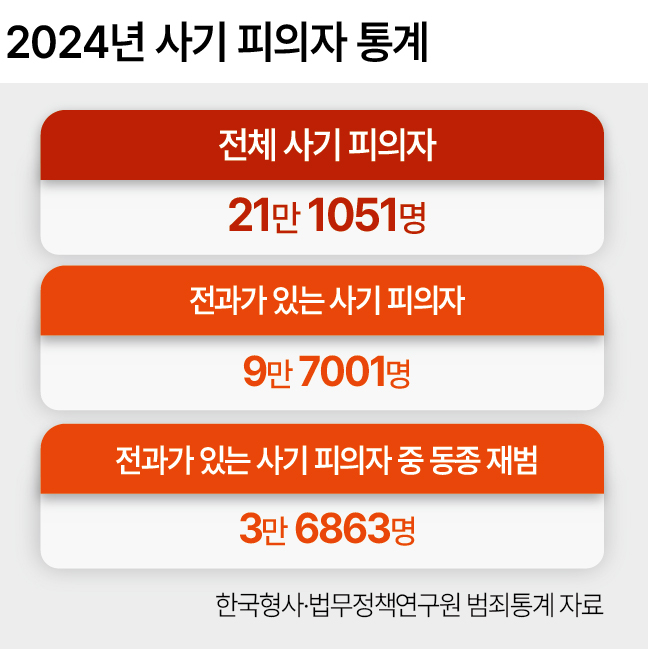
South Korea's persistent fraud epidemic — so pervasive the country has been dubbed a "republic of fraud" — is driven in large part by high recidivism rates. Nearly half of all suspects charged with fraud already had prior criminal records, and four in 10 of those with prior records had committed fraud again, making it a same-crime recurrence.
Legal experts point to lenient sentencing as a key driver of repeat fraud offenses. Even in cases involving substantial losses, suspended sentences are frequently handed down when partial restitution has been made — and even those who receive prison terms still have incentives to reoffend after release. When criminal proceeds are hidden or already spent, recovery becomes difficult, reinforcing the perception that "the gains from crime outweigh the punishment" and fueling further offenses.
The Supreme Prosecutors' Office, responding Friday to a query about why fraud recidivism rates remain high, said "there are many cases where offenders essentially commit crimes professionally as a livelihood, and there is a view that punishment is light relative to the criminal proceeds obtained."
The office added that "because fraud and other property crimes are rarely caught at the scene, and proving fraudulent intent is difficult, decisions on whether to detain a suspect are often made only at the trial stage — meaning it is possible to continue reoffending even while standing trial, as long as one is not in custody." It also said "there is a recurring pattern of 'robbing Peter to pay Paul,' where funds obtained through new crimes are used to compensate earlier victims or pay settlement money in exchange for leniency."
According to crime statistics from the Korean Institute of Criminology and Justice, 211,051 people were investigated on fraud charges in 2024. Of those, 97,001 — or 45.96 percent — had prior convictions. Another 48,310 had no prior record, while the criminal history of 65,740 could not be confirmed. Roughly one in two fraud suspects had already been convicted of a crime before.
Breaking down fraud suspects with prior records by number of previous offenses, those with nine or more prior convictions were the largest group at 36,030 — accounting for 37.14 percent of all previously convicted fraud suspects and 17.07 percent of all fraud suspects. The remaining groups, in descending order, were: one prior offense (15,153), two (10,875), three (9,140), four (7,018), five (6,264), six (4,938), seven (4,094) and eight (3,489).
The share of fraud suspects with prior convictions has risen consistently over the past 15 years. The figure stood at 30.75 percent in 2011, climbed to 43.24 percent by 2021, then held relatively steady at 41.90 percent in 2022 and 42.91 percent in 2023, before jumping sharply to 45.96 percent in 2024.
Fraud in particular shows a high rate of same-crime recidivism — meaning offenders who commit fraud again after a prior fraud conviction. Among the 97,001 fraud suspects with prior records, 36,863 — or 38 percent — were same-crime recidivists. The remaining 60,138 had prior convictions for other types of crimes. By time elapsed before reoffending, 3,437 reoffended within one year, 3,474 within two years, 3,538 within three years, and 10,264 after more than three years.
Legal experts say the high same-crime recidivism rate in fraud cases stems from a widespread belief that fraud is simply "good business." A sitting prosecutor said "fraud cases are difficult to pursue with pretrial detention because restitution to victims tends to take priority," adding that even when a prison sentence is handed down, offenders who have already hidden their proceeds often think 'I'll just do my time and walk out' — and after release, many go on to run new fraud schemes using those hidden funds."
Recovery of fraud proceeds is, in practice, extremely rare. Of the 253,956 fraud cases recorded in 2024, only 12,735 — about 5 percent — resulted in full recovery of criminal proceeds. Cases in which no proceeds were recovered at all numbered 235,648, approaching 93 percent of the total.
yg@heraldcorp.com