MOU with Rural Development Administration, Gyeongsang National University targets nano-cellulose-based crop protection
Aims to cut cold-damage rate in fruit orchards by up to 20% upon commercialization
Moorim P&P expands pulp applications into biotech and agriculture to boost high-value business
Moorim P&P is entering the eco-friendly agricultural materials market, leveraging its position as South Korea's only producer of natural fresh pulp. The company is accelerating its push into high-value businesses by extending pulp applications beyond paper and packaging into biotech and now agriculture.
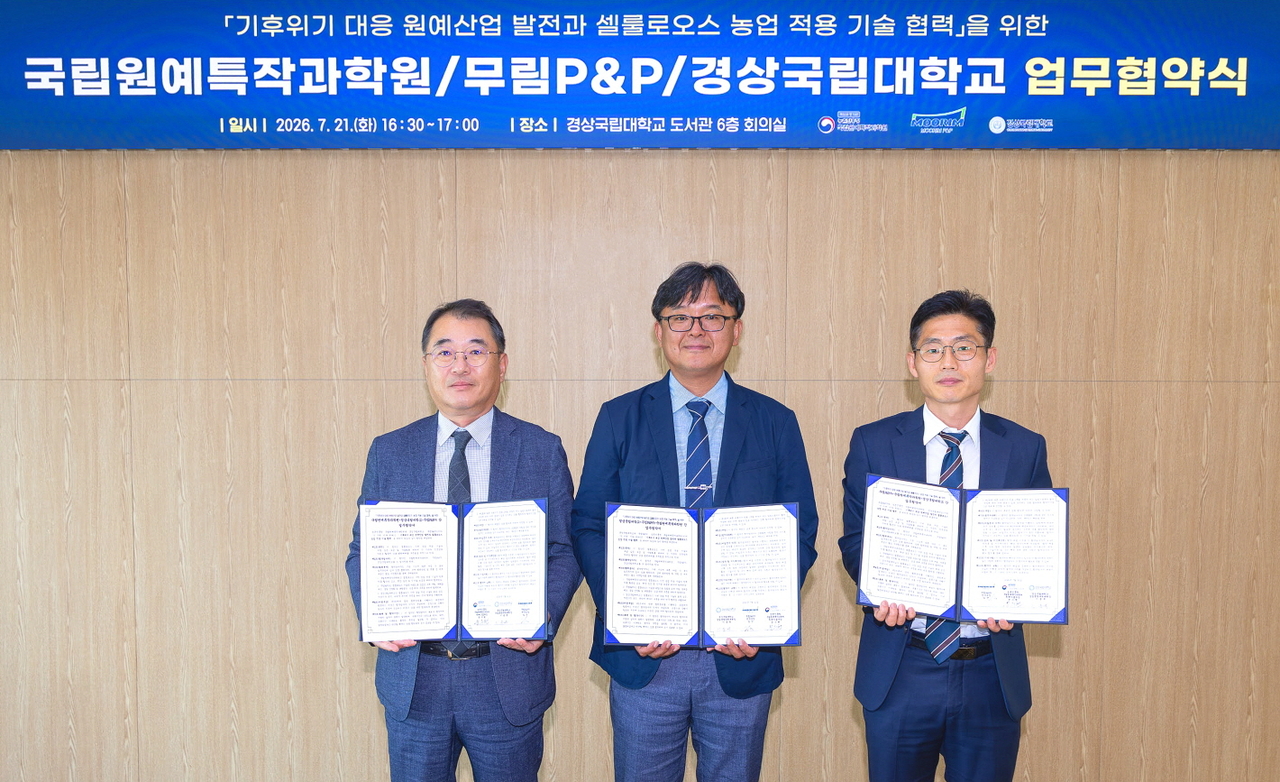
Moorim P&P announced Friday it had signed an MOU with the Rural Development Administration's National Institute of Horticultural and Herbal Science and Gyeongsang National University to jointly develop an eco-friendly cryoprotectant using cellulose derived from natural pulp.
A cryoprotectant is an agricultural material that forms a protective coating on fruit tree flower buds to reduce cold damage. Abnormal weather patterns have caused repeated spring cold snaps in recent years, inflicting growing losses on fruit orchards, and the technology has drawn attention as a potential climate-adaptation tool.
The product will incorporate cellulose nanofibers (CNF) extracted from natural pulp produced by Moorim P&P. CNF is an eco-friendly material made by grinding cellulose fibers down to the nanometer scale; its strong insulating and durability properties are expected to protect flower buds even in sub-zero conditions.
"If commercialized, the product could reduce cold-damage rates in fruit orchards by up to 20% compared with current levels," Moorim P&P said.
The three organizations agreed to build a collaborative framework spanning research and development, field trials, performance verification, mass production and technology dissemination. Moorim P&P will handle raw material supply and product development and mass production; the National Institute of Horticultural and Herbal Science will conduct orchard field trials and oversee technology dissemination; and Gyeongsang National University will carry out performance verification and data collection.
The agreement also marks Moorim P&P's expansion of its pulp-based advanced materials business into agriculture. The company has previously developed pulp-based products including pulp mold, wet wipes, bioplastics, eco-friendly paint and cosmetics moisturizers. With this latest step, it is broadening its reach into functional agricultural materials as it seeks new growth engines.
"Natural pulp-based cellulose has now extended its range of applications to eco-friendly agricultural materials that help address climate change," said Im Geon, director of the Moorim research institute. "We will continue developing new pulp-based materials in collaboration with diverse industries to secure future growth drivers."
hong@heraldcorp.com