![President Lee Jae Myung speaks at a public forum on real estate policy held at KBS in Yeouido, Seoul, on Thursday. [Yonhap]](https://wimg.heraldcorp.com/news/cms/2026/07/24/news-p.v1.20260723.599eb38d9d474270935ed720e4313f48_P1.jpg)
Remarks by President Lee Jae Myung at a public real estate policy forum on Thursday point to higher property holding taxes on ultra-expensive homes and non-owner-occupied single-home properties as the centerpiece of the government's upcoming tax reform. The broad thrust is to protect owner-occupied, mid-to-low-priced and regional housing while using a multilayered regulatory approach to normalize the broader real estate market.
Real estate experts said a general tightening of the tax regime could, in the short term, push some listings onto the market — particularly from cash-poor elderly owners or those seeking to reduce their tax burden. But with Seoul apartment prices rising faster than any likely tax increase, they warned that the downward effect on prices and the long-term supply of listings could be limited. Some also raised concerns about a widening divide between the high-end market, which would bear the brunt of the new taxes, and the mid-to-low-price segment, potentially fragmenting the market further.
Tax reform takes shape: ultra-pricey homes in the crosshairs, middle class and owner-occupiers to keep incentives
Market experts said Friday that Thursday's remarks by President Lee signal a restructuring of the current comprehensive real estate tax framework into a tiered system that adds or subtracts levies based on use, price and location. The existing law, which varies tax rates mainly by the number of homes owned, is expected to give way to more specific criteria — including whether the owner actually lives in the property, the property's price, and where it is located. The issue is also expected to be taken up at an additional forum to be chaired by Prime Minister Han Seong-sook on Monday afternoon.
Lee made clear his intention to raise the tax rate on so-called "prime single properties" — high-value homes held as a concentrated asset bet — including ultra-expensive housing. On Thursday, he said that even bringing property holding taxes in line with "the typical level of advanced countries" would require tripling the current rate, adding, "Even if it costs us politically, we have to prepare for the possibility of a housing bubble bursting."
At the same time, he stressed that tax relief would be maintained for owner-occupied single-home properties, working-class and middle-class households, and regional housing. "Set a reasonable holding burden based on the standard single home, then reduce it if it is used as a residence, reduce it further if it is for ordinary or middle-class people, and also take regional factors like rural areas into account," he said.
Key questions — including whether the comprehensive real estate tax base should be determined by the number of homes owned or by assessed value, and how to define "ultra-expensive" — remain unresolved. Forum participants noted that South Korea's property holding taxes are low compared with major cities abroad. Some argued that homes priced at 1 billion won ($680,000) — roughly twice the national average home price of 500 million won — should serve as the threshold for the ultra-expensive category.
On the definition of non-owner-occupied single homes, Lee said the government would broadly recognize work, education and medical reasons as qualifying a resident as an "actual occupant." He said many people had raised concerns about being penalized for being away from home due to jobs, schooling or hospitalization, and proposed replacing the term "actual residence" with "residential use." The remarks were widely interpreted to mean that a home left vacant or rented out short-term would still be treated the same as an owner-occupied property — and spared any tax penalty — as long as its original purpose is residential.
Dual targets: ultra-pricey and investment homes — but experts see limited impact on supply and prices
The market expects the government's tax reform to bring both ultra-expensive "prime single properties" and multi-home owners within its scope. Woo Byung-tak, a senior adviser at Shinhan Bank's Premier Pathfinder unit, said the reform primarily targets high-value single properties, but noted that the policy blends several objectives — protecting genuine owner-occupiers while curbing speculative holdings — since the government intends to preserve tax benefits for those who actually live in their homes.
The prevailing view, however, is that the effect on listings and price stability in the high-end segment will be limited. Not only are Seoul property prices rising faster than any planned tax increase, but wealthy owners have learned from past experience — raising concerns that higher taxes could simply be passed on to tenants, producing the opposite of the intended effect.
According to Park Won-gap, chief real estate specialist at KB Kookmin Bank, if 3 billion won in market value is used as the threshold for ultra-expensive homes, roughly 166,000 households in Seoul would fall under the tightened holding-tax regime. About 14 of the city's 25 autonomous districts would be affected, with more than 91 percent of the targeted properties concentrated in the Han River belt — Gangnam, Seocho, Songpa, Seongdong and Yongsan-gu.
In the short term, some elderly owners feeling the tax burden may put their properties up for sale. Park said that with South Korea's elderly population accounting for around 22 percent of the total, a so-called "core discount" phenomenon could emerge — where older owners of high-value homes decide to sell in response to rising tax costs.
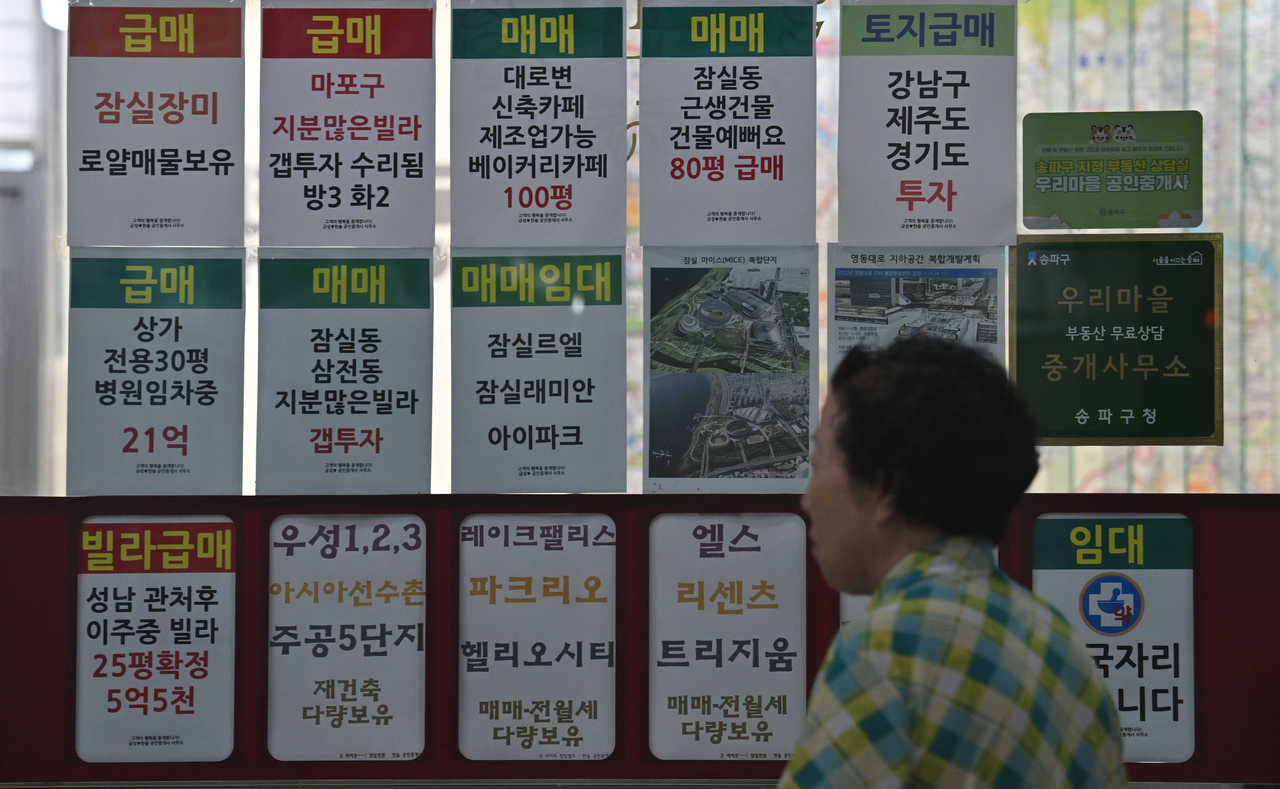
Others believe the medium-to-long-term supply lock-in will persist. Woo cited the Banpo Xi apartment complex as an example, noting that actual transaction prices there had risen by about 1.5 billion won over the past two years. "You might have to pay around 20 million to 30 million won a year in holding taxes, but if the property is going to gain more than 100 million won in a year, nobody is going to sell just to save that money," he said. The remark underscored what he described as a fundamental limitation of holding-tax increases as a tool for drawing out supply.
Concerns were also raised that the gap between Gangnam and non-Gangnam areas could widen further. Park said the market fragmentation — where Gangnam and non-Gangnam areas move in opposite directions — could intensify, with high-end districts reacting sharply to tax changes while mid-to-low-price areas see worsening jeonse shortages, creating a two-track market.
Meanwhile, some called for swift discussion on changes to the tax base, which lies at the heart of the holding-tax overhaul. Lee Hyeok-jun, a managing director at Nice Investors Service's financial structured-finance rating division who attended the forum, said the market has consistently called for a shift in the comprehensive real estate tax base from the number of homes owned to assessed value — but added that the current government, which still views multi-home owners as the primary target for higher taxes, is unlikely to make that change easily.
hss@heraldcorp.com
quq@heraldcorp.com