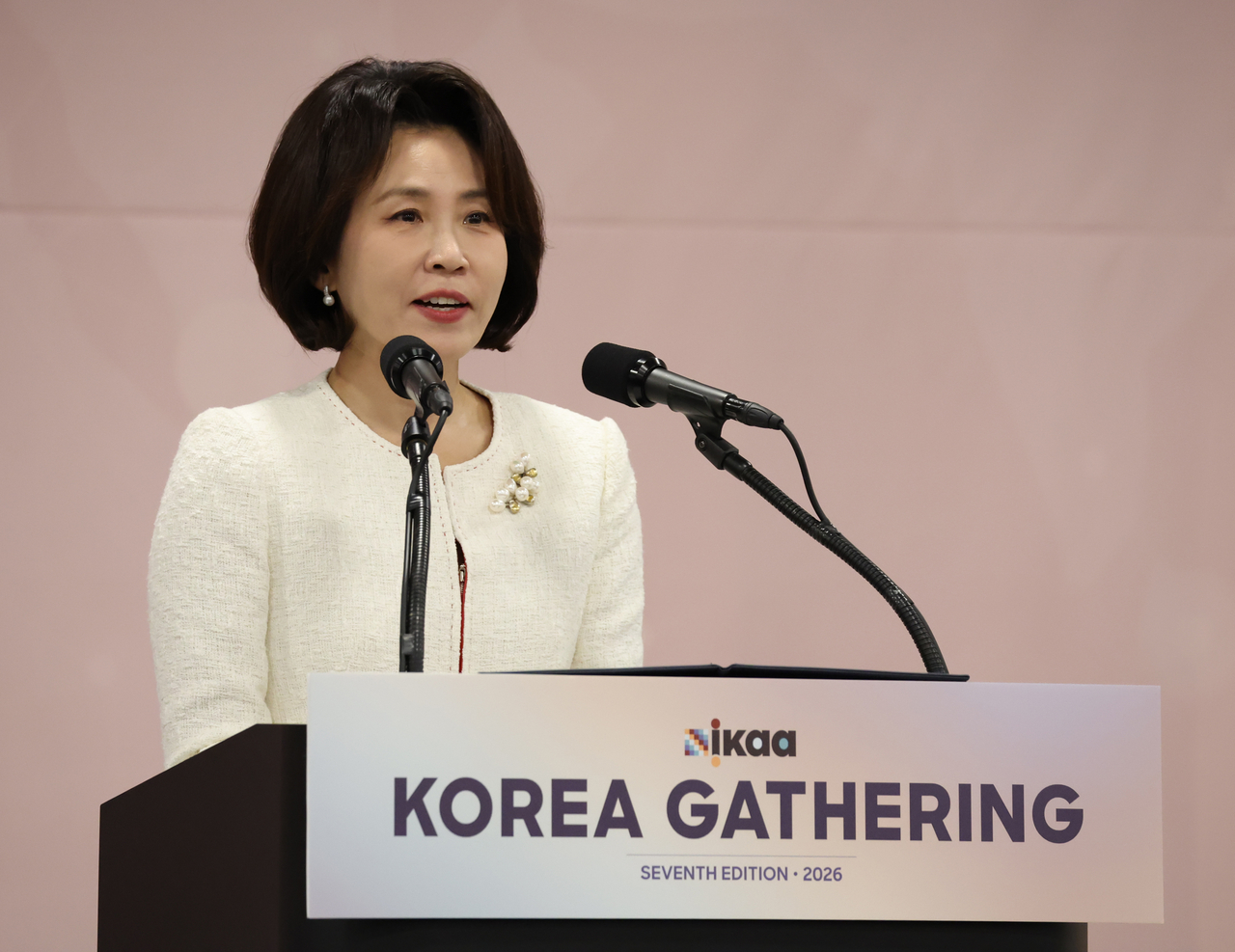
![Minister of Culture, Sports and Tourism Choi Hwi-yeong delivers opening remarks at the first "Everyone's Forum," held Sunday at Yonsei University in Seodaemun-gu, Seoul, on the question of whether a hangul nameplate should be added to Gwanghwamun Gate. [Ministry of Interior and Safety]](https://wimg.heraldcorp.com/news/cms/2026/07/27/news-p.v1.20260727.99f1feee75564944983bea7bb33209d2_P1.jpg)
Experts and citizens gathered for a heated debate over whether a hangul nameplate should be added alongside the existing hanja sign on Gwanghwamun Gate.
Participants were sharply divided between preserving the gate's original hanja nameplate as a cultural heritage site and adding a hangul version to reflect national identity.
The Ministry of Culture, Sports and Tourism and the Ministry of Interior and Safety jointly held the first "Everyone's Forum" on Sunday at Yonsei University in Seodaemun-gu, Seoul, to discuss the proposal. The forum drew experts in cultural heritage, history, hangul and urban landscape, along with about 200 citizens selected through a prior application process.
Park Hyeon-mo, president of the Sejong National Governance Institute and the lead speaker for the pro-addition side, said Gwanghwamun is "the space Koreans love most and the face of Korea that foreign visitors encounter first." He said adding a hangul nameplate would reflect the historical significance of hangul's creation during the reign of King Sejong and embody national identity.
Citing Notre-Dame Cathedral in France and Ise Jingu shrine in Japan, Park said "globally, preserving the original form of cultural heritage is not an absolute principle — there are many cases where changes reflect the times and new values."
He added that the proposal was not about removing the hanja sign. "The idea is to install an additional hangul nameplate — to preserve the history of the past while also building the values of today's Korea and a legacy for future generations together," he said. "Adding a hangul nameplate is not damaging history but continuing it."
Kim Hyeon-gyeong, a professor in the department of national heritage management at the Korea National University of Cultural Heritage and the lead speaker for the opposing side, said Gwanghwamun had undergone multiple restorations and changes over the years, but "each time, only a single nameplate was chosen." She said the current proposal "is a different kind of layered intervention from past changes and runs counter to the principles of cultural heritage preservation."
Kim said a nameplate "is not a simple sign but an element that concentrates the symbolism and centrality of a structure." She added that adding a hangul nameplate would alter the frontal composition of Gwanghwamun and could undermine its existing historical and architectural significance.
She further argued that a desire to add new meaning was not sufficient grounds to alter the physical form of a cultural heritage site, and suggested that "the value of hangul can be communicated through exhibitions, interpretation and education, rather than adding another nameplate."
A pre-event survey also showed divided opinion.
Among survey respondents, 76 percent agreed that "preserving the original form is the principle for cultural heritage," and 83 percent said "Gwanghwamun is part of our cultural heritage." Some 97 percent agreed that "hangul is a representative cultural resource symbolizing Korea's national identity," while 60 percent favored keeping only the hanja nameplate on Gwanghwamun.
Perceptions of Gwanghwamun as a space were similarly high across two framings: 99 percent described it as "the main gate of Gyeongbokgung Palace and a precious cultural heritage site," while 97 percent also saw it as "an urban space that citizens use in their daily lives."
Asked whether "the symbolism of hangul is worth expressing through the physical nameplate on Gwanghwamun," 63 percent agreed. Some 56 percent agreed that "keeping the hanja nameplate while adding hangul alongside it would allow both values to coexist."
Following the expert presentations, citizen participants broke into small groups for discussion.
Those opposed to adding a hangul nameplate emphasized "cultural heritage preservation" and "maintaining the original form," while supporters called for "a meeting of past and present that embodies national identity" and said "the hangul nameplate should come first."
The Ministry of Culture, Sports and Tourism said it plans to draw on the range of opinions expressed at the forum in its future policy review. The ministry will open a public comment board on its website to gather further public opinion and will conduct additional expert surveys and a nationwide public poll.
Culture Minister Choi Hwi-yeong said in his opening remarks that the ministry would "listen carefully and impartially to the views of all citizens participating in today's forum, with no preconceptions," and expressed hope that the forum would serve as "a valuable occasion to hear the thoughts of more citizens and broaden common ground."
The Gwanghwamun nameplate has taken different forms across the centuries. The hanja sign written by Im Tae-yeong, a military commander, when Gyeongbokgung Palace was rebuilt in 1868 was destroyed during the Korean War. When the gate was restored in 1968, then-President Park Chung-hee installed a hangul nameplate in his own handwriting. That sign was replaced in 2010 under the Lee Myung-bak administration with a hanja nameplate restored in Im's original script, but wood cracking led to the installation of the current hanja nameplate — black background with gold lettering — in October 2023.
pink@heraldcorp.com