
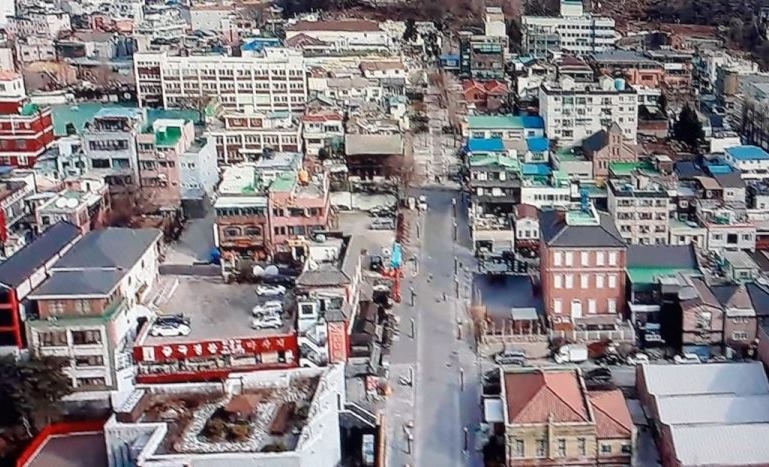
The Sinpo-dong area of Incheon's Jeomulpo-gu has entered the gateway of a sweeping urban restructuring, triggered by the publication of the district unit plan for the area surrounding Jayu Park late last year.
Interest in joint development between long-stagnant building owners and private developers has surfaced, raising expectations for a major transformation of the old city center around Jayu Park.
Building owners in the target zones have largely responded positively to joint development, giving the project fresh momentum.
The key test for the success of "private joint development through lot consolidation" — the centerpiece of the district unit plan — is whether building owners within the designated zones agree to participate.
Based on reporting compiled Thursday, the mood among building owners, who had long been passive about development due to various regulations, has turned positive since the district unit plan was published on Dec. 1, 2025.
As one example, a private developer sent mailings in April to building owners in one district unit plan zone near Sinpo station on the Suin Line, outlining guidelines for joint development under the plan.
Of the 24 buildings in the zone, roughly half indicated initial support for joint development.
The remaining owners have yet to respond, but if the same rate of positive response among those who did reply is applied to the non-respondents, at least 10 more are expected to come on board.
That would put the total at 18 to 20 of the 24 buildings — roughly 70 to 80 percent — participating in the project, making reconstruction a highly likely outcome.
Long-term vacancies and serious deterioration leave joint development as the only alternative.
The convergence of building owners reflects a very real sense of crisis stemming from the old city center's prolonged decline.
The main commercial strip of Sinpo-dong and its surrounding streets were once known as "Incheon's Myeong-dong," a reference to Seoul's premier shopping district, but years of mounting vacancies and severe building deterioration have made it nearly impossible to secure tenants, creating a vicious cycle.
One building owner in Sinseong-dong said "Most buildings in this area have been sitting vacant for years. This is not something that started recently. The buildings are too old and there are too many regulations — even remodeling is difficult — and that is why finding tenants has become nearly impossible."
"To revive Sinpo-dong, once known as Incheon's Myeong-dong, while the local commercial district remains in a prolonged slump, the only option is a complete transformation through large-scale reconstruction in line with the district unit plan," the owner added.
That is why Jeomulpo District Office published the district unit plan with bold guidelines, including floor area ratio incentives and an increase in the permitted residential ratio to as much as 80 percent.
The move reflects a structural judgment that a fundamental revival of the Sinpo-dong commercial district is possible only by drawing in both transient and permanent residents through private reconstruction — going well beyond simple streetscape improvements.
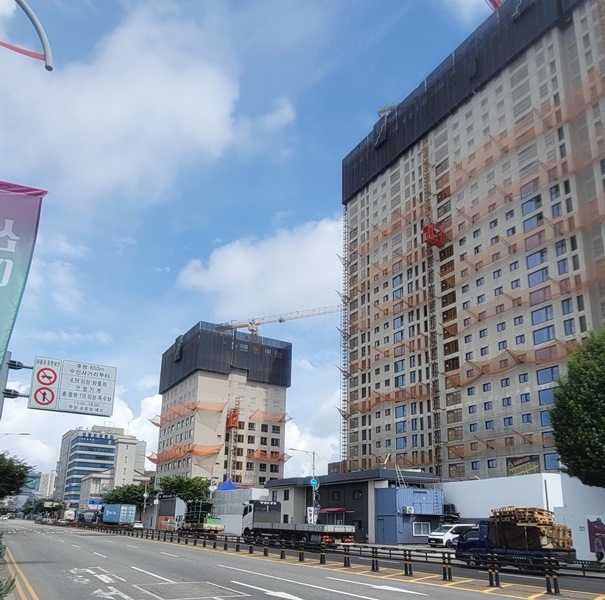
Redevelopment around Sinpo station transit-oriented area takes shape, with residential complexes emerging.
The physical transformation of the Sinpo-dong area is already under way on its periphery. Development centered on the Sinpo station transit-oriented area has already begun. A reconstruction project near Incheon Girls' Commercial High School is in full swing, targeting completion in February 2028 and set to deliver 579 units of apartments and officetels.
Across from the E-mart Dongincheon branch next door, a large mixed-use residential complex is also planned, bringing additional housing supply within reach.
"The Sinpo-dong area already had an established commercial district — it was known as Incheon's Myeong-dong — and it sits at the intersection of Sinpo station on the Suin Line and Dongincheon station on the Gyeongin Line, so expectations for a new transformation are high," one private developer said. "Among developers, it stands out as a prime example of an old city center worth watching."
With large residential infrastructure taking shape around the Sinpo station transit-oriented area and joint development talks between private developers and building owners gaining traction since early this year, urban change is fast becoming a near-term reality for the broader Jayu Park area, which encompasses seven neighborhoods: Sinpo-dong, Sinseong-dong, Bukseong-dong, Nae-dong, Songwol-dong, Jeon-dong and Inhyeon-dong.
With decades of regulatory constraints now lifted and building owners rallying behind development, all eyes are on whether Sinpo-dong can overcome the limitations of an old city center and re-emerge as a hub of Incheon's economy and culture.
gilbert@heraldcorp.com





