President Lee Jae Myung said Tuesday that South Korea and Brazil can grow together as aviation manufacturing powerhouses, supply chain partners and leaders in the global beauty market — if business leaders from both sides join forces. Speaking at the Korea-Brazil Business Roundtable held at a hotel in Sao Paulo during his state visit to Brazil, Lee said it was "very meaningful to discuss future cooperation between the two countries."
Seven MOUs were signed between major private companies from the two countries at the event.
Particularly notable was an MOU on "cooperation in the civil aviation and aerospace sectors" signed between Korea Aerospace Industries (KAI) and Brazil's Embraer. The two companies agreed to pursue research and development cooperation in new aviation technologies and to carry out joint development projects in commercial aircraft, aircraft structures and future air mobility.
Earlier in his state visit, Lee inspected the C-390 — a large transport aircraft manufactured by Embraer for delivery to the South Korean Air Force — at an air force base in Brasilia, where he proposed that the two sides "build civilian aircraft together going forward." Embraer ranks third globally in commercial aircraft market share, behind Boeing and Airbus, though the gap is significant.
At the roundtable, Lee also praised Embraer, saying Brazil "possesses world-class production capabilities in small and medium-sized commercial aircraft."
Regarding an MOU signed between Posco International and Brazil's Meteoric Resources to secure a stable rare earth supply chain, Lee called Brazil "a treasure trove of critical minerals essential to advanced industries, including nickel and iron ore," and praised the country for "leading the hydropower, wind, solar and abundant clean energy sectors, as well as the bio-ethanol market."
He added that South Korea "is a manufacturing powerhouse with strengths in AI, semiconductors and biotech, as well as automobiles and steel," and said that if "Korea's unrivaled innovative technology and manufacturing capabilities combine with Brazil's abundant resources, our two countries will leap forward as the ideal partners to jointly lead stable supply chains and future industries."
Posco Holdings proposed not only receiving rare earth supplies from Brazil through cooperation in critical minerals including rare earths, but also building a rare earth supply chain within Brazil to create a mutually beneficial model for both countries.
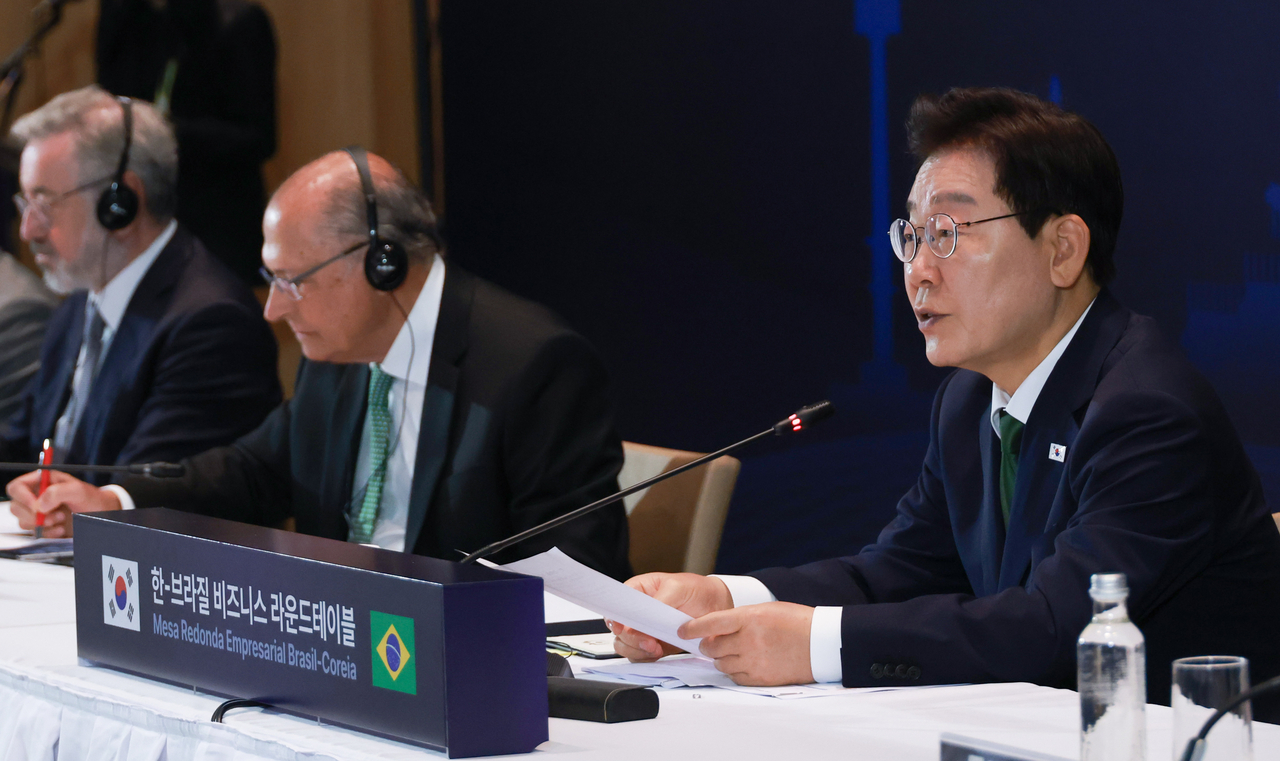
Kim Yong-beom, chief of the Cheong Wa Dae policy office, told reporters after the event that the two sides focused their discussions on private-sector cooperation in three areas: manufacturing and infrastructure, advanced industries, and consumer goods and retail.
On future economic cooperation, Lee instructed Kim to quickly establish platforms in each country to directly hear and resolve difficulties faced by companies that have already entered or wish to enter the other country's market, and to report the results to both presidents.
On the reaffirmation — included in a joint statement signed Tuesday — of existing commitments on Brazilian beef and pork access to the South Korean market, and the agreement to flesh out quarantine and sanitary procedures, Lee acknowledged that "there are indeed complex competing interests surrounding the opening of the Brazilian market to South Korean manufactured goods and the opening of the South Korean market to Brazilian agricultural and livestock products," but urged that "dedicated channels in both countries coordinate this, as it benefits both sides."
Ryu Jin, chairman of the Korea Enterprises Federation, said at the event that "Brazil today is a country leading the global supply chains that will become the core of energy, mineral and food economic security," adding that "Korea holds competitiveness in advanced manufacturing and digital innovation."
Lee also visited the headquarters of the Sao Paulo metalworkers' union — a political symbol of Brazilian President Luiz Inacio Lula da Silva.
Lula is credited with launching his political career after being elected head of the metalworkers' union in 1975, when it had 100,000 members, and leading the largest strike in Brazilian history in 1980.
Meanwhile, after concluding his schedule in Brazil, Lee departed Wednesday for Santiago, Chile, the third destination of his current overseas tour.
sang@heraldcorp.com
moone@heraldcorp.com