
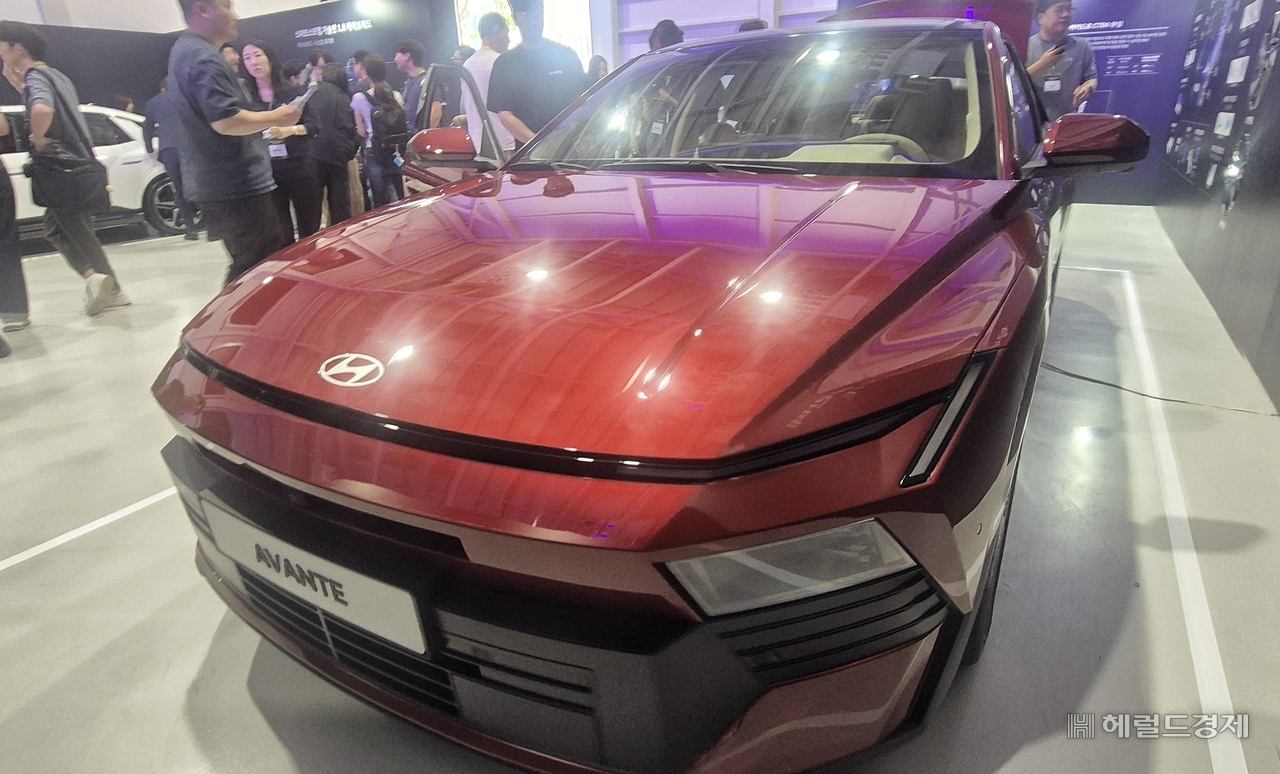
Hyundai Motor has broken from the compact segment's value-for-money formula and gone premium. The fully redesigned Elantra — its first complete overhaul in six years — offers more interior space while raising safety, ride quality and the digital experience to near-segment-above standards. The company's stated development keyword is "value beyond class."
Hyundai Motor held "The All-New Elantra Tech Day" at Arc Gangnam in Seocho-gu, Seoul, on Wednesday, unveiling the new model's core technologies and development background. Researchers responsible for the concept, design, safety, driving performance and hybrid system each presented their work at the event.
With the new Elantra, Hyundai Motor aims to rewrite the benchmark for the compact sedan segment by raising the bar across space, safety, ride quality and the digital experience. The development focus, the company said, was not simply on making the car bigger, but on bringing experiences previously reserved for higher-segment vehicles within reach of more customers.
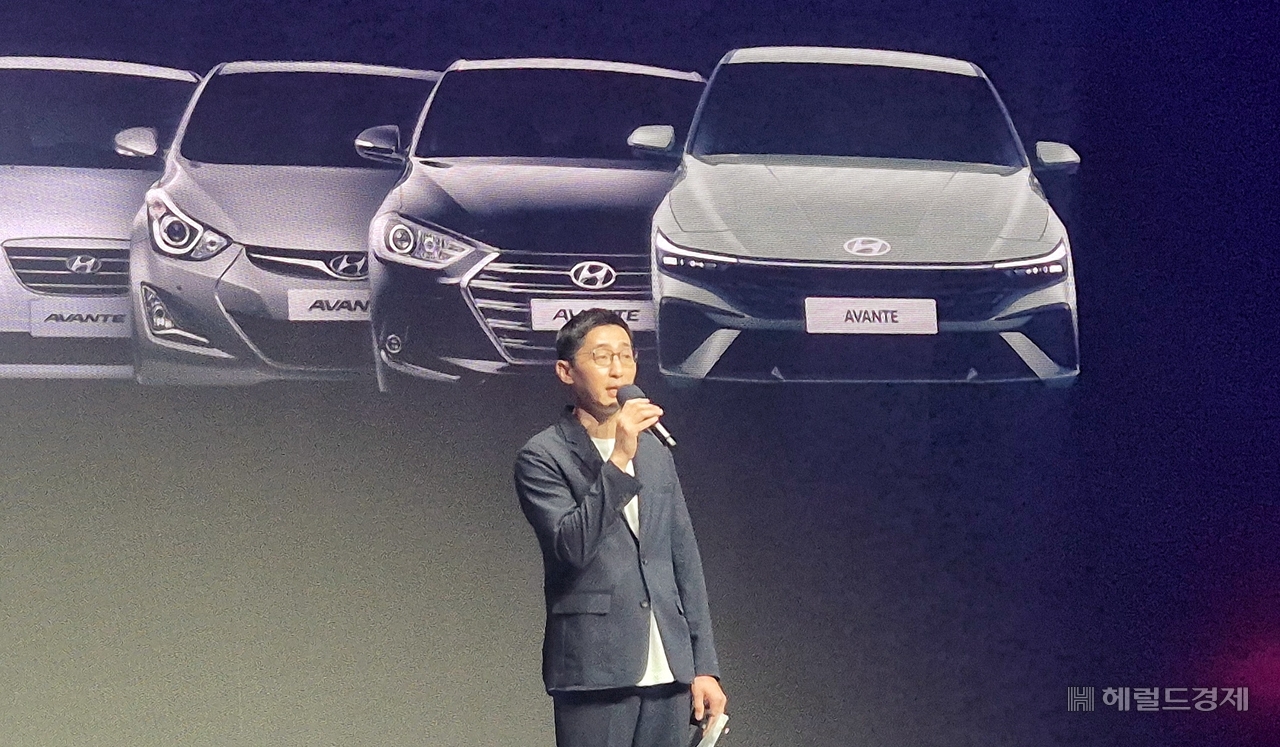
Yang Yu-chan, head of Hyundai Motor's MSV Project 1 division, described the Elantra as "Hyundai's global best-selling sedan that has long raised the standard for mainstream cars," adding that it is "a global top-tier model that puts safety first while further strengthening design, practicality and efficiency — and adding performance improvements and advanced digital technology to deliver premium value and a technology experience that exceeds its class."
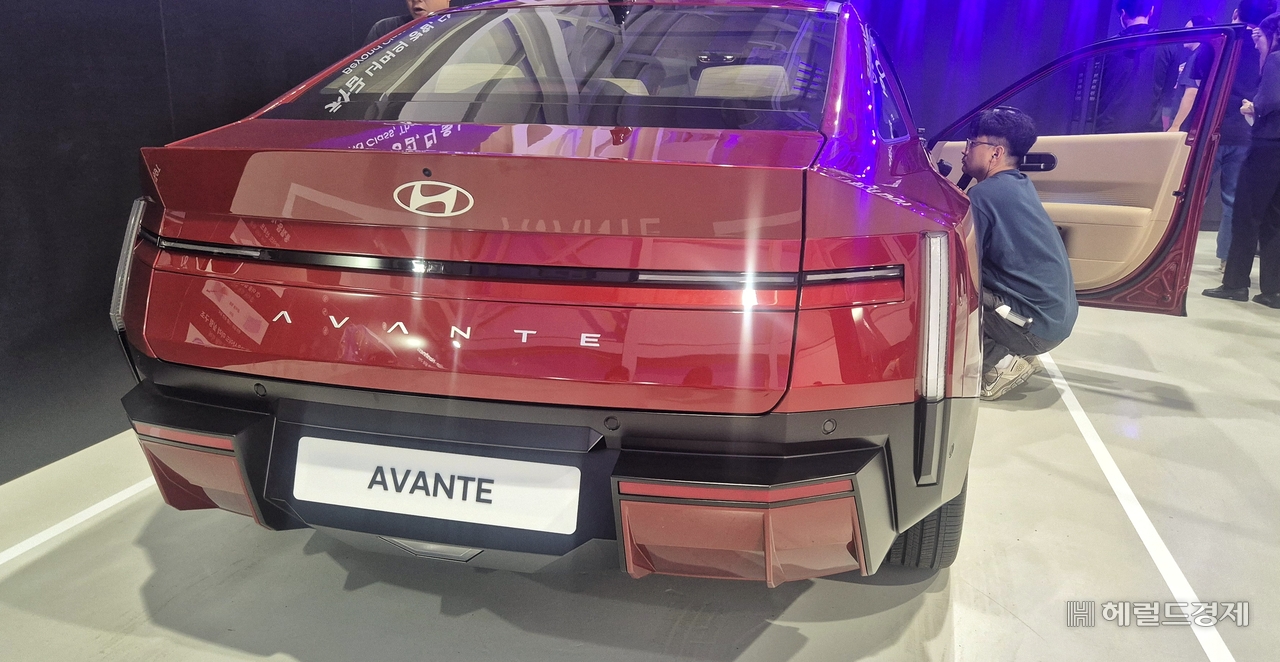
'Golf bags and strollers, no problem' — new Elantra grows to near-Sonata proportions
The most striking changes are to the body and interior space.
The new Elantra stretches to 4,765mm in overall length — 55mm longer than before — while overall width grows 30mm to 1,855mm and the wheelbase extends 30mm to 2,750mm. The width is now just 5mm narrower than the Sonata's. In person, the car carries the presence of a segment-above sedan rather than a compact.
Sitting in the rear seat, the improvement in knee room and shoulder room is immediately apparent. Even for a full-grown adult, the sense of confinement is greatly reduced, and the cramped feeling typical of compact sedans has largely disappeared.
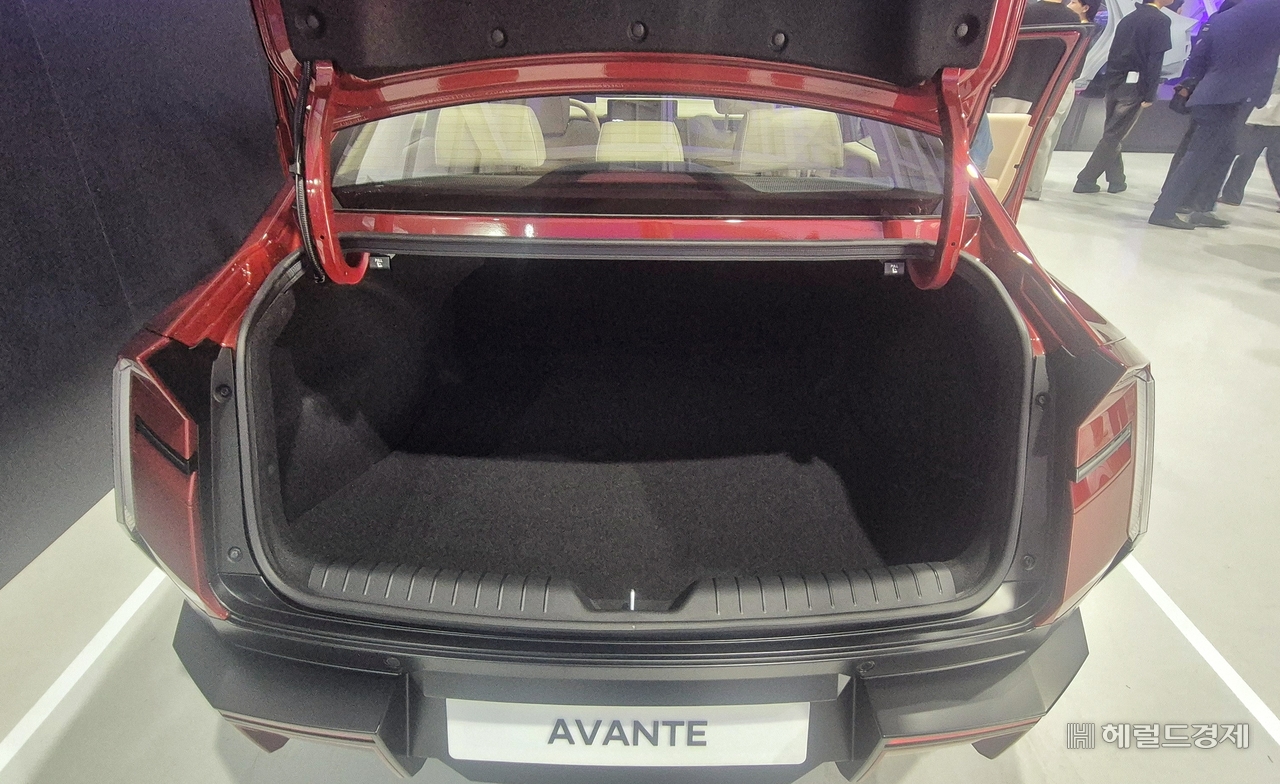
The trunk was particularly impressive. Hyundai Motor did not simply increase cargo volume — it widened the opening itself, expanding the trunk aperture by 45mm to 475mm. At the event, it was easy to load and unload a golf bag and even a stroller without angling them sideways, a sign that everyday convenience was carefully factored into the design.
Hwang Se-young, a senior researcher on Hyundai Motor's MSV Project 1 team, said the goal was not merely to increase trunk capacity but to lower the load floor and widen the opening to "significantly improve the real-world convenience of loading and unloading luggage."
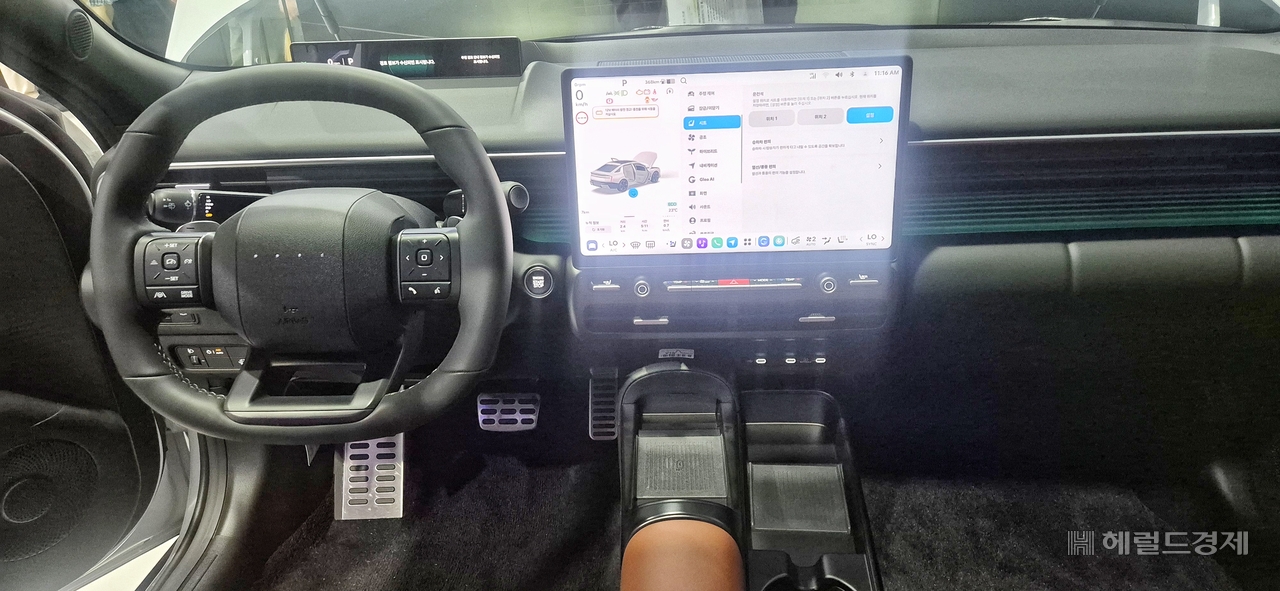
The cabin, too, feels markedly different from the previous generation.
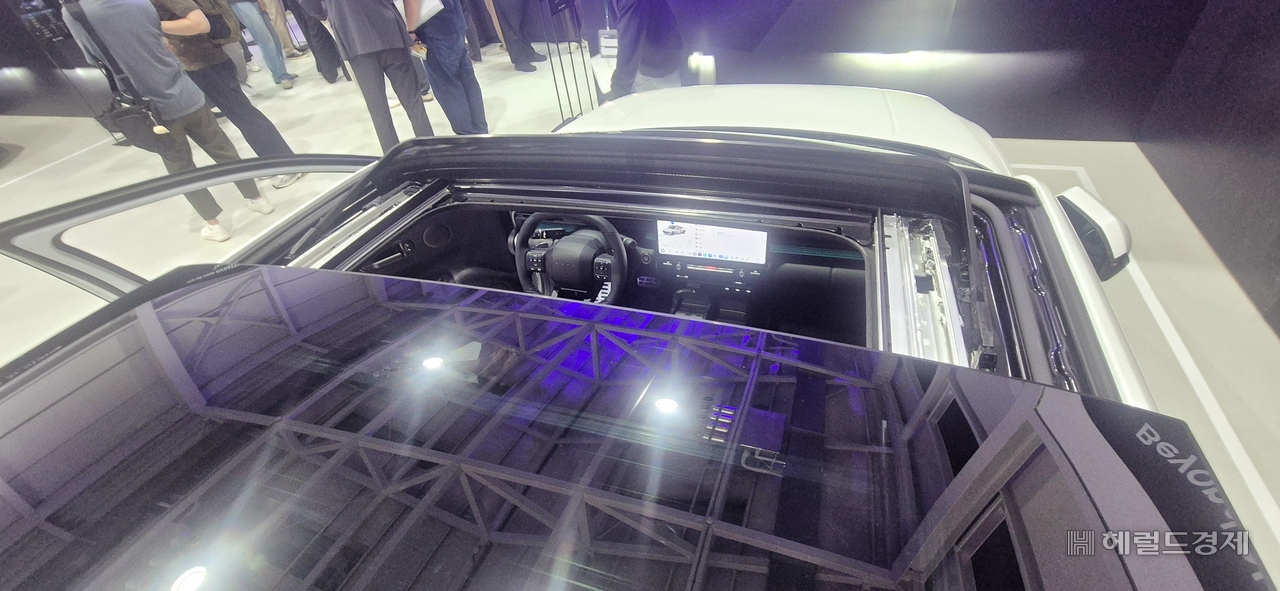
Settling into the driver's seat, the first things that stand out are a wider display and noticeably more refined seats. The seats use a higher-rigidity, slimmer design to free up cabin space, while the center console gains dual wireless charging and a hidden storage compartment. The door trim and dashboard finish are softer and more upscale, giving the interior the feel of a segment-above sedan.
Hyundai Motor's next-generation infotainment system, Pleos Connect, is also fitted as standard. Built on an operating system that lets users download a variety of apps — much like a smartphone — it also incorporates the generative AI assistant Gleo AI.
Hyundai Motor's first P-button emergency braking — safety technology gets a major upgrade
Safety is the area where Hyundai Motor invested the most effort.
The proportion of ultra-high-strength steel in key body sections rises from 52.6 percent to 58.7 percent, and average tensile strength climbs to 718 MPa. In plain terms, the body structure is significantly stiffer to keep the passenger cell as intact as possible in a collision. The bumper rear beam, B-pillar and side sills have also been reinforced to disperse crash energy more effectively.
Hong Seong-chan, a senior researcher on Hyundai Motor's Safety Performance Test 1 team, said the body structure was improved "to minimize deformation of the passenger compartment in a collision," with the development target set at the highest level of crash safety globally.
The feature that drew the most attention is a first for Hyundai Motor: P-button emergency braking via the electronic shift-by-wire lever.
In an emergency, holding down the P button on the shift lever causes the vehicle to automatically limit acceleration and apply the brakes to all four wheels. Below 1 km/h, the electronic parking brake engages automatically as well. Where the P button previously served only as a parking function, it now doubles as an emergency brake for moments when a driver panics.
When asked whether the system could also respond to unintended sudden acceleration, Hyundai Motor drew a line. Hong said the feature "is not a function designed with sudden unintended acceleration in mind, but rather a safety function that can be used more intuitively when a driver accidentally presses the accelerator or when emergency braking is needed."
A range of other advanced safety features also come as standard, including pedal misapplication safety assist, Navigation-based Smart Cruise Control 2 (NSCC2), Memory Reverse Assist (MRA), rear-seat belt pretensioners and 10 airbags.
'Even speed bumps feel different' — ride quality gets an upgrade too
Improvements to ride comfort and cabin quietness are among the new Elantra's less visible but meaningful changes.
Hyundai Motor fitted a frequency-selective damping valve (SFD3), a hydraulic rebound stopper (HRS2) and hydro bushings. The suspension tuning was reworked so that the body absorbs impacts from speed bumps and rough surfaces in multiple stages rather than all at once.
Body rigidity was also increased, and sound-absorbing and sound-deadening materials, laminated acoustic glass and noise-absorbing tires were added to reduce wind noise and road noise.
Song Hyeon-jin, a senior researcher on Hyundai Motor's MSV Integration Test team, said the team "focused on delivering a comfortable and stable ride quality befitting a premium sedan, both in the city and on rough roads," adding that ride comfort, handling and quietness were all improved in a balanced way.
'Faster and farther' — hybrid gains in both performance and efficiency
The hybrid model improves on both performance and efficiency.
A third-generation Smartstream 1.6 hybrid engine is paired with an upgraded six-speed dual-clutch transmission, a more powerful electric motor and a larger-capacity battery. Technologies that reduce internal engine friction and enable finer fuel injection were also applied to improve engine efficiency.
As a result, combined system output rises by 16 horsepower to 157 horsepower. Zero-to-100 km/h acceleration improves by about 6 percent, and passing acceleration from 80 to 120 km/h improves by about 17 percent. Fuel economy also improves by about 10 percent despite the larger body.
Shim Jae-gang, a senior researcher on Hyundai Motor's Electrification Project 1 team, said that while performance and fuel economy typically trade off against each other, the team improved both by enhancing the efficiency of the powertrain and the vehicle as a whole. "We developed the car so customers can feel a more spirited yet economical drive in their daily lives," he said.
kwater@heraldcorp.com





