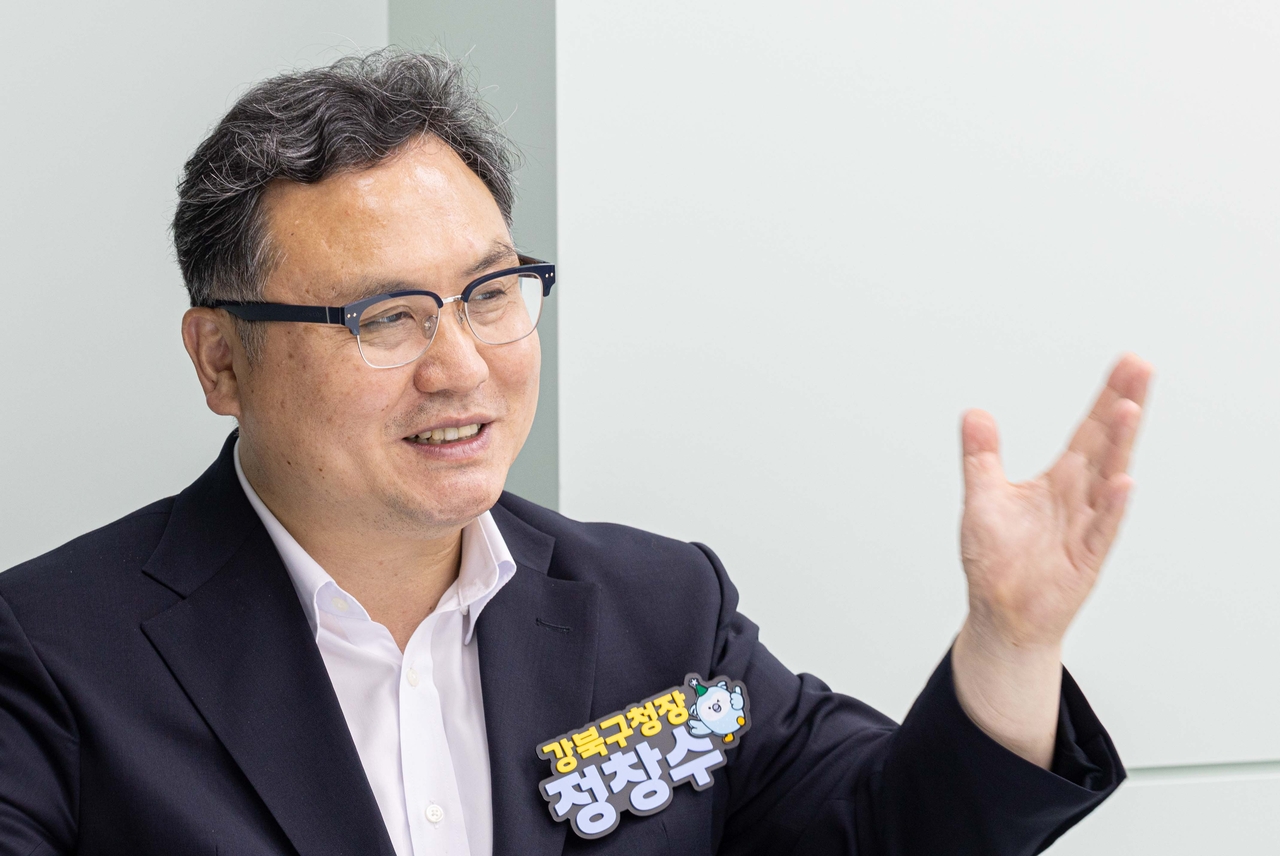
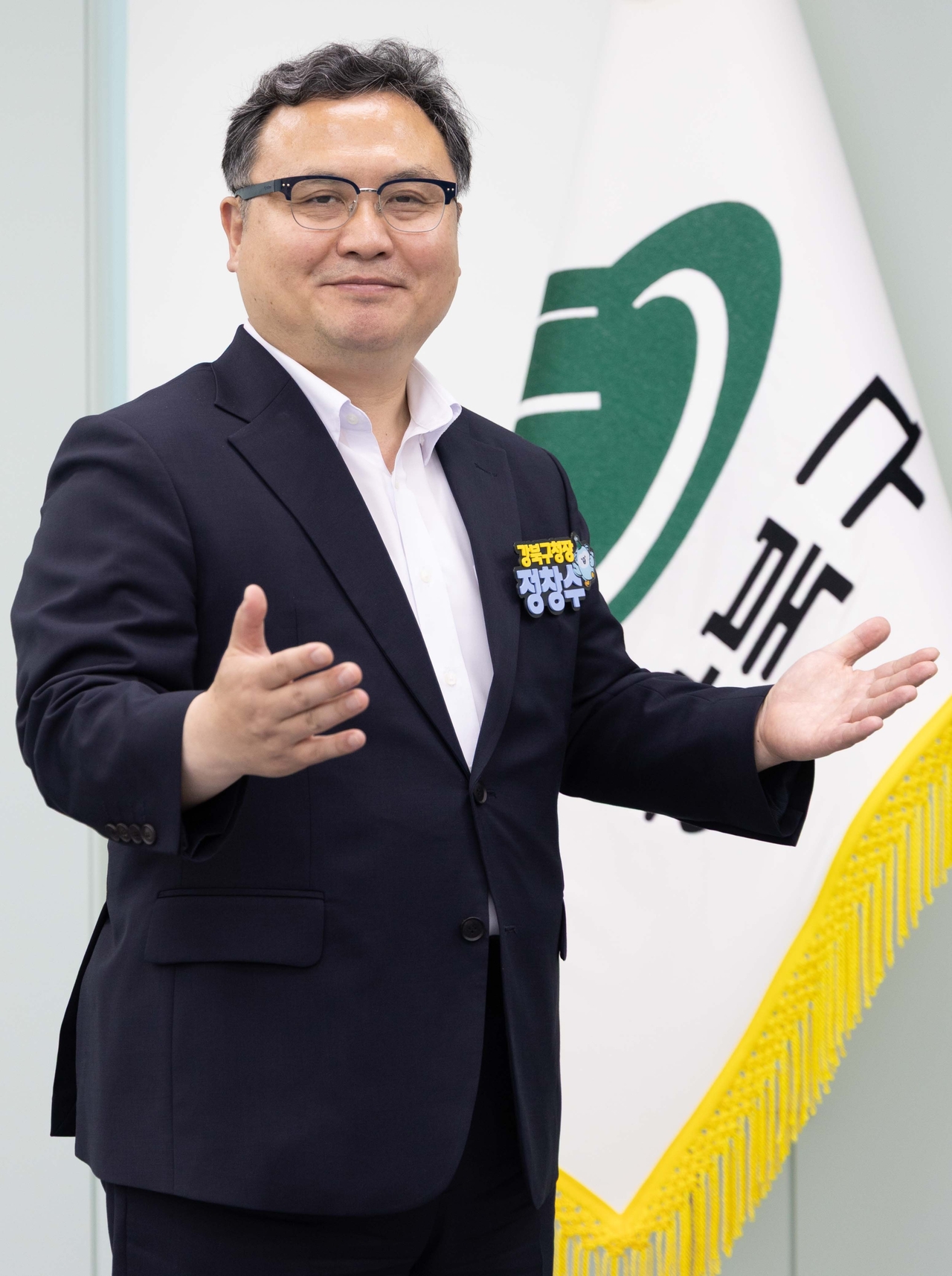
Jung Chang-su was widely regarded as one of the surprise winners of the June 3 local elections. By his own admission, he had not imagined he would become district mayor even two months before the vote. Having spent most of his career as a civic watchdog — at the Citizens' Coalition for Economic Justice and the Narasallim Research Institute — he now finds himself on the opposite side of the administrative fence. Jung said he plans to use his new position to address, one by one, the inconveniences and unmet policy needs he experienced firsthand during 16 years of living in Gangbuk-gu after his marriage. To drive that change, he said he intends to draw fully on his background as a budget expert — and through that, to make raising residents' sense of happiness his defining mission. The following is an edited transcript of the interview.
— What are your thoughts on taking office as Gangbuk-gu district mayor?
I believe residents' choice carries within it a deep longing — a genuine expectation that Gangbuk-gu must now truly change, and an earnest wish for a better future. Before gratitude, what I feel is a heavy sense of responsibility. Over the past 16 years I have shared the daily life of Gangbuk-gu residents: the inconvenience of the commute, the frustration with aging housing, the desire for a better education environment. During the campaign, the words I heard at each site were all different, but the meaning inside them was one: "Make Gangbuk a better city to live in." I believe the greatest duty entrusted to me is to take the experience I have built over years of researching budgets and policy, and to turn the changes residents want into reality, one by one, delivering visible results.
— What is the core keyword for Gangbuk-gu's administration under the ninth round of local governance?
"Residents' happiness." My most important goal in running the district is to build a city where people can say "I am happy living in Gangbuk-gu" — a city where being a Gangbuk-gu resident is a source of pride. The operating principles for this term are communication, pragmatism and results. What matters is the way we make residents feel satisfied. Spending money to move dirt from the east side to the west side is still spending money, but if that same money goes instead toward education, toward the future, toward raising people's current level of satisfaction — that is what I call results and pragmatism. To get there, we must check and verify constantly. I place great importance on indicators and performance targets. To that end, I will conduct a district satisfaction survey this month and a social indicators survey next year. By surveying residents every year to understand where they are satisfied and where they are not, I will align policy direction accordingly. I believe "policy begins with numbers." Only by examining residents' voices alongside objective data can we find the most accurate answers about what to address first and where to concentrate our efforts. Limited budgets and administrative capacity will be focused where they are needed most, and projects with low impact or those carried on simply out of habit will be boldly reviewed.
— What is the single most important task for raising Gangbuk's urban competitiveness over the next four years?
The most important task is improving living conditions so that current residents want to stay and younger generations want to come. The key lies in accelerating urban renewal and expanding public infrastructure. Gangbuk-gu currently has 133 redevelopment and reconstruction projects under way, spanning fast-track integrated planning, Moa Town initiatives, and transit-oriented area renewal. This is a critical moment to reshape the district's urban structure. To that end, on June 10 the district significantly expanded the staffing and functions of its existing redevelopment and reconstruction support team and established a new "Gangbuk-type Rapid Redevelopment Project Support Team." Centered on that team, we will operate a full one-stop support system from the earliest stages of each project — examining site-specific conditions in detail, providing tailored consulting at each phase, expediting permits, reviewing project viability with simulations, and linking in private-sector expert advice. One thing I consider particularly important is land donation. Rather than allowing disorganized development, I intend to draw up a comprehensive plan and fill in the gaps around the facilities Gangbuk-gu needs most. When it comes to donated assets, I believe receiving land is more valuable than receiving part of a building. We are currently surveying available land, and building critical public infrastructure on those sites is a key priority. Residential renewal must proceed as quickly as possible on its own track, but public infrastructure must reach the same level at the same time — only then will residents' satisfaction truly rise.
— Alongside residential renewal, transportation must also be a critical piece of public infrastructure.
Improving transportation infrastructure must go hand in hand with raising urban competitiveness. Transportation is not simply a matter of making it easier to get around — it is core infrastructure that transforms both residents' daily lives and the city's competitive standing. The change residents will feel first is the opening of the Dongbuk Line. Construction is proceeding smoothly, and I will work closely with the Seoul Metropolitan Government and relevant agencies to ensure the remaining work is managed with safety as the top priority and the line opens on schedule without disruption. At the same time, we will push to improve convenience at existing transit facilities. For Line 4, which many residents use, I plan to actively petition the Seoul Metropolitan Government and relevant agencies to expand escalators, elevators and other accessibility amenities. The Dongbu Line, which I put forward as a campaign pledge, is an important transportation corridor that will strengthen Gangbuk-gu's long-term urban competitiveness. A cost-benefit analysis was conducted four years ago. Since then, many new apartment redevelopment sites have been confirmed, and factoring those in will push the economic viability figure significantly higher. The ratio was 0.8 at the time; I am confident it now exceeds 1.0. Improving the transportation network cannot be achieved through political pressure alone. I will persuade the Seoul Metropolitan Government with solid data.
— What is the most important change needed for Gangbuk-gu to become a city people want to live in and visit?
I believe the most fundamental solution to population decline is to build a city where current residents want to stay and new generations want to come and settle. To achieve that, we must build a dense, well-rounded set of living conditions — not just housing and transportation, but also education and childcare, culture and sports, and welfare. For younger generations in particular, the education environment is a very important factor when choosing where to live and put down roots. Gangbuk-gu will establish its first-ever "Education Development Support Plan" to set the medium- and long-term direction of education policy and build a stable foundation for education support. Rather than one-off assistance, I will create a foundation for consistently advancing education policy that takes into account both Gangbuk-gu's circumstances and the future of its children.
— How do you plan to incorporate residents' opinions into district administration going forward?
I believe residents' attention and participation are the greatest force behind good district governance. For administration to genuinely change residents' lives, it is essential first to listen to them fully. I am already changing the way we meet residents. I am running a "direct-text complaint service" through which any resident can send a single text message to reach the district mayor directly with everyday inconveniences, complaints or policy ideas. I also make time whenever I can to visit major subway stations and intersections during morning and evening rush hours to meet residents in person. Going out to where residents live, rather than waiting for them to come to us, is what genuine communication looks like. I intend to consistently continue these commute-hour outreach visits throughout my term, listening to residents' voices as close to the source as possible. The district mayor's role, as I see it, is to listen broadly to the diverse voices of residents and to incorporate them into district administration with a sense of responsibility.
ikson@heraldcorp.com