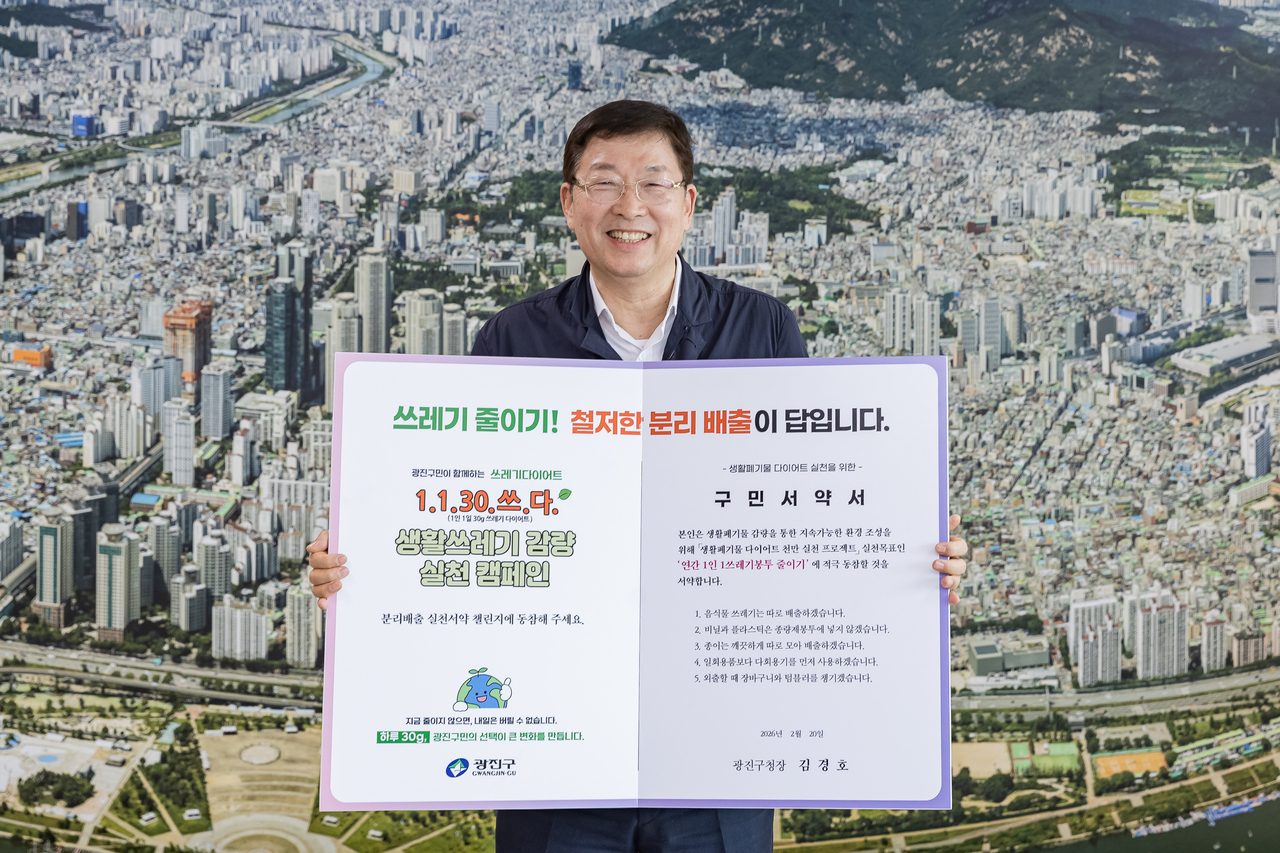
Gwangjin-gu has been named an "encouragement district" in the Seoul Metropolitan Government's 2026 municipal waste reduction and recycling performance evaluation, securing 80 million won ($55,200) in city incentive funding.
The evaluation — introduced this year for the first time as part of Seoul's response to the metropolitan area's ban on direct landfilling of household waste — assessed all 25 autonomous districts across four areas: household waste reduction results, participation in source-separated disposal, resident practice efforts, and district-specific projects.
Gwangjin-gu faces structural disadvantages in waste management, lacking both a waste-to-energy facility and a transfer station within its boundaries. In response, the district set a campaign pledge under the ninth elected administration to cut household waste 10 percent by 2030 compared with 2025 levels, and has consistently pursued policies that reduce waste at the point of generation rather than focusing on processing — an approach that earned strong marks in this evaluation.
This year, the district ran a waste reduction campaign tied to "Clean Day" events at neighborhood community centers, a resident-wide drive asking all 330,000 residents to cut their daily waste by 30 grams per person, and projects to promote reusable containers and reduce single-use items — all aimed at embedding waste reduction into everyday life.
In addition, the district provided newly arrived single-person households with guides on source-separated disposal and dedicated waste bags, operated recycling programs for waste vinyl, discarded fabric, coffee grounds and fallen leaves, and ran mobile source-separation education classes as part of its broader resource-circulation policy.
The 80 million won secured will go toward replacing aging sanitation equipment, strengthening the district's resource-circulation infrastructure and funding household waste reduction projects.
"Even without a waste-to-energy facility or transfer station, Gwangjin-gu was able to achieve meaningful results thanks to the active participation of our residents," District Mayor Kim Kyung-ho said. "This outcome is the product of small everyday actions adding up to something truly valuable." He added that the district would "consistently advance resource-circulation policies suited to local conditions — including waste reduction measures tailored to single-person households, expanded use of reusable containers, and more active recycling — to build Gwangjin into a sustainable resource-circulation city."
seouldream01@heraldcorp.com