![Logos of the four major card companies — Samsung Card, Shinhan Card, KB Kookmin Card and Hyundai Card. [Provided by each company]](https://wimg.heraldcorp.com/news/cms/2026/07/30/news-p.v1.20260730.8a73f46c509f4383b299542cb712ee7c_P1.png)
Yields on specialized credit finance bonds — the benchmark funding instrument for card companies — climbed to 4.551 percent on Friday, the highest level in roughly two years and eight months. While the higher funding costs have yet to be fully reflected in first-half earnings, analysts expect downward pressure on card companies' profitability to intensify as a wave of debt maturities arrives in the second half.
Second-half maturities loom, funding burden set to deepen — According to the Korea Financial Investment Association's bond information center, the yield on three-year specialized credit finance bonds (AA+, unsecured, average of five rating agencies) hit an annual high of 4.551 percent on Friday, up 1.214 percentage points from 3.337 percent on Jan. 2, the first trading day of the year.
By contrast, card companies' average funding costs in the first half remained well below market rates — 3.1 percent at Samsung Card, 3.42 percent at Shinhan Card and 3.6 percent at Hyundai Card. Long-term bonds issued during the earlier low-rate environment are still on the books, keeping the blended average artificially low. At Samsung Card, debt maturing within one year accounts for 30.5 percent — 7.1 trillion won — of total borrowings of 23.05 trillion won ($15.7 billion), while debt maturing within three years approaches 80 percent. Refinancing those bonds at current market rates would sharply increase interest costs.
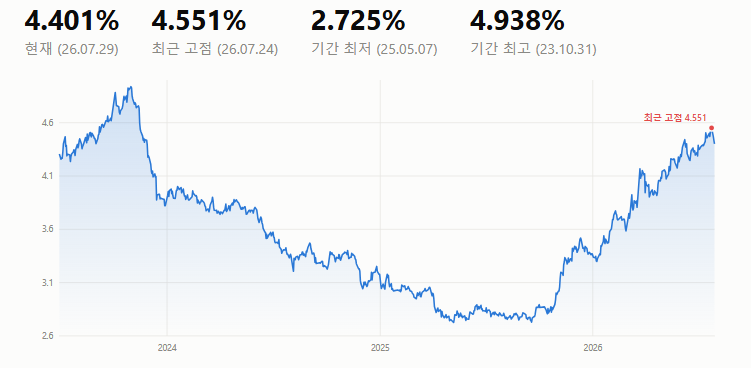
Yields could climb further if the Bank of Korea continues its monetary tightening cycle. The central bank's Monetary Policy Board raised the benchmark interest rate by 25 basis points to 2.75 percent on July 16, marking its first shift to a tightening stance in three and a half years. Markets are pricing in at least one additional hike before year-end. Adding to the pressure, the US Federal Reserve opted for a hawkish hold — keeping rates steady while signaling a bias toward further tightening — on Tuesday (local time), a move seen as reinforcing the Bank of Korea's case for continued rate increases.
Card companies are responding by shifting away from expensive long-term bonds toward commercial paper and short-term notes, effectively shortening their debt maturity profiles. Samsung Card's share of short-term notes and commercial paper within total borrowings nearly doubled, rising from 4.3 percent at the end of last year to 9.8 percent at the end of June. Shinhan Card expanded its commercial paper issuance by 14.2 percent over the same six-month period. Hyundai Card raised the share of general loans in its funding mix from 6.2 percent to 8.5 percent.
Short-term funding, however, only accelerates the pace at which debt comes due, and the gap between new funding costs — Samsung Card's second-quarter rate stood at 3.67 percent — and market rates is narrowing.
Volume up, margins squeezed — Profitability in the core credit-card payment business is also deteriorating. Combined transaction volume at the four major card companies reached 410.91 trillion won in the first half, up 6.6 percent from a year earlier, but card revenue grew only 3.8 percent to 6.71 trillion won, weighed down by cuts to merchant fee rates.
A pullback in higher-margin card loans — long-term revolving credit — also weighed on profit margins. Shinhan Card, Samsung Card and Hyundai Card trimmed their card loan books by 5.2 percent, 8.3 percent and 6.3 percent, respectively, which helped push delinquency rates down to a range of 0.7 to 1.2 percent, but core margins contracted in tandem. Meanwhile, a drop in bad-debt recovery rates in the second quarter prompted KB Kookmin Card and Hyundai Card to rebuild loan-loss provisions — up 30.4 percent and 23.6 percent, respectively, quarter on quarter.
The push by card companies into new business lines reflects the same underlying pressures. Shinhan Card is building capabilities in stablecoins and agentic payment systems, while Samsung Card has identified AI, stablecoins and platform businesses as the pillars of its future growth strategy. Hyundai Card, for its part, has made private equity fund investment a core business pillar.
won@heraldcorp.com