Elevator Safety Act flags single injury as 'serious accident'
Threshold far stricter than 10-person standard under labor, construction laws
Industry calls for shift from post-accident response to worker safety prevention
![An elevator installed at the 108-step stairway in Haebangchon, Yongsan-gu. [Herald Business DB]](https://wimg.heraldcorp.com/news/cms/2026/07/30/news-p.v1.20251010.768ad5e7fa414c8ebff2fb18f001dca0_P1.jpg)
The government classifies elevator accidents as "serious" under a far stricter standard than other industries, but the elevator industry says the rules are falling short of their intended goal of preventing accidents.
When an accident occurs, sweeping administrative investigations and disciplinary procedures follow — yet investment in prevention and improvements to safety management systems remain comparatively neglected, industry officials say. The industry agrees that the focus should shift toward prevention-centered policy, with excessive post-accident regulation scaled back.
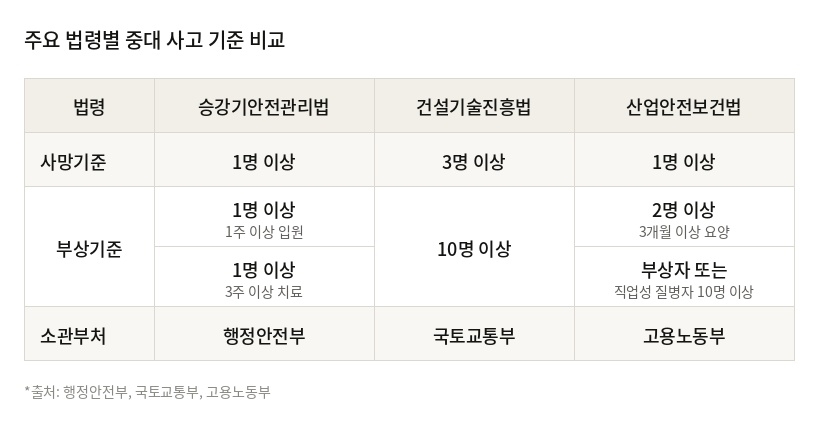
Under the current Elevator Safety Management Act, an accident is classified as "serious" if it results in at least one fatality, at least one injury requiring hospitalization for a week or more, or at least one injury requiring treatment for three weeks or more, according to industry sources Thursday.
Once an accident is deemed serious, the elevator manager must immediately report it to the Korea Elevator Safety Agency. The Ministry of Interior and Safety then launches an investigation and convenes a separate elevator accident investigation committee. Depending on the findings, administrative measures and criminal referrals may follow.
The problem, industry officials say, is that this standard is far broader than those applied in other sectors. Under the Construction Technology Promotion Act, an accident must result in at least three deaths or 10 or more injuries to qualify as a serious construction accident. The Occupational Safety and Health Act sets its threshold for a serious industrial accident at one or more fatalities, two or more injuries requiring at least three months of medical leave, or 10 or more injuries. In effect, how a worker's injury or death is treated depends heavily on which industry the accident occurred in.
Within the elevator industry, complaints are growing that strict regulations waste administrative resources even though elevator-related fatalities are far lower than in other sectors. "Annual elevator accident deaths remain in the single digits, while construction sites see around 200 fatalities a year — yet the elevator industry is held to a stricter serious-accident standard," one industry official said. "It goes against basic fairness that a worker's death is treated as more or less serious depending on the industry."
Particularly pointed is the criticism that investigation-heavy, post-accident regulation does little to prevent accidents. According to the Ministry of Interior and Safety, 27 people died in elevator accidents between 2019 and August 2023. Of those, 13 — or 48 percent — died while performing maintenance or repair work. Industry officials say this underscores the importance of preventing accidents through basic safety practices, such as requiring two-person teams during maintenance work, rather than focusing on responses after the fact.
Moon Hyeon-cheol, a professor in the public safety department at Honam University, said two-person work teams are essential for elevator safety management, but that labor shortages compounded by wage cuts driven by low-price competition are raising workplace risk. "Proactive safety measures must come first — training specialized elevator technicians and guaranteeing safe pricing," he said.
The government itself has acknowledged that the current standard may be excessive and has moved to revise the relevant regulations. The Ministry of Interior and Safety last year announced a proposed amendment to the enforcement decree of the Elevator Safety Management Act that would loosen the definition of a serious accident — raising the hospitalization threshold from one week to two weeks, and the treatment threshold from three weeks to six weeks. However, the legislative process has stalled since the proposal was announced.
"Even for minor accidents, investigators and expert committee members are dispatched for lengthy on-site probes, followed by disciplinary action and criminal referrals," one industry official said. "Holding people accountable after the fact matters, but what matters more is preventing accidents from happening in the first place."
The official added that encouraging genuine safety investment — supporting the replacement of aging elevators, improving maintenance quality and better compensating skilled technicians — is what will actually reduce the growing number of casualties.
eyre@heraldcorp.com