
![The exterior of Coupang Inc's Logistics Center 32 in Seo-hae District, Incheon, is blackened with soot on Tuesday as investigators conduct a joint forensic inspection into the fire. A massive blaze broke out at the facility at around 6:54 a.m. on July 18 and was extinguished on the afternoon of July 22, some 109 hours and 40 minutes later. [Yonhap]](https://wimg.heraldcorp.com/news/cms/2026/07/31/rcv.YNA.20260728.PYH2026072813180001300_P1.jpg)
The government is launching the country's first-ever pan-government fire safety inspection targeting more than 190,000 factories and warehouses nationwide, in a bid to curb recurring large-scale industrial blazes. The plan calls for mandatory use of non-combustible exterior materials at hazardous facilities and expanded subsidies, policy financing and tax support for fire-prevention equipment investment — measures aimed at bringing fire safety standards at manufacturing sites up to the level of advanced economies.
The government unveiled the measures, titled "Plan to Strengthen Factory Fire Safety," on Friday at Government Complex Seoul during an emergency economic headquarters meeting and economic ministers' meeting chaired by Deputy Prime Minister Koo Yun-cheol, who also serves as minister of economy and finance. Officials said the package was designed to reframe workplace safety not as a cost but as a source of manufacturing competitiveness, and to bolster supply chain stability and the broader industrial ecosystem.
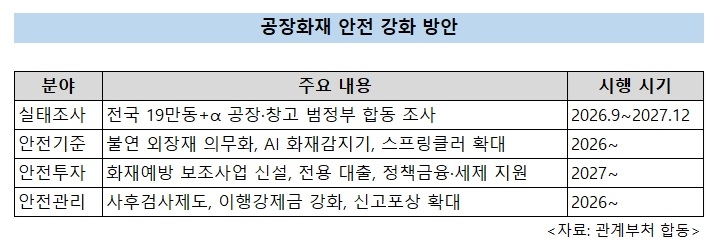
The government said inadequate safety standards and chronic underinvestment during the country's rapid industrialization have allowed large factory fires to recur. Citing an analysis by the Korea Occupational Safety and Health Research Institute showing that a 1-percentage-point rise in the industrial accident rate is associated with a 0.45 to 0.71 percentage-point drop in revenue growth, officials concluded that factory fires inflict damage well beyond individual companies, with negative ripple effects on supply chains, employment and the wider industrial ecosystem. To address this, the government will pursue four key tasks: a large-scale factory and warehouse safety inspection, an overhaul of fire safety standards, expanded safety investment incentives and strengthened safety management.
The inspection will cover 190,000 factories and warehouses with a total floor area of 500 square meters or more, as well as hazardous materials storage facilities and small workplaces at risk of industrial accidents. The survey will run from September next year through the end of 2027, divided into three risk-based tiers, with ultra-high-risk factories storing hazardous materials and accident-prone workplaces to be inspected first. Private-sector experts including architects and fire protection engineers, youth personnel, and local governments, fire departments and labor offices will participate in the joint inspections. Violations identified will be corrected immediately, and the findings will be compiled into a database for ongoing management.
Fire safety standards will also be significantly tightened. Hazardous materials storage and processing facilities will be required to use fully non-combustible exterior cladding, replacing the current standard of semi-non-combustible materials, and the government is reviewing whether to extend fire-resistant structural requirements to all industries. Intelligent fire detectors capable of distinguishing actual fires from false alarms will be made mandatory in place of conventional detectors, and sprinkler installation will be extended to all floors of factories with a total floor area of 5,000 square meters or more. The government is also reviewing mandatory management requirements for work involving metal dust and cutting oils, and will introduce a new specialized inspection industry for hazardous materials facilities.
Support to encourage corporate safety investment will also be expanded. The government will create new subsidy programs to help fire- and explosion-prone workplaces install AI fire detectors, electrical safety monitoring systems, smart evacuation guidance equipment and sprinklers, and will launch dedicated loan programs for small and midsize enterprises. Policy financing through Korea Development Bank, Industrial Bank of Korea and the Korea Credit Guarantee Fund will be expanded, and the government will pursue tax credits, accelerated depreciation and insurance premium discounts for safety equipment investment. Companies with strong safety records will receive bonus points in public procurement evaluations, while firms that suffer serious accidents will face penalties including deductions in eligibility assessments.
Safety management frameworks will also be strengthened. A post-approval inspection system will be introduced to verify compliance even after a facility receives its use permit, and local governments will be required to conduct safety surveys at least once a year. Repeated imposition of compliance fines will be made mandatory, and the scope of those subject to punishment will be expanded to include designers and contractors. The government will also run a focused factory-fire reporting campaign and increase whistleblower rewards, and will pursue a measure to pay internal public-interest whistleblowers up to 30 percent of any fines or surcharges collected as a result of their reports.
fact0514@heraldcorp.com





