Recommended monthly fee: 205,000 won — average contract price: half that
1,126 firms compete on price, not quality
Elevator casualties have risen over the past three years
Experts call for legally mandated minimum fees to drive safety investment
![A worker installs a flood barrier to prevent rainwater from entering an elevator shaft during the summer rainy season. [Hyundai Elevator]](https://wimg.heraldcorp.com/news/cms/2026/07/30/news-p.v1.20250716.5e59929e850746dd956f4f455f12bb8c_P1.jpg)
Alarm bells are ringing over elevator safety in South Korea, home to roughly 880,000 elevators — the seventh-largest installed base in the world. The proliferation of small maintenance firms has left upkeep and repairs inadequately performed, and a race to the bottom on contract prices has pushed market rates to less than half the government's recommended fee.
According to industry sources Thursday, the government publishes a standard maintenance fee each year under the Elevator Safety Management Act, intended both to ensure safe operation and to protect the financial interests of maintenance contractors. In practice, however, the average contract price in apartment complexes falls well short of even half that recommended figure — prompting calls for a legally mandated minimum fee to raise service quality and prevent accidents.
Average apartment contract price: 99,200 won — half the recommended rate for three consecutive years

A Herald Business comparison of the Korea Elevator Safety Agency's standard maintenance fee and the average apartment elevator contract price compiled by the Korea Elevator Association found that last year's government-recommended monthly fee stood at 205,000 won ($141), while the actual average contract price in apartment complexes was limited to 99,200 won per month — just 48.4 percent of the recommended rate.
The gap was equally stark in prior years. In 2024, the standard fee was 197,000 won, but the average contract price was only 88,920 won — 45.1 percent of the recommended rate. In 2023, the standard fee was 188,000 won against a market average of 86,654 won, or just 26.1 percent.
The standard maintenance fee is a recommended amount calculated annually by the Korea Elevator Safety Agency under the Elevator Safety Act. It covers all costs associated with monthly self-inspections that maintenance contractors must conduct at least once a month, as well as emergency call-outs for breakdowns, parts checks, emergency repairs, and the operation of safety management personnel.
The government's intent is to guarantee a minimum level of elevator safety by recommending the lowest cost at which adequate maintenance service can be provided. In practice, however, industry insiders say the low-price bidding war has pushed passenger safety to the back seat.
Low-ball contracts cut labor costs, raising fears of shoddy maintenance
![[123RF]](https://wimg.heraldcorp.com/news/cms/2026/07/30/news-p.v1.20260730.7fe9e0facf8548a5a35b5b1587c20450_P1.jpg)
Industry observers point to the proliferation of small maintenance firms as the root cause of the price collapse. As of the end of last year, South Korea had 885,928 elevators managed by 1,126 maintenance companies — an average of about 786 units per firm. With so many players competing for a finite market, critics say quality has become the inevitable casualty.
Each elevator has roughly 180 inspection items, according to industry sources. Technicians must check brakes, traction machines, door mechanisms, wire ropes, emergency communication devices, and an array of safety-critical sensors. Inspecting the 10 to 15 elevators typically installed in a 500-unit apartment complex normally takes two to three days.
Yet maintenance fees of less than 100,000 won a month make it difficult to deploy adequate staff, industry officials say. Although operating guidelines for elevator safety and management explicitly require inspections to be carried out by teams of two, there are no fines or penalties for non-compliance. As a result, technicians frequently split up to service elevators separately — a loophole exploited to cut labor costs.
Casualties on the rise — industry urges legally guaranteed minimum prices
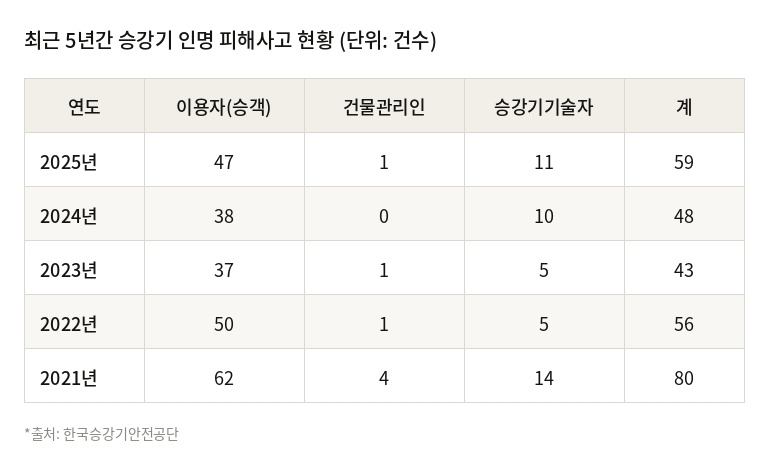
The consequences of cut-rate service are showing up in passenger safety statistics. According to the Korea Elevator Safety Agency, elevator casualties have trended upward over the past three years. Injuries and fatalities from elevator accidents fell from 56 cases in 2022 to 43 in 2023, then reversed course. Last year, the total reached 59 cases, with 47 involving harm to passengers — the largest category.
Breakdown reports have also remained stubbornly high, hovering around 23,000 a year. Filings covering passenger elevators, freight elevators, escalators, and wheelchair lifts totaled 23,358 in 2021 and 23,315 in 2025 — virtually unchanged over five years.
Against this backdrop, calls are growing for a legally mandated minimum price to lift maintenance service quality. Rather than issuing a non-binding recommended fee, the argument goes, the government should enshrine a minimum price in law to push companies to compete on quality rather than cost.
Moon Hyeon-cheol, a professor in the public safety department at Honam University, said elevators are "a quintessential everyday mode of transport that people use multiple times a day," adding that if the race to the lowest price continues, "it will very likely lead to labor cost cuts and shoddy management."
Moon called on the government to go beyond issuing recommendations and "put in place a mechanism that can guarantee a minimum safety price," and urged reforms to the contractor selection system so that companies are evaluated not only on price but also on the size and experience of their technical workforce and their maintenance track record.
eyre@heraldcorp.com