About seven in 10 stocks listed on the Kospi and Kosdaq fell last month, data showed.
Korea Exchange and Yonhap data show that 1,859 stocks on the two markets posted negative returns as of July 31 compared with June 30 — equal to 70 percent of the combined 2,645 listed issues.
Breaking down by market, 566 Kospi-listed stocks declined, accounting for 62 percent of the bourse's 917 total issues. On the Kosdaq, 1,293 stocks fell — 75 percent of the market's 1,728 listed companies.
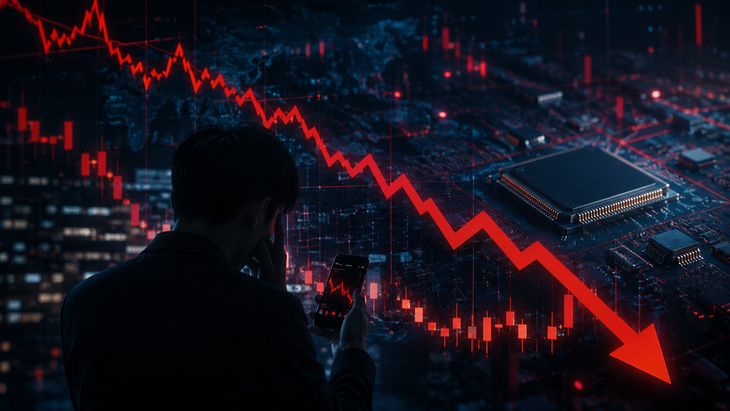
Market watchers attributed the broad selloff to concerns about a peak in the semiconductor industry cycle and rising tensions in the Middle East. The Kospi's 101 percent surge in the first half of this year had also left room for profit-taking, which analysts said weighed on prices.
The Kospi tumbled 22.2 percent last month while the Kosdaq fell 21.4 percent — the steepest monthly declines for both benchmarks since October 2008, when the global financial crisis roiled equity markets.
The biggest loser last month was Kolon TissueGene, whose share price plunged 86 percent. The stock closed at 93,600 won ($65) at the end of June and collapsed to 13,000 won by the end of July.
The selloff came after the company disclosed that a clinical trial for a cell-gene therapy targeting osteoarthritis had failed to produce statistically significant results, triggering a wave of disappointed selling.
The Technology ranked second with a decline of 76 percent, followed by Kolon Life Science and ContentreeJoongAng, both down 67 percent, StradVision at minus 65 percent and Justek at minus 64 percent.
On the other side of the ledger, G&E Healthcare was the top gainer, surging 222 percent over the same period. ICH rose 87 percent, Vect 86 percent, Enex 85 percent and JOYWORKS&Co 75 percent.
Meanwhile, securities analysts say that if market volatility eases next week, a rebound could take hold, led by beaten-down semiconductor and other earnings-driven stocks.
"The Kospi's 12-month forward price-to-earnings ratio has dropped to 4.85 times, entering a historically undervalued range," said Kang Jin-hyeok, an analyst at Shinhan Investment. "After the capitulation selling, bargain hunters are stepping in and the supply-demand picture appears to be bottoming out. In a deep-value recovery phase, investors should look beyond semiconductors to sectors with solid earnings backing — cosmetics, transportation and financials among them."
likehyo85@heraldcorp.com