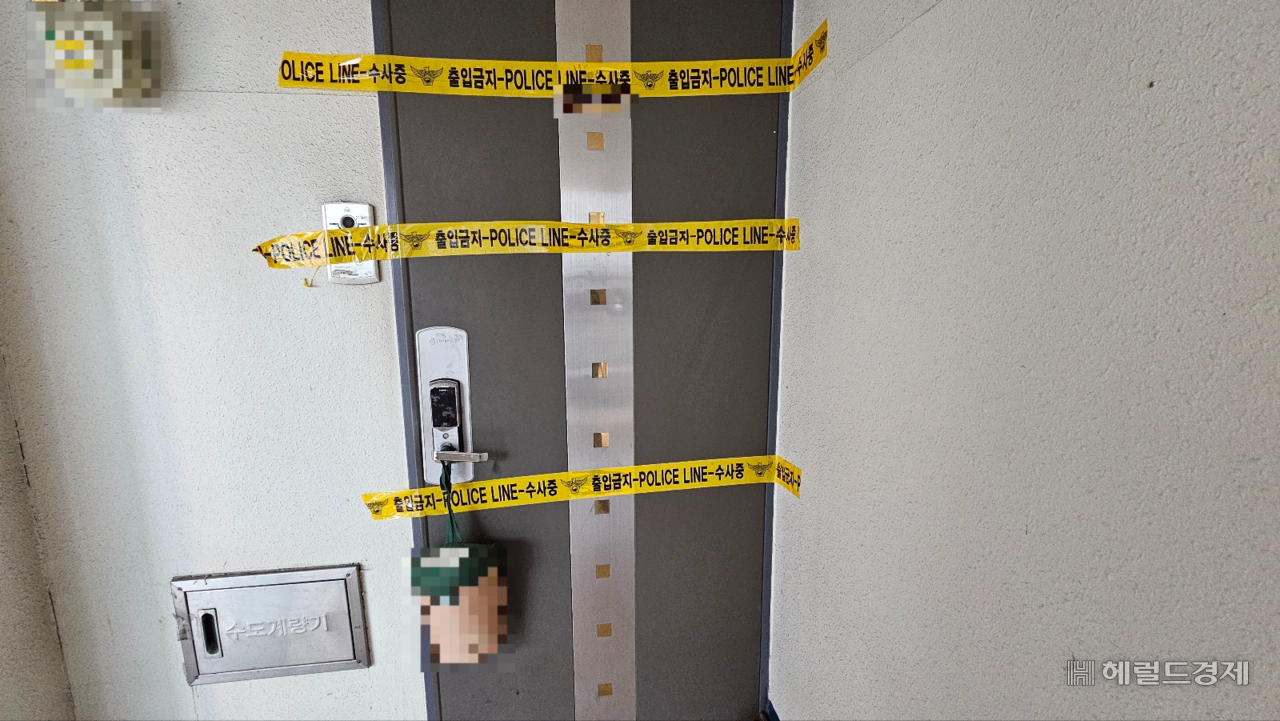
On Monday, police monitoring a drug-use tip reviewed CCTV footage and spotted a man with blood on his trousers. Tracing his movements, they arrested a man in his 50s in the underground parking garage of an officetel in Suyu-dong, Gangbuk-gu, Seoul. When officers accompanied the suspect upstairs to his unit, they found a woman in her 50s dead inside.
The suspect, identified by his surname Na, has a criminal record that extends well beyond the murder charge — prior offenses include drug use, possession of child and youth sexual exploitation material, and destruction of an electronic monitoring anklet. Experts say the case is a textbook example of "multiple-crime escalation," in which varied offenses accumulate until they culminate in the gravest crime of all.
Anklet destruction, drugs, and murder
The case began not with a murder report but with a drug tip. Officers at the Seongnam Sujeong Police Station were verifying intelligence about Na's alleged drug use on Monday when they obtained CCTV footage from the officetel. The footage showed Na in the early morning hours stepping into an elevator with blood on his trousers, carrying a bag and a towel-wrapped object along with what appeared to be a bladed weapon.
"The moment I saw the footage, I judged that something had likely happened," an investigator from the Seongnam Sujeong Police Station said. "We kept retracing the suspect's movements until we were able to arrest him in the underground parking garage."
Following that CCTV trail, police arrested Na at 1:42 a.m. Tuesday in the underground parking garage of the officetel in Suyu-dong, Gangbuk-gu. Officers then went upstairs with the suspect and confirmed the victim was dead. The case was subsequently transferred to the Seoul Gangbuk Police Station.
Narcotics were found at the scene immediately after the arrest, and a field drug test on Na came back positive for methamphetamine and cannabis. Police have requested a detailed forensic analysis from the National Forensic Service.
Police expanded the investigation and on Friday searched Na's residence in Paju, Gyeonggi Province, looking to secure additional physical evidence related to the crime and further leads on drug offenses.
Na was punished in 2016 for destroying an electronic monitoring anklet. In 2021, he was sentenced to 10 months in prison, suspended for two years, after being convicted of purchasing and possessing 253 videos of child and youth sexual exploitation.
In the current case, Na has acknowledged the murder charge and drug use but has refused to provide details about the specific time and location of the crime. Police are analyzing data from his mobile phone and search results to determine his relationship with the victim and his motive.
'Accumulated crimes led to killing'
Experts analyzed the background of the crime from multiple angles based on the suspect's criminal history. Kim Sang-gyun, a professor at Baekseok University's Department of Police Studies, said offenders who commit multiple types of crimes — rather than repeating a single offense — are not uncommon. "This case can be seen as one in which a variety of prior crimes accumulated and ultimately led to murder, the final stage of criminal escalation," he said.
Kim added that a growing criminal record tends to deepen social isolation and make reintegration increasingly difficult, raising the likelihood that an offender gives up on himself. "In a state where grievances toward society and women, along with personal anger and frustration, had built up, drugs may have served as the trigger for the crime," he said.
Experts also said that both sex crimes and drug offenses can involve problems with impulse control and judgment. Jo Young-il, a professor at Dongguk University's Department of Police Administration, said the suspect appeared to have had difficulty controlling sexual impulses. "Drugs can affect brain function and impair judgment and cognitive processing, and impulse-control problems can appear in both sex offenders and drug offenders alike," Jo said.
Lee Su-jeong, a professor of criminal psychology at Kyonggi University, said the pattern of the crime raises the possibility of psychopathic tendencies. "When a lack of guilt and difficulty controlling impulses are compounded by drug use, the risk of violent crime can increase significantly," she said. Lee also said that if the suspect had a sex-crime record serious enough to warrant an electronic anklet, it was worth examining whether probation and other supervision had been properly carried out.
Yeom Geon-ung, a professor at U1 University's Department of Police Studies, said the ultimate goal of the criminal justice system is to prevent reoffending, and the fact that the case ended in murder suggests something was missed in the correction and supervision process. "If ongoing management of individuals with sex-crime records had been more thorough, there would have been room to reduce the risk of reoffending," he said. He added that drugs can heighten hallucinations and aggression, becoming a factor that increases both the likelihood and the brutality of violent crimes such as murder.
jookapooka@heraldcorp.com