![Customers line up before store opening at E-mart's Yongsan branch during a discount event on July 2. [E-mart]](https://wimg.heraldcorp.com/news/cms/2026/08/03/news-p.v1.20260803.60ea5a9e00fa42739929a8b376739323_P1.jpg)
Prices for leafy vegetables have surged amid the monsoon season and a prolonged heat wave, squeezing household grocery budgets. Discount events at major hypermarkets are drawing crowds in response — in some cases triggering opening-rush lines before stores even open.
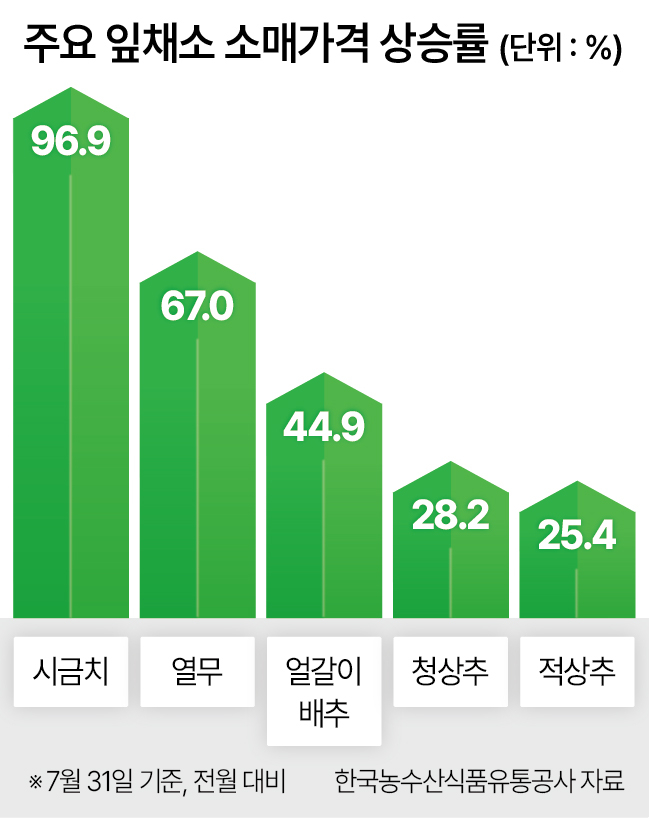
According to the Korea Agricultural Marketing Information Service (KAMIS), the average retail price of 100 grams of spinach stood at 1,701 won ($1.23) as of July 31, up 96.9% from the previous month's average of 864 won. The average retail price of 1 kilogram of yeolmu radish rose 67.0% over the same period to 3,880 won. Other major leafy vegetables also posted sharp gains — young cabbage climbed 44.9%, red lettuce 25.4% and green lettuce 28.2%.
Leafy vegetables are particularly vulnerable to heat waves and heavy rain because of their large leaf surface area and high moisture content. Concentrated downpours from mid-July disrupted harvesting and shipping, cutting into supply. Damage worsened as extreme heat followed the monsoon rains.
As grocery costs mount, consumers are gravitating toward channels offering the steepest discounts, a trend that has translated into a clear sales boost for hypermarkets running promotional events. E-mart said sales during its "Goraeit Festa" event, held July 2 to 5, jumped 73.8% compared with the preceding week, while the number of visitors rose 60%.
At E-mart's Eunpyeong and Yongsan branches, between 100 and 200 customers queued outside before opening time. Lotte Mart's monthly discount event "Tongkeun Day" also posted sales growth of about 11% in the first half of this year compared with the same period last year.
Meanwhile, the Ministry of Statistics said last month that the consumer price index stood at 119.99 in June, up 3.2% from a year earlier — the highest reading in two and a half years since December 2023. After holding around 2.0% early this year, the annual inflation rate climbed steadily following the outbreak of war in the Middle East: 2.2% in March, 2.6% in April, 3.1% in May and 3.2% in June. Agricultural, livestock and fishery prices rose 3.2%, pushing up the overall index by 0.24 percentage points.
"Crop yields are suffering from the monsoon and heat wave, and overall food ingredient prices are rising due to high fuel costs and the weak won," said Lee Eun-hee, an emeritus professor of consumer science at Inha University. "The government needs to move quickly to stabilize grocery prices — by releasing stockpiles or pursuing imports more aggressively."

korean@heraldcorp.com