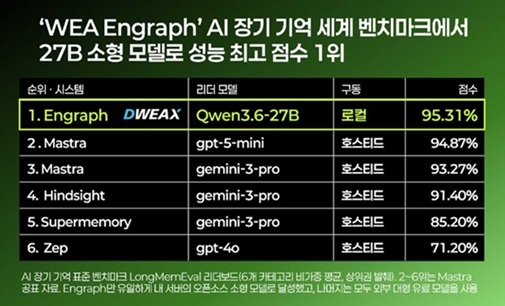
WEA Engraph, an AI long-term memory solution, ranked first in a global benchmark comparison of long-term memory performance among small-scale AI models.
Developed by AI agent company Diwix (CEO Ahn Jun-hyeong), Engraph accumulates context, knowledge, actions, reasoning, outcomes and feedback generated during work as structured memory and supplies it to AI agents. The solution is designed not merely to store conversational records but to reflect an organization's operational standards and knowledge framework.
Diwix announced Monday that Engraph achieved an unweighted average score of 95.31% on LongMemEval, a global benchmark for long-term memory performance.
Engraph answered 475 of 500 questions correctly, for an overall accuracy rate of 95.0%. Its average across six equally weighted evaluation categories came to 95.31%, surpassing the previous public high of 94.87%.
The evaluation used a 27B-class open-weight model running on a local server, without relying on external large-scale paid AI models or APIs. Unlike leading systems that use externally hosted general-purpose models, Engraph matched or exceeded their results with a single local model — demonstrating that long-term memory performance depends not only on the scale of the underlying model but also on how memory is structured, retrieved and managed.
Long-term memory is distinct from standard multi-turn functionality, which maintains context within a single ongoing conversation. While multi-turn capability preserves the flow of an active exchange, long-term memory retains information scattered across multiple sessions and points in time — connecting updated facts, timestamps, frequencies and relationships so they can be drawn on when needed.
LongMemEval assesses and scores precisely these capabilities. The benchmark evaluates a range of tasks, from recalling user and AI utterances within a single session to linking facts across multiple sessions, incorporating information updates, performing temporal reasoning and retaining user preferences.
Ahn Cheol-hee, head of the Diwix research lab, said the results show that strong AI memory performance does not require dependence on external paid models. "We have achieved performance that can compete with top global systems even in a local environment where data is never transmitted externally," he said.
He added that the company aims to build controllable, auditable enterprise AI memory that goes beyond simply storing information and retrieving answers. "We want to make it possible to verify what the AI remembered, on what basis it made a judgment, and who modified information and when," he said.
freiheit@heraldcorp.com