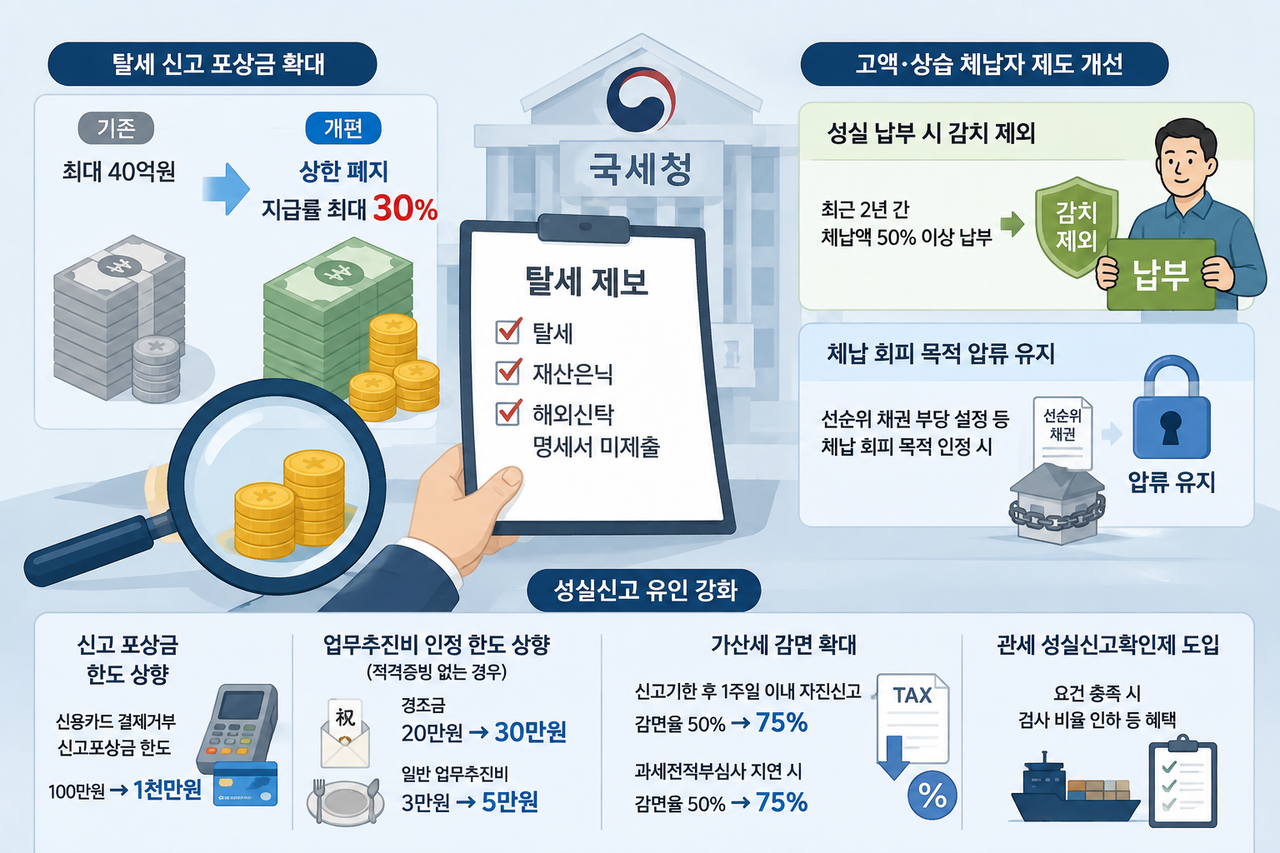
The government plans to remove the cap on reward payments to informants who report large-scale tax evasion and raise the payout rate.
It will also pursue exemptions from detention for habitual high-value tax delinquents who demonstrate a genuine intent to pay by settling at least half of their outstanding arrears.
The Ministry of Economy and Finance announced Monday that its 2026 tax reform package includes measures to expand rewards for tax-evasion tips, strengthen the collection of overdue taxes and create stronger incentives for voluntary compliance.
The most significant change overhauls the reward system for reporting tax evasion and asset concealment. Under current rules, informants can receive no more than 4 billion won ($2.79 million) regardless of how large the evasion is. That ceiling will be abolished. The maximum payout rate will also rise from 20 percent to 30 percent.
For example, reporting 100 billion won in tax evasion currently yields a maximum reward of 4 billion won. Under the revised system, the same tip could earn up to 10.25 billion won.
The eligibility threshold for rewards will also be lowered. Currently, informants receive nothing if the additional tax assessed falls below 50 million won — or 20 million won for customs duties. Under the new rules, the floor drops to 30 million won for national taxes and 10 million won for customs. As a result, a tipster who provides decisive evidence of 30 million won in evasion — previously ineligible — could receive up to 9 million won.
To crack down on asset concealment through overseas trusts, the government will also pay informants 10 to 15 percent of any fine or penalty imposed for failing to file overseas trust disclosure statements. The ceiling on fines for late or false filing of such statements will rise from 100 million won to 1 billion won.
The annual cap on rewards for reporting refusals to accept credit card payments will rise from 1 million won to 10 million won.
Rules governing habitual high-value delinquents will also be tightened. Under current law, a seizure can be lifted if the estimated value of the seized asset falls below the cost of forced collection. Going forward, if authorities determine that a priority lien was established or maintained to avoid paying national taxes, the National Tax Delinquency Settlement Committee can vote to keep the seizure in place.
For instance, if a delinquent owes 3 billion won in back taxes, holds seized assets worth 3.5 billion won and has a senior lien of 5 billion won, the seizure would currently qualify for release. Under the new rules, if evasion intent is established, the seizure can be maintained.
At the same time, the government is strengthening incentives for voluntary payment. Habitual high-value delinquents who have paid at least 50 percent of their arrears over the past two years will be exempt from detention requests. Under current law, a delinquent who has failed to pay three or more times, has been delinquent for at least a year and owes 100 million won or more can be held in a prison or detention facility for up to 30 days. The reform carves out an exception for those who show a sufficient willingness to pay.
The government will also update the rules on corporate entertainment expenses to reflect rising prices. The per-transaction limit for expenses recognized without qualifying documentation — such as tax invoices or credit card receipts — will be raised. The ceiling for congratulatory and condolence payments will increase from 200,000 won to 300,000 won, while the limit for general business entertainment expenses will rise from 30,000 won to 50,000 won.
Penalty tax reductions for voluntary compliance will be expanded as well. Taxpayers who file voluntarily within one week after the statutory deadline will see their non-filing surcharge reduction rate rise from 50 percent to 75 percent. The same 75 percent reduction will apply to taxpayers who challenged a pre-assessment notice through a pre-taxation review but missed the payment deadline because a decision was delayed.
In addition, a verified-compliance program will be introduced for customs. Importers with annual import volumes below $30 million in the prior year can apply, and those who meet the requirements will receive administrative benefits including a lower rate of import cargo inspections.
Finally, to reduce confusion among taxpayers, two fields on tax invoices will be renamed: "date of preparation" will become "date of supply," and "date of supply" will become "date of issuance."
fact0514@heraldcorp.com