IP chief briefs president on second-half priorities: securing overseas patents for top technologies, nurturing IP monetization firms, applying AI across all IP administration
Intellectual property is emerging as a core driver of national economic growth, heralding what officials are calling a new era of "IP resource utilization."
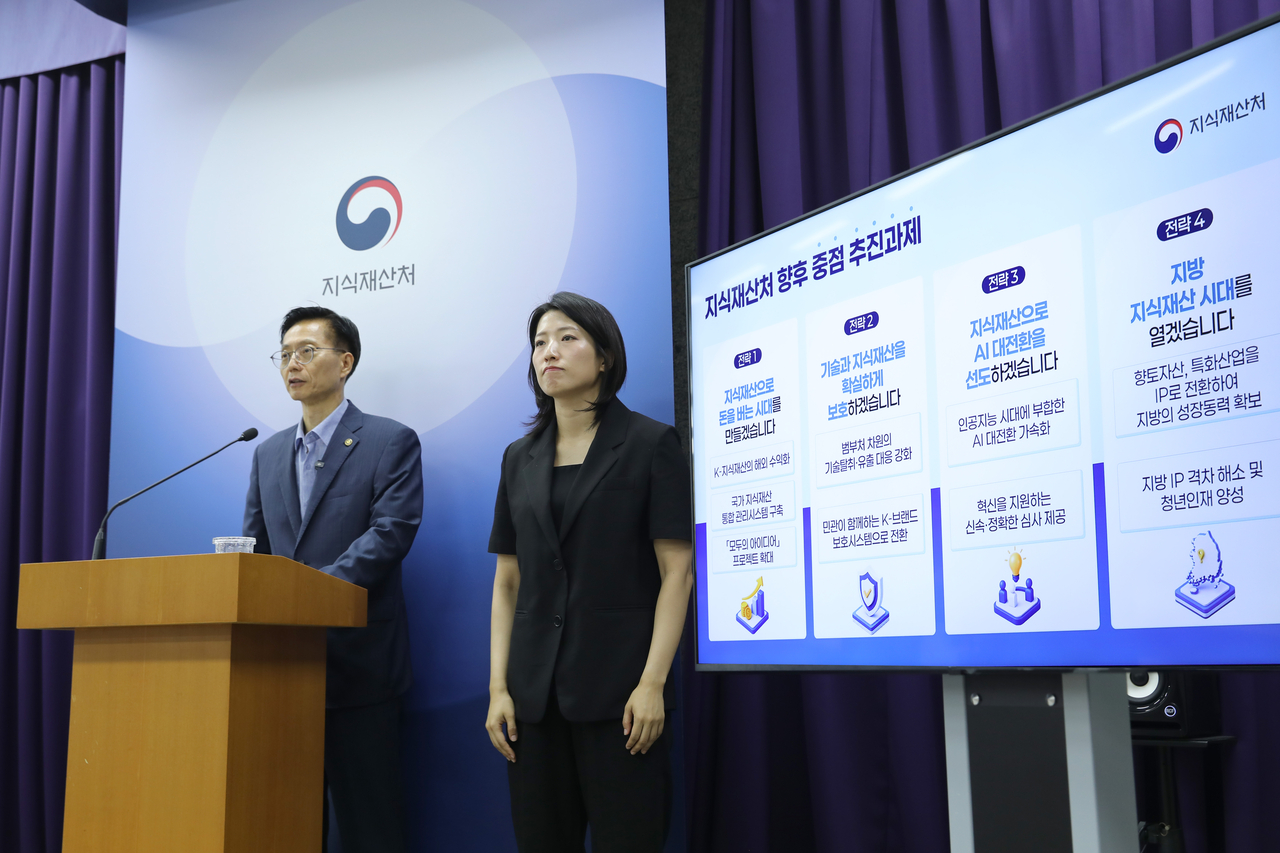
Kim Yong-seon, commissioner of the Korean Intellectual Property Office, presented the agency's second-half priorities to the president at Cheong Wa Dae's Yeongbingwan on Tuesday under the theme "Changing the game of economic growth through intellectual property." The priorities cover four areas: building an era of earning through IP, strengthening technology and IP protection, transforming IP administration with AI, and leading a regional IP era.
Building an era of earning through IP
To generate revenue from Korean patents in global markets, the agency will select 50 outstanding technologies in the second half of this year to secure overseas patents and designate 20 IP monetization pioneer companies for support. An IP monetization and trading fund — the seed capital for IP commercialization — will be established at 140 billion won ($97.9 million) this year, while the overall IP finance pool will be expanded to 13.3 trillion won.
The agency also plans to provide administrative backing for the establishment of private IP exchanges modeled on US firms such as Ocean Tomo and IPwe, so that ideas and intellectual property can be traded at fair market value.
A national integrated IP management system will also be built. The agency will launch a unified search service covering patents, trademarks and copyrights in the second half of this year, and from next year will construct a "National IP Database" consolidating IP information scattered across ministries, local governments and public institutions, along with ideas submitted by the public. The "Everyone's Ideas" project, launched this year, is set to select 60 outstanding ideas in October, with follow-up support for startups, commercialization and policy adoption.
Strengthening technology and IP protection
To combat technology theft and leakage, the agency will stand up a dedicated technology investigation unit — expanding from one division of 27 officers to four divisions of 61 — and broaden its investigative scope to cover the full range of technology crimes, including theft from large and small and medium-sized enterprises and overseas leakage of advanced technologies. The unit will also build a proactive early-warning system to detect leakage risks and strengthen technical advisory support to other investigative and intelligence agencies, positioning itself as a frontline force for economic security.
A "K-Brand Government Certification" regime will take effect in October to stamp out counterfeit goods overseas. The government will register national certification trademarks in 70 major export countries to authenticate genuine K-brand products and will work in lockstep with companies to mount a strong response against overseas counterfeits, enhancing the value and credibility of K-brands.
AI transformation of IP administration
To introduce AI across all areas of IP administration, the agency will begin developing a next-generation administrative system and will pursue amendments to the Unfair Competition Prevention Act in the second half of the year to address new forms of unfair competition such as digital replicas.
The agency will also bolster examination capacity by expanding examiner staffing and fully deploying AI, targeting a reduction in examination wait times to 14 months for patents and 11.2 months for trademarks by year-end. Fast-track examination — delivering results within one month — will be extended to nationally important areas such as youth startups and the three major mega-projects.
Leading a regional IP era
To make local heritage assets an engine of regional economic vitality, the agency will pilot-select 10 local heritage assets this year and support trademark registration and product design development, then scale up to cultivate representative brands across all regions from next year.
To encourage youth entrepreneurship through IP rooted in regionally specialized industries, the agency will designate priority support sectors by region in the second half of this year and provide comprehensive support for IP-based commercialization strategies and product development.
To close the IP infrastructure gap concentrated in the Greater Seoul area, the agency will establish three new comprehensive IP support centers this year — covering the southeastern and Honam regions, among others — to provide integrated services for IP creation, utilization and protection. The agency will also expand next-generation gifted entrepreneur education programs in the regions to cultivate talent combining IP expertise with an entrepreneurial mindset.
"South Korea is the world's fourth-largest patent-filing nation, but our capacity to generate revenue from those patents remains insufficient," Kim said. "Going forward, we will focus our policy efforts on building an innovation ecosystem where the full value of intellectual property is realized in the market, so that IP becomes a solid growth asset for citizens and businesses alike and a core driver of South Korea's economic leap forward."
kwonhl@heraldcorp.com