The government plans to train 110,000 workers for three major mega-projects and accelerate its push to convert manufacturing operations to AI, a drive known as M.AX.
The government will select "growth engine" projects for regional development this month and pursue legislation this year for both a mega special zone act and a renewable energy self-sufficient cities act. It will also strengthen industrial resource security by establishing a new industrial resource security fund.
The Ministry of Trade, Industry and Energy unveiled these plans Tuesday under the theme "Ultra-Growth + New Space: An Irreplaceable Industrial Powerhouse" at a second-half work report session held at Cheong Wa Dae's banquet hall and presided over by President Lee Jae-myung.
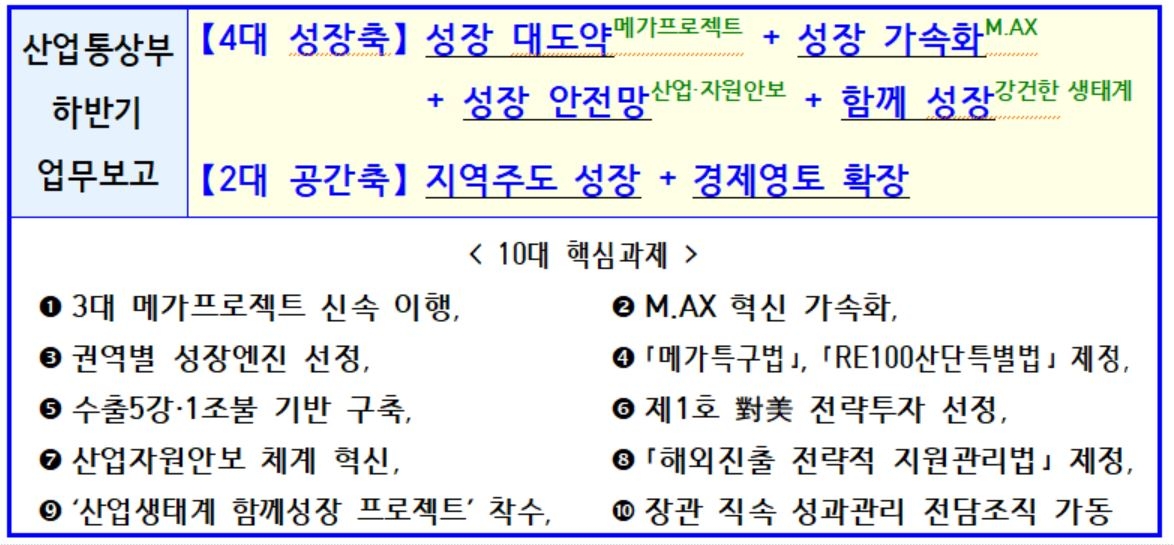
The report lays out 10 core tasks organized around four growth pillars — mega-projects, M.AX, industrial and resource security, and shared growth — and two spatial pillars: region-led growth and economic territory expansion.
The ministry said it will mount an all-out effort to implement the mega-projects swiftly, with monthly progress review meetings chaired by the president.
For the Honam region semiconductor cluster, the ministry plans to complete the selection of a project operator and designate candidate industrial complex sites this year, while securing power and water supplies and advancing permitting procedures.
For the Yongin semiconductor cluster, completion timelines for the general and national industrial complexes have been moved up by 12 and 8 years respectively. The government aims to finish land compensation procedures this year to begin fab operations at the national industrial complex by 2029.
The government intends to drive ecosystem innovation and maximize economic impact through the localization of materials, parts and equipment related to the three mega-projects, and by training 110,000 workers in semiconductors and robotics.
Under the M.AX initiative, the ministry aims to convert a cumulative total of 220 manufacturing processes to AI factories by year-end — with 50 conversions planned for the second half — and to expand AI deployment on factory floors through the digitization of tacit manufacturing knowledge and humanoid robot pilot programs.
Seven key industrial complexes across different regions will be developed into M.AX clusters by 2030.
The ministry also outlined plans to expand the country's economic territory at home and abroad. It will select three to four "growth engine" projects per region this month and announce them alongside a seven-part support package covering fiscal measures, tax incentives, infrastructure and other areas.
The government will establish a legal basis for broad support of local investment and mega-projects. Legislation for mega special zones is to be enacted this year, giving companies access to more than 300 regulatory exemptions and special subsidies.
A renewable energy self-sufficient cities act — aimed at creating industrial complexes that run entirely on renewable energy under the RE100 standard — is also targeted for enactment this year.
The ministry is laying the groundwork to reach annual exports of $1 trillion and join the world's top five export nations. For strategic items including defense and nuclear power, it plans to provide 18 trillion won ($12.6 billion) in trade finance this year and 127 trillion won through 2030.
On investment projects targeting the United States, the government is coordinating with Washington on initiatives including a gas combined-cycle power plant construction project. It plans to designate a first project this year and announce additional cooperation projects in areas of mutual interest on a rolling basis.
The ministry is also reviewing a renewed push to join the Comprehensive and Progressive Agreement for Trans-Pacific Partnership to diversify markets and strengthen supply chain foundations.
A new industrial resource security fund will be established to build a long-term resource security base. Plans include upgrading production facilities to handle a wider range of crude oil grades — from heavy to light — as well as expanding crude oil and gas storage capacity and increasing strategic mineral stockpiles.
The government will also tighten economic sanctions to make damages claims more effective, as part of efforts to prevent the leakage of nationally critical technologies.
Alongside this, the ministry will enact legislation this year to support overseas expansion in strategically important areas such as supply chain development and the securing of critical resources.
To foster shared growth between anchor companies and their suppliers, the government and anchor companies will jointly invest 5 trillion won over five years through an "industrial ecosystem co-growth project." A 10 trillion won public-private industrial growth fund will also be established.
The ministry said it will launch a policy performance innovation task force directly under the minister to generate early results on core tasks and deliver what it called "real outcomes."
The ministry plans to strengthen regular communication with regional governments, businesses and labor groups through a region-led growth consultative body, an industrial investment strategy council, and issue-specific labor union consultative meetings.
oskymoon@heraldcorp.com