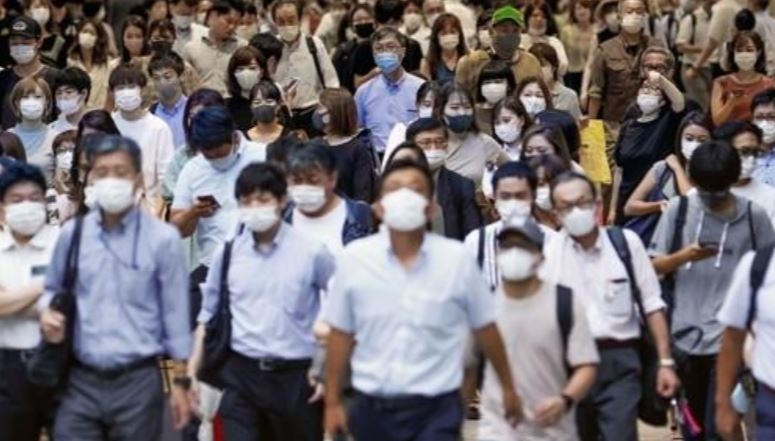
"Everything we thought we knew is being upended."
Dismissing South Korea's recent heat as simply "summer being summer" is no longer tenable. Amid a string of abnormal temperature spikes, the country recorded its highest temperature in 122 years of modern meteorological observation — 42.5 degrees Celsius.
What makes the heat even more striking is that the record did not just break South Korea's own all-time high. It surpassed Japan's all-time recorded temperature as well.
In roughly a century of comparable observation records, this is the first time South Korea's all-time high has exceeded Japan's. A long-standing gap in summer heat between the two countries has, in effect, been reversed.

South Korea's record even surpassed the all-time highs of some Southeast Asian nations, including the Philippines — a tropical-climate country — as well as Malaysia and Indonesia.
No single cause can be pinpointed. What is clear, however, is that the pace of climate change in South Korea is accelerating faster than in most other countries.
The country is approaching new extremes not only beyond its own historical norms, but faster than its neighbors.

Korea 42.5°C vs. Japan 41.8°C: a new national record gap
According to the Korea Meteorological Administration, the daytime high in Yangsan, South Gyeongsang Province, reached 42.5 degrees Celsius on Sunday. It was the first time temperatures had entered the 42-degree range since modern meteorological observation began in Korea in 1904 — a span of 122 years. The previous record was 41 degrees Celsius, set in Hongcheon, Gangwon Province, in August 2018.
The record was not anomalous only on the Korean Peninsula. According to Japan's Meteorological Agency, the highest temperature ever recorded in Japan was 41.8 degrees Celsius, measured in Isesaki, Gunma Prefecture, on Aug. 5, 2025. As of Sunday, South Korea's all-time high exceeds Japan's by about 0.7 degrees Celsius.

For a long time, it was almost conventional wisdom that Japanese summers were hotter than Korean ones. Japan's sweltering heat drew labels like "heat-wave archipelago" and "killer heat" every summer, owing to its hot and humid climate. The data backed this up. Over the past century or so, temperatures in both countries rose steadily under the influence of climate change — but South Korea's all-time high never once overtook Japan's.
Combined official data from the meteorological agencies of both countries shows that Japan crossed the 40-degree threshold first, recording 40.2 degrees Celsius in Uwajima, Ehime Prefecture, on July 22, 1927. South Korea did not reach 40 degrees until 1942, in Daegu — 15 years later.

Japan then widened the gap, recording 40.8 degrees Celsius in Yamagata in 1933. In 2013, it became the first to cross the 41-degree mark, with a reading of 41 degrees in Ekawasaki, Kochi Prefecture. South Korea also hit 41 degrees in Hongcheon, Gangwon Province, in 2018 — but Japan recorded 41.1 degrees in Kumagaya that same year.
Last year, Japan's record climbed to 41.8 degrees Celsius in Isesaki, Gunma Prefecture, pushing the gap between the two countries back to 0.8 degrees. Then this year, the 42.5-degree reading in Yangsan, South Gyeongsang Province, overturned a trend that had held for roughly a century — in a single stroke.
The record-breaking heat in the inland areas of South Gyeongsang Province was driven in large part by a dual high-pressure system — the North Pacific High and the Tibetan High — simultaneously blanketing the Korean Peninsula and trapping heat. Intense solar radiation and topographical factors compounded the effect, creating near-ideal conditions for temperatures to soar.
Climate change accelerating — and Korea is leading the way
The record cannot be dismissed as a one-off weather event. South Korea's trend of extreme temperature increases has begun to outpace Japan's, and long-term observation data shows that South Korea's rate of warming is higher than Japan's.
According to the Korea Meteorological Administration's "113-Year Climate Change Analysis Report for Korea," published last year, the country's annual mean temperature rose from 12 degrees Celsius in the 1910s to 13.9 degrees in the 2010s and 14.8 degrees in the 2020s — an increase of 0.21 degrees Celsius per decade from 1912 to 2024.
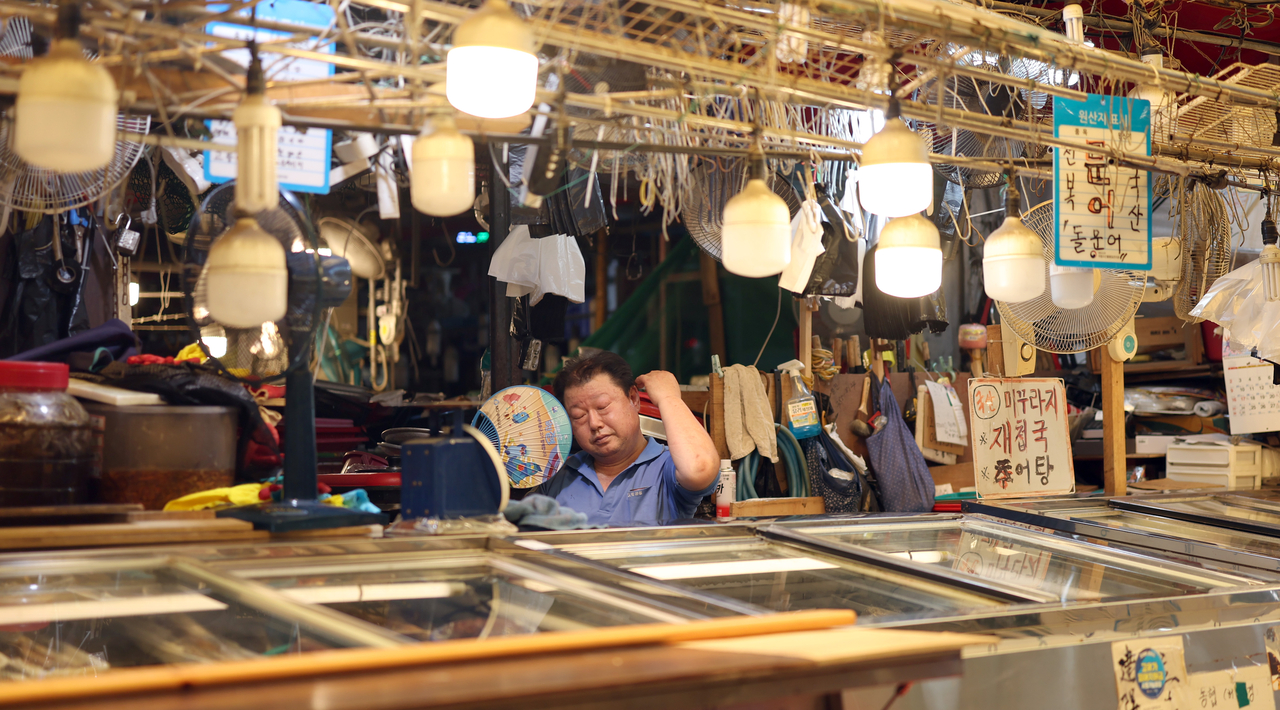
![Gyeongdong Market in Dongdaemun-gu, Seoul, is quiet on Tuesday afternoon amid the heat wave. [Photo by Lim Se-jun]](https://wimg.heraldcorp.com/news/cms/2026/08/04/news-p.v1.20260804.8da90559958740ab86553b506a205f11_P1.jpg)
Japan, by contrast, saw its annual mean temperature rise by 1.4 degrees Celsius per decade from 1898 to 2024, according to Japan's Ministry of Education, Culture, Sports, Science and Technology and its meteorological agency. A simple comparison of the figures suggests South Korea's rate of warming was about 1.5 times faster.
The gap persists even when a standardized data-processing methodology is applied. National temperature data published by Berkeley Earth, a US climate research organization, shows that since 1960, South Korea's rate of temperature increase has been 2.00 ± 0.2 degrees Celsius per century, compared with 1.66 ± 0.23 degrees for Japan — making South Korea's warming rate roughly 20 percent faster.
The pace is also picking up. The "Korea Climate Crisis Assessment Report 2025," jointly released by the Korea Meteorological Administration and the Ministry of Environment in September 2025, said South Korea's rate of temperature increase was 0.18 degrees Celsius per decade for the period 1912–2017, but rose to 0.21 degrees when the analysis was extended through 2024.

The shift is even more pronounced in summer. According to an analysis of changes in heat wave and tropical night patterns published by the Korea Meteorological Administration last month, South Korea's average summer temperature rose by 0.28 degrees Celsius per decade between 1973 and 2025. The average summer temperature in 2025 was 25.7 degrees Celsius — the highest since the national observation network was established in 1973 — with 2024 close behind at 25.6 degrees. The two hottest summers on record came back to back.
South Korea's record has even surpassed those of some Southeast Asian countries. The Philippines, which has a tropical climate, recorded an all-time high of 42.2 degrees Celsius — a mark reached twice, in 1912 and 1969. That is about 0.3 degrees below Sunday's reading of 42.5 degrees in Yangsan. The all-time highs of Malaysia and Indonesia also fall below South Korea's new record.
The reasons South Korea's rate of warming exceeds Japan's are difficult to pin down definitively. One possibility, however, is that because land heats up faster than the ocean — a well-established characteristic of climate change — South Korea, which is more directly exposed to continental influences, may be warming faster than an island nation with stronger oceanic buffering effects.
What matters most is that if the trend continues, South Korea's summer heat may not simply surpass neighboring countries — it could go far beyond that. Looking further ahead, summer in South Korea is projected to account for roughly half the year within this century, and heat waves exceeding 40 degrees Celsius are expected to become the new normal.
![Workers produce ice at a cold-storage facility in Bucheon, Gyeonggi Province. [Photo by Lim Se-jun]](https://wimg.heraldcorp.com/news/cms/2026/08/04/news-p.v1.20260727.70dcb5ef1a9f4760956919649f7a996b_P1.jpg)
An analysis based on the Korea Meteorological Administration's publicly available climate change scenario maps projects that, under a scenario in which greenhouse gas emissions continue at roughly current levels, the number of summer days in Seoul during the late-century period (2080–2100) would reach 188 days per year — about two months more than the current 127 days.
Heat wave intensity is also expected to increase. In the 2020s, Seoul averages 31 heat wave days per year. By the 2080s, that figure is projected to reach 103 days, and by the 2090s, 115.6 days. The maximum temperature, currently around 35.9 degrees Celsius, is expected to climb to 43.8 degrees between 2080 and 2100.
![A thermal imaging camera captures the downtown Seoul area from Bugaksan in Jongno-gu, Seoul, glowing red with heat. [Photo by Lim Se-jun]](https://wimg.heraldcorp.com/news/cms/2026/08/04/news-p.v1.20260713.b948b865ac264aaf97ec7b3a42618539_P1.jpg)
There is a real possibility that South Korea could set yet another temperature record before this summer is out — or sometime next year. A "super El Niño" event driving global temperatures higher has been confirmed this year, and analysts warn it could trigger extreme weather next year. The notion that this summer will be the coolest of those that remain is no longer an exaggeration.
Jake Hausfather, a research scientist at Berkeley Earth, said of 2027 — when the full effects of a strong El Niño are expected to take hold — that it "is shaping up to be a truly alarming year, and is likely to be the hottest year on record by a significant margin."

woo@heraldcorp.com