
Solar tracking firm expands into AI agriculture and energy platform
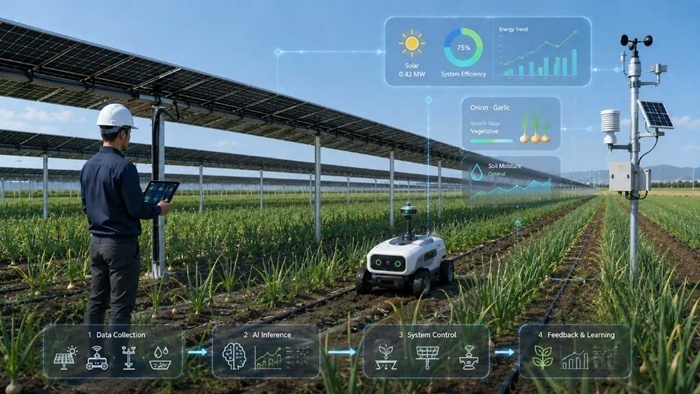
Paru Co., a Kosdaq-listed company, has been selected to lead the Ministry of Agriculture, Food and Rural Affairs' "AI Application Product Rapid Commercialization Support Project," run jointly with the Korea Agency of Education, Promotion and Information Service in Food, Agriculture, Forestry and Fisheries.
Paru, a specialist in agrivoltaic solutions, will serve as the lead company and develop an integrated solution combining AI-based precision cultivation management with variable shading control for agrivoltaic solar systems.
Partner companies AKiS Co. and Huintech Co. will join the consortium, integrating hardware, AI and Internet of Things technology into a single system.
The total project cost is 2.857 billion won, including 2 billion won ($1.4 million) in government funding. AKiS will build an AI integrated control platform capable of identifying crop growth stages, predicting yields and calculating irrigation volumes, while Huintech will develop an autonomous crop-monitoring robot, outdoor IoT sensors and an automated drip irrigation control system.
A defining feature of the project is its rapid-commercialization mandate — the consortium must deliver market-ready products and services within one year of the agreement date, not merely conduct research and development.
The Paru consortium aims to commercialize three products: an AI-linked single-axis tracking agrivoltaic power generation system, an AI-based integrated crop and power management solution, and an outdoor smart farm IoT package.
The system moves away from the conventional approach of managing solar power generation and crop cultivation separately, analyzing power output, crop growth, soil conditions, weather and irrigation data on a single AI platform instead.
The AI assesses each crop's growth stage and sunlight requirements to adjust solar panel angles, and analyzes soil moisture and weather conditions to automatically supply the right amount of water to each zone.
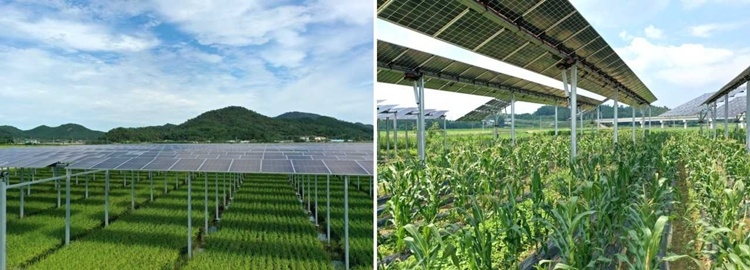
When crops receive insufficient sunlight, for example, the panels tilt to direct more light below; when solar radiation is too intense, the panels partially block sunlight to reduce heat and moisture stress on the crops.
The system feeds irrigation results and subsequent crop changes back into the AI for continuous learning, enabling increasingly precise control tailored to each farm's environment over time.
Within the consortium, Paru oversees the entire project and handles the single-axis tracking solar power system, panel angle control and energy storage system integration.
Paru has already supplied a 1-megawatt single-axis tracking agrivoltaic solar system in Yeonggwang, South Jeolla Province, and built and operates a 400-kilowatt agrivoltaic demonstration complex in Yeongam-gun, verifying structural stability, operational reliability, and communication and control performance in large-scale array environments.
The demonstration will use Paru's existing complexes in South Jeolla Province, collecting crop imagery, soil moisture, weather, solar radiation and power generation data across the full growing cycle of onions and garlic — from sowing to harvest — to verify how AI-calculated panel angles and irrigation volumes affect agricultural productivity and power generation efficiency.
Paru plans to use the project as a springboard to expand its business from solar tracking devices and power generation equipment into AI agriculture and energy integrated solutions.
Going forward, the company intends to build a service-based business model generating recurring revenue by combining AI control platform subscriptions, agricultural data services, and remote maintenance and operations alongside equipment sales.
Through the project, the company also plans to secure four patents and two software copyrights, and establish an integrated supply system for entry into domestic and overseas markets.
The company plans to first build a track record through demonstration projects centered on agricultural cooperatives, agrivoltaic power operators and local governments in South Jeolla Province, then expand supply to the national market and overseas agriculture and energy markets.
"This project will open new markets in agriculture and energy by combining Paru's accumulated solar tracking technology with AI and smart farming technology," a company official said. "We will complete a field-oriented solution that contributes not only to power generation revenue but also to stable crop production and reducing the labor burden on farming households."
parkds@heraldcorp.com





