![The Sinhydae apartment complex in Apgujeong-dong, Gangnam-gu, Seoul. [The Herald Business DB]](https://wimg.heraldcorp.com/news/cms/2026/08/05/news-p.v1.20250126.652ede5443d44b8890b54972fa66965c_P1.jpg)
I have lived in this apartment for 45 years. How could we have known home prices would rise this much? I own just one home, but now that I'm old and have no income, I've become house-poor. It's heartbreaking to think I have to sell my home because I'm afraid of the taxes.
Neighborhoods around Apgujeong-dong in Gangnam-gu and Banpo-dong in Seocho-gu have been rattled since the government unveiled its real estate tax reform plan. Inquiries are pouring in — particularly from elderly single-homeowners who have held high-value properties for decades — as residents try to calculate how much their property tax and capital gains tax burdens will increase. Traffic to tax accountants and real estate agencies has also picked up, as owners weigh their options: selling, gifting, inheritance or moving in themselves.
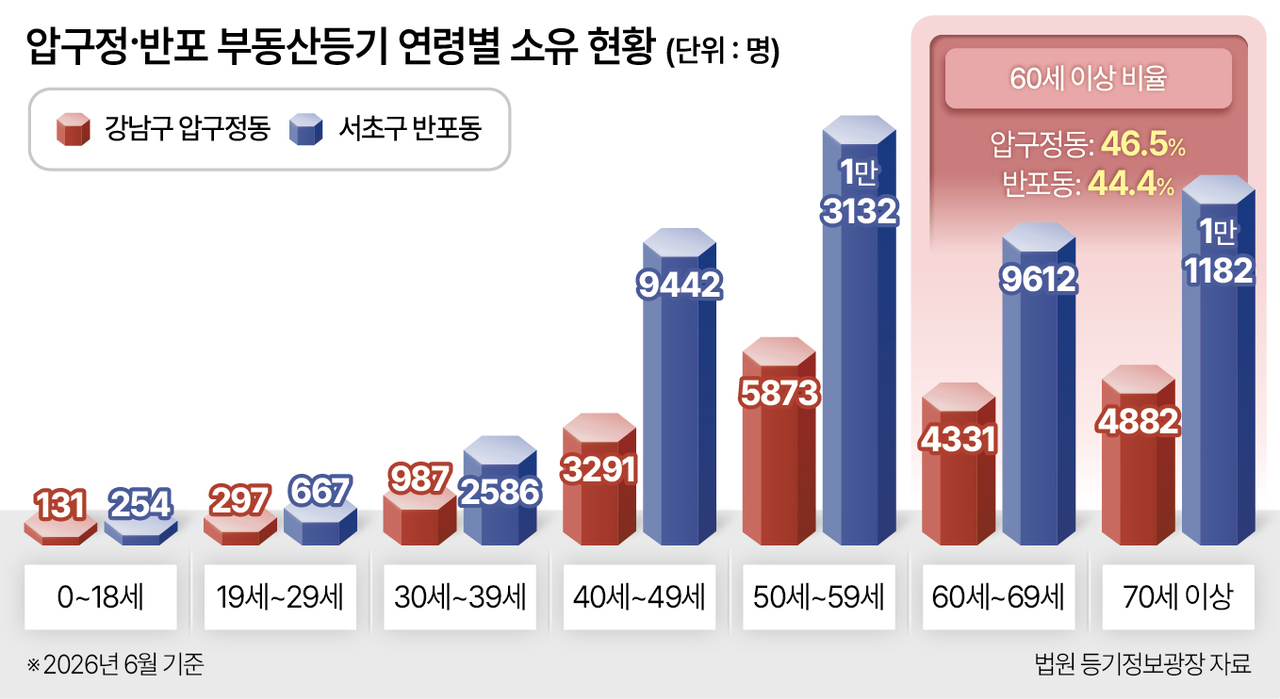
Residents 60 and older account for 46.5 percent of all property owners in Apgujeong-dong and 44.4 percent in Banpo-dong, according to real estate ownership data by age group from the Court Registry Information Plaza — meaning nearly half of all property owners in both neighborhoods are 60 or older.
Many of these areas are home to long-time elderly residents who have lived in the same apartment since the 1970s and 1980s. While the asset value of their homes can run into the billions of won, many have little income after retirement. Concerns are growing that the so-called "house-poor" problem — where rising home prices inflate tax bills that owners lack the cash to pay — could become a reality even in the most expensive residential neighborhoods.
A resident surnamed A, 81, who said she has lived in Apgujeong for 40 years, said elderly people had simply stayed put in one home for four decades, and that suddenly raising taxes left them with nowhere to turn. "When you go to the real estate office, they say people are listing their homes but there's no one to buy," she said.
Another resident, B, 85, said she paid about 6.4 million won ($4,480) in property tax this year. "Living in my own home feels the same as paying monthly rent," she said. She added that her son was currently preventing her from selling, but that she doubted she could keep up with the tax burden once redevelopment relocations begin in three years. "By early next year, I think I'll have to sell — even at a loss — and move back to my hometown of Jeju Island," she said.
Anxiety among older residents has also been rising in Banpo-dong since the tax reform plan was announced. The head of a real estate agency in Banpo-dong, identified only as C, said three or four people visited the office immediately after the government's announcement, with one customer sitting for three to four hours doing nothing but worrying before leaving. "There were also two or three cases where people actually listed their properties," C said.
C added that even after selling their Banpo homes, elderly residents appeared to be looking to move to nearby neighborhoods — such as Bangbae, Heukseok, Mapo and Seongdong — rather than relocating to the provinces, suggesting some may sell homes in the 5 billion won range and trade down to newly built apartments in the 2 billion to 3 billion won range.
However, C said that even with tax incentives for relocating outside the Greater Seoul area, few people would actually be willing to move to an unfamiliar region.
There are also concerns that the higher tax burden could be passed on to tenants. Real estate agencies in the Banpo area have fielded a stream of inquiries about raising jeonse and monthly rent since the reform plan was announced.
C said a client who owns two homes called after 9 p.m. on the day of the announcement and asked whether it was not simply easier to hold on and raise the monthly rent. "The client even used the phrase 'tax shifting' themselves," C said.
C said the same client had held out through 2020 and was again refusing to sell. "It's unfortunate for tenants, but the attitude was that raising the monthly rent would take care of it," C said.
The introduction of a cap on capital gains tax deductions for long-term ownership and residency is also being cited as a factor pushing some owners to sell sooner. The government plans to leave the deduction uncapped through next year, but will limit it to 2 billion won in 2028 and a maximum of 1 billion won from 2029 onward.
Apgujeong has many long-term owners who bought their homes before the 1980s and 1990s, and capital gains exceeding 5 billion won are not uncommon. The head of a real estate agency in Apgujeong-dong, identified as D, said owners who absolutely need to sell will list their properties this year or next, but that those who miss that window are more likely to choose gifting or inheritance rather than selling and absorbing a heavy capital gains tax bill.
![Property listings posted at a real estate agency in Apgujeong-dong, Gangnam-gu, on Tuesday afternoon. [Yun Seong-hyeon]](https://wimg.heraldcorp.com/news/cms/2026/08/05/news-p.v1.20260805.4ba387073f9942d39cd6884aab714913_P1.jpg)
Complaints have also emerged that the tax incentives tied to relocating outside the Greater Seoul area fail to adequately account for the living conditions of elderly residents.
As part of the tax reform package, the government said it would temporarily reduce capital gains tax for homeowners aged 65 and older who sell their single home in the Greater Seoul area and move to a non-metropolitan region, aiming to ease overcrowding in the capital and help older residents unlock the value of their assets.
Those who sell in 2027 would receive a deduction of up to 50 percent on gains up to 500 million won, while those who sell in 2028 would receive up to 30 percent on gains up to 300 million won. A resident in his 70s living in Apgujeong, identified as E, objected strongly. "Telling elderly people who need to live near a hospital to move to the provinces and commute to Seoul by train and bus shows a complete lack of understanding of reality," he said.
Experts said the reform could drive demand toward relatively lower-priced homes as buyers seek to avoid the price brackets where the tax burden rises most sharply.
Ham Yeong-jin, head of the real estate research lab at Woori Bank, said the reform applies different deduction thresholds at each stage and creates a structure in which the tax burden rises steeply for multi-homeowners and properties in certain price ranges. "Demand trying to avoid the brackets where taxes spike could concentrate on homes in the 2 billion to 3 billion won range — what you might call the 'less prime single home,'" Ham said.
Ham added that through next year, elderly owners who have held their homes for 30 years or more may still be eligible for the long-term holding special deduction and other benefits, making it necessary to assess each individual's actual capital gains tax liability separately. "Whether to stay in the current home or sell and move will ultimately come down to each household's income and asset situation," he said.
An 85-year-old woman who has lived in the Apgujeong apartment for 45 years said: "I've lived in this apartment for 45 years. How could we have known home prices would rise this much? I own just one home, but now that I'm old and have no income, I've become house-poor. It's heartbreaking to think I have to sell my home because I'm afraid of the taxes."
quq@heraldcorp.com
shy@heraldcorp.com