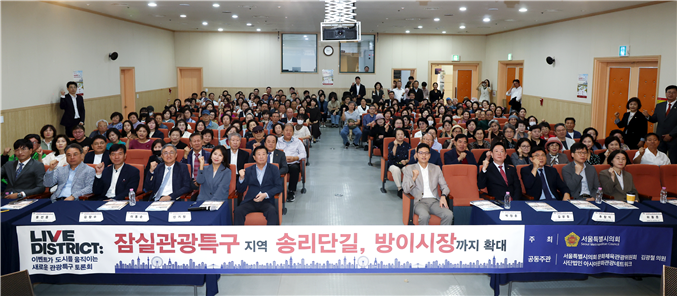
![Minister of Climate, Environment and Energy Kim Sung-hwan discusses ways to improve community acceptance with representatives from Imsil, Jangseong, South Chungcheong Province, Daejeon's Seo-gu, Buan and Gokseong at the third meeting of the Power Grid Construction Countermeasure Committee, held Wednesday at the Power Infrastructure Center in Yeouido, Seoul. [Ministry of Climate, Environment and Energy]](https://wimg.heraldcorp.com/news/cms/2026/08/05/rcv.YNA.20260805.PYH2026080513400001300_P1.jpg)
The government plans to consolidate transmission line routes and build up to 40% fewer new transmission towers, a move aimed at reducing opposition from communities along planned corridors. However, concerns have been raised that the measures will have limited effect unless the country addresses its fundamental reliance on generating electricity outside the Greater Seoul area and transmitting it into the metropolitan region.
The Ministry of Climate, Environment and Energy unveiled the community acceptance measures Wednesday, when Minister Kim Sung-hwan met with representatives of residents opposing power grid construction in their areas.
The ministry said that building the national backbone power grid would originally require 4,723 towers along 2,169 kilometers of line, but that consolidating routes as much as possible would reduce that to 2,509 towers across 1,200 kilometers — cutting the tower count by roughly 40%.
The ministry said it would issue an official notice requiring that line consolidation be the first option considered whenever new transmission infrastructure is planned.
The ministry also said it would expand underground cabling — burying transmission lines beneath the surface — particularly in densely populated areas along candidate routes.
Specifically, it plans to establish criteria requiring that underground cabling be prioritized wherever a sufficient number of residents live within a set distance of a planned line, and to enshrine those criteria in an official notice.
The ministry also said it would proactively identify sections suitable for underground cabling so that those findings can inform site selection for transmission lines.
To strengthen procedural transparency and democratic participation, the ministry said it would hold briefings for local governments and residents from the moment a site selection committee is formed for transmission and substation facilities.
Residents are currently barred as a rule from observing site selection committee meetings. The ministry said it would reverse that default — allowing observation in principle and permitting exclusions only in exceptional cases. It also plans to have ministry staff monitor how site selection committees are run.
For candidate corridor zones through which transmission lines may pass, the ministry said it would identify at least two route options unless a stretch is very short or has distinctive topographical constraints, giving communities a greater say in the process.
The ministry said it would issue guidelines to ensure that the 2 billion won ($1.4 million) per kilometer in support funds allocated to areas where transmission lines pass is directed primarily toward communities that suffer actual harm. It offered as an example a rule requiring that at least two-thirds of the funds be spent in the affected towns and villages.
The ministry is also pursuing legislation to index the cost of support projects under the Act on Support for Areas around Transmission and Substation Facilities to inflation.
The ministry plans to introduce a "grid income" scheme under which residents near transmission and substation facilities who invest in Korea Electric Power Corporation's transmission grid projects would receive interest-based returns at a fixed rate of 8 to 10 percent.
The ministry also said it would actively promote "sunshine income village" programs in communities near transmission and substation facilities.
The ministry said it aims to shift the current structure — in which electricity generated outside the Greater Seoul area is consumed within it — toward a model of local production and local consumption. However, it made clear that transmission lines already under development must continue, as they are needed to supply power to advanced industries and support the expansion of renewable energy.
The community acceptance measures unveiled Wednesday are expected to be finalized soon by the working committee on national backbone power grid expansion.
oskymoon@heraldcorp.com