![Apartment complexes line the Han River in Seoul on Thursday. [Yonhap]](https://wimg.heraldcorp.com/news/cms/2026/08/07/rcv.YNA.20260806.PYH2026080609900001300_P1.jpg)
Just as I was starting to look for a home, the June 27 regulations came out and I couldn't get as large a loan as I had expected. I ended up starting my married life in a jeonse rental — and the apartment I had been looking at has since gone up by about 300 million won, putting it completely out of reach.
— A (30), who married last September
The government has been pushing hard to expand housing supply under what it has called a "just build" approach, but the financial resources available to buyers who would actually purchase those new homes are shrinking. Critics say that as demand-side curbs through lending restrictions and tax measures continue, the purchasing power needed to absorb new supply is eroding.
The government is expected to soon announce a supply package drawing on public housing sites and idle land in the Greater Seoul area. Successive loan restrictions introduced since last year have significantly reduced the buying capacity of end-users in the metropolitan area, however, and concerns are growing about whether the measures will actually stabilize home prices.
Under the June 27 lending regulations, the maximum mortgage available for home purchases in the Greater Seoul area and regulated zones was capped at 600 million won ($421,000). The Oct. 15 measures then introduced a tiered system: 600 million won for homes valued at up to 1.5 billion won, 400 million won for homes between 1.5 billion and 2.5 billion won, and 200 million won for homes above 2.5 billion won. The stress interest rate floor applied to mortgages in regulated zones was also raised to 3 percent.
Each time new lending restrictions were announced, Seoul's apartment transaction market froze sharply. According to the Seoul Real Estate Information Plaza, apartment sales in Seoul stood at 11,269 in June last year but fell 63.2 percent to 4,149 in July, immediately after the June 27 measures took effect.
Transactions rebounded as buyers rushed to close deals before additional restrictions took effect. Volume climbed to 8,532 in October last year, only to fall 60.3 percent to 3,390 in November after the Oct. 15 measures were implemented. In May this year, 8,925 transactions were recorded ahead of the introduction of a heavier capital gains tax surcharge on multi-home owners, but the figure fell 41.6 percent to 5,212 in June.
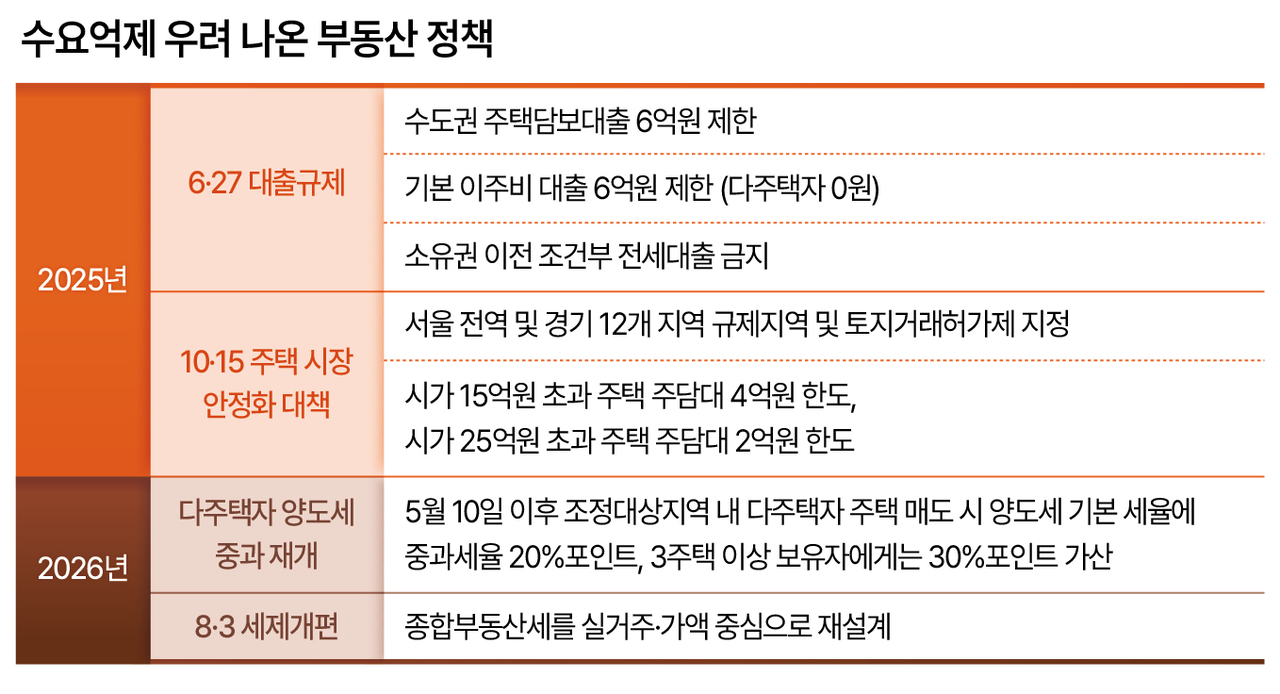
The impact of the lending curbs extended beyond the existing home sales market. The June 27 restrictions also banned jeonse loans contingent on ownership transfer in the Greater Seoul area and regulated zones, blocking the common practice of securing a balance payment on a new apartment by leasing it out on a jeonse contract before completing the purchase.
Tenants now find it difficult to obtain jeonse loans before the buyer has fully paid for the unit and completed the ownership transfer. Buyers with insufficient personal funds may struggle to move in and settle their final payments, and the jeonse supply that typically flows from newly built complexes all at once could also be constrained.
The deeper problem is that home prices and pre-sale prices are rising rapidly even as buyers' financial capacity shrinks. The average sale price of Seoul apartments reached 1.59 billion won in July, according to KB Real Estate data, putting it on the verge of surpassing 1.6 billion won for the first time.
The national average pre-sale price for apartments in the first half of this year rose to 21.43 million won per 3.3 square meters, up 2.2 percent from last year's average of 20.96 million won, according to Real Estate R114. This marks the first time the national average pre-sale price has exceeded 21 million won per 3.3 square meters.
The average pre-sale price in Seoul rose 14.9 percent over the same period, from 51.31 million won to 58.97 million won per 3.3 square meters — an increase of 7.66 million won, the largest gain of any region nationwide. Based on the average pre-sale price alone, a standard 84-square-meter apartment would cost around 2 billion won by simple calculation.
At prime redevelopment sites, pre-sale prices for 84-square-meter units are in fact climbing into the late 2 billion won range. The top pre-sale price for an 84-square-meter unit at Acro River Sky — a redevelopment of the Noryangjin District 8 zone in Dongjak-gu, Seoul, launched in May — reached 2.8 billion won, with an average pre-sale price of 77.33 million won per 3.3 square meters.
As pre-sale prices for the standard 84-square-meter unit in new Seoul apartments surge, the government's planned tax reform is also expected to add to buyers' burden. Under the 2026 tax reform proposal, homes with a market value effectively above 2 billion won — corresponding to a published price of 1.4 billion won — become subject to the comprehensive real estate tax. Given recent pre-sale price trends, buyers are in effect locked into a tax liability the moment they take ownership.
Market observers say that for supply measures to actually stabilize home prices, the government must consider not only the volume of new housing but also the purchasing power of the end-users who need to absorb it. Park Hap-su, an adjunct professor at Konkuk University's Graduate School of Real Estate, said expanding supply while cutting loans is "a textbook example of mismatched policy."
"In a market where Seoul home prices are approaching 2 billion won, the only people who can buy without a loan are essentially those with cash," Park said. "If you keep blocking end-users from securing financing the way things stand now, you could end up with supply that no one can actually buy."
quq@heraldcorp.com