Sole proprietor to corporation: is it right for you?
If taxable income tops 25.2 million won
and reinvestment outweighs living costs,
incorporation beats sole proprietorship.
Set clear rules for executive pay and dividends.
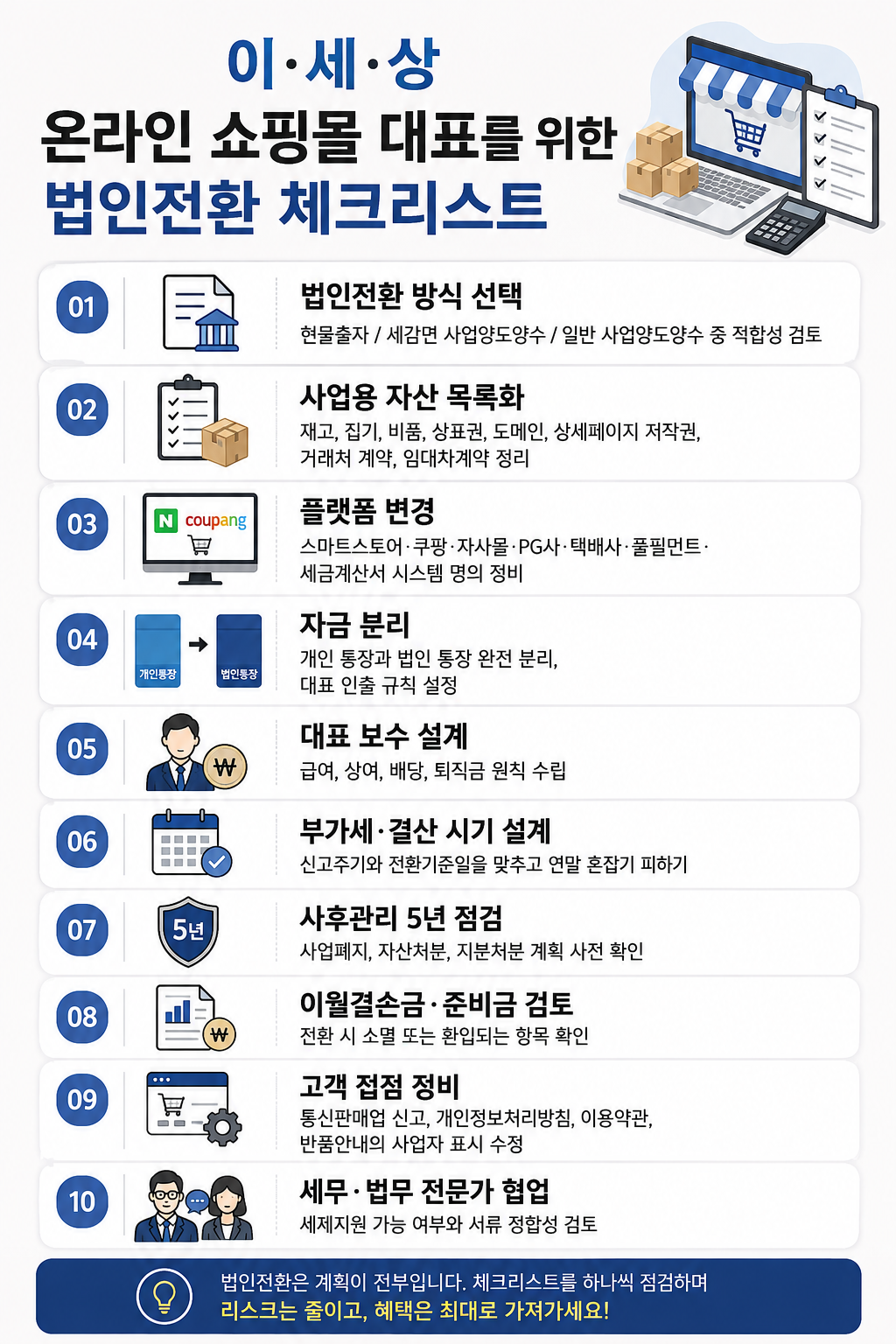
![[Created using ChatGPT]](https://wimg.heraldcorp.com/news/cms/2026/08/06/news-p.v1.20260806.cd3e2cf6719742dfab95790753045297_P1.png)
Housing, food, transportation — money drains away just by being alive. But there is one more expense quietly embedded in daily life that rarely gets noticed: taxes. Owning even a single apartment now means grappling with inheritance and gift taxes. There is no need to panic, though. Reading through other people's cases — even ones that seem irrelevant at first — will naturally surface tax-saving hints you can apply to your own situation. Drawing on consultations with tax experts, this column — "Your Tax Questions Answered" — breaks down the everyday tax dilemmas you are likely to face.
Just by switching to a corporation, you end up with more than 300 million won extra in your pocket three years later?
Lee Se-hui (pseudonym, 34) built a career as an influencer running group-buy promotions and brand sponsorships before eventually becoming the owner of an online shopping mall. Over the past three years the business has generated annual cash flow in the 300 million won range and has settled into a stable rhythm — but the success has brought its own headaches. As profits grew, so did her comprehensive income tax bill.
As the business expanded, she also began to feel the friction of mixing business funds with personal living expenses. Platform settlement payments, advertising costs, inventory purchases, staff salaries and outsourcing fees flowed in and out constantly, blurring the line between her personal finances and the company's money.
She plans to build out her own brand and hire more staff, but she has started to wonder whether staying a sole proprietor still makes sense. "What if I switch to a corporation and end up paying even more in taxes?" To help business owners wrestling with that question, we consulted Kim Hye-ri, a tax accountant and former National Tax Service official known as "NTS Unni."
Q: Why are so many influencers and online shopping mall owners converting to corporations these days?
A: Online shopping malls have complex cost structures — advertising, logistics, labor, outsourcing — and must also manage platform settlements, inventory and returns simultaneously. As a business scales up, a corporate structure is often more efficient from a management standpoint than operating as a sole proprietorship.
For example, consolidating settlement accounts, payment-gateway contracts, purchase-safety services, mail-order business registrations, privacy policies, return and exchange responsibilities, and tax invoice issuance under a single corporate entity can reduce operational confusion and the risk of disputes down the road.
The tax structure also differs. A sole proprietor's business profit flows directly into the owner's personal income and is subject to the progressive rates of the comprehensive income tax. A corporation, by contrast, pays corporate tax first, after which the CEO can structure compensation through a combination of salary and dividends — giving far more flexibility in how funds are deployed.
That said, incorporating should be approached not as a simple tax-saving move but as a fundamental change in how the business is run. There are many other factors to work through as well, including transferring business assets, updating business registration information and preparing for potential investment.
Q: So in what situations should someone seriously consider incorporating?
A: First, ask whether profits are large enough. What matters more than revenue is the actual profit left over. The bigger the profit, the heavier the comprehensive income tax burden — which is when it becomes worth calculating whether incorporation would help.
Second, consider how you plan to use the money you earn. If most of it goes toward living expenses, staying a sole proprietor may be simpler. However, if you plan to leave profits in the company for reinvestment — expanding the business or hiring staff — incorporation is likely to be more advantageous.
Third, think about what may change within the next three years. If you are planning to expand your brand, bring on employees, attract outside investment, take on a co-founder or eventually pass the business to a family member, a corporate structure is often the better fit.
Q: Looking purely at taxes, what threshold signals that it is time to incorporate?
A: Comparing tax rates alone, the break-even point — where the tax burden is roughly equal for an individual and a corporation — falls at a taxable income of around 25.2 million won. That figure is based on applying the 15 percent personal income tax rate against the 10 percent corporate tax rate.
If you run a small online shopping mall that has only recently turned a profit, it is better to first confirm that your annual taxable income is consistently clearing 25.2 million won before rushing into incorporation.
Q: How does incorporation actually work? Can you just close the sole proprietorship and open a new company?
A: Simply shutting down a sole proprietorship and registering a new corporation is a different concept from a proper corporate conversion. The standard approach is to transfer the business's assets, rights and obligations to the new entity while keeping operations running continuously.
The two most common methods are an in-kind contribution and a business transfer-and-acquisition. With an in-kind contribution, the sole proprietor contributes business assets to the new corporation in the form of property rather than cash.
The process is complex — it requires asset valuation, an appraisal and the appointment of an inspector — and the costs are not trivial. This method is typically chosen when the business is large or when there are substantial assets to transfer, such as real estate.
A business transfer-and-acquisition involves first establishing the corporation and then comprehensively transferring the sole proprietorship's assets, liabilities, rights and obligations to it. In practice this method is used more often because the procedures are relatively straightforward.
For online shopping malls in particular, the transfer must cover not just inventory but also supplier relationships, the brand, the domain, advertising accounts, marketplace seller accounts and various operating contracts. Carefully mapping out exactly which assets and rights will be carried over to the corporation is therefore essential.
Q: Will moving assets during incorporation trigger additional taxes? I am worried about VAT and capital gains tax.
A: In principle, tax liabilities can arise. Because a sole proprietor and a corporation are legally separate entities, transferring business assets — real estate, machinery, intangible assets — into the corporation's name can trigger capital gains tax or VAT on the transfer.
However, if the conversion meets certain conditions, the tax burden can be reduced or the payment deferred.
When tangible or intangible business assets are transferred to a corporation through an in-kind contribution or a business transfer-and-acquisition, a capital gains tax deferral may apply. Instead of paying the tax at the time of conversion, the liability is pushed to the future — when the corporation eventually disposes of those assets.
The same logic applies to VAT. A business transfer-and-acquisition that comprehensively succeeds to the physical and human resources, rights and obligations of the business is not treated as a supply of goods under the VAT Act, meaning VAT may not be levied. This is why the scope of the business succession must be designed with precision in practice.
For instance, if only inventory is transferred to the corporation while supplier contracts, operating accounts and employee relationships remain under the sole proprietor's name, the transaction may not qualify as a comprehensive business succession. The business must genuinely continue as the same entity under the corporation — not merely on paper through a contract.
These tax benefits are not applied automatically, however. The business type, assets involved, scope of succession and post-management requirements must all be satisfied, and the relevant contracts and filing documents must be consistent with one another. The right approach is to draw up a list of which assets, rights and obligations will be transferred beforehand and then structure the transfer to meet the applicable tax-relief requirements.
Q: Once incorporated, how should the CEO draw a salary? Should dividends also be part of the plan?
A: This is the most important consideration after incorporation. For a sole proprietor, business profit is the owner's personal income. In a corporation, the company and the CEO are legally separate, so the CEO must plan in advance how money will be drawn from the company and what disposable income will actually end up in hand.
Pushing dividends too high can actually increase the effective tax burden. If all corporate profit is paid out as dividends, for example, income that has already been subject to corporate tax gets hit again with dividend income tax.
For an online shopping mall owner, the stable approach is generally to first set a reasonable salary that reflects living costs and management responsibilities, then use bonuses or dividends as a supplement based on the company's profit level and cash position.
A salary generates personal income tax and national insurance contributions for the CEO, but it is recognized as a deductible expense for the company and also improves management transparency.
After incorporation, the habit of freely withdrawing living expenses from the company account — common among sole proprietors — must also change. Clear standards for managing salary, dividends and shareholder loans must be established to keep the company's finances and the CEO's personal finances strictly separate.
Q: How much would I actually save in taxes if I incorporated?

A: Assuming an online shopping mall with identical revenue and profit structure, the combined after-tax cash flow over three years as a corporation comes to 1.248 billion won. Under the same conditions as a sole proprietor, the figure is 941.48 million won — a difference of approximately 306.58 million won over three years.
That is a substantial cumulative gap even over just three years. In summary, for someone like Se-hui — generating stable profits above a certain level with plans to reinvest — incorporation is likely to be the more advantageous path.
Q: When is the best time to incorporate?
A: In consultations, many business owners ask whether starting on Jan. 1 is the way to go — but that is not necessarily the case. The timing of conversion is not a simple administrative formality; it is a significant variable that affects both taxes and business operations.
The first decision is a long-term one: convert this year or push it to next year. After that, you need to pin down which month and which date to use as the cutover point. Online shopping malls in particular have many items to settle — marketplace payments, expected returns, prepaid advertising costs, inventory movements — so choosing the right reference date matters.
In practice, aligning the conversion with a VAT filing period tends to make the process smoother. It is easier to wrap up the VAT filing triggered by the sole proprietorship's closure alongside the incorporation procedures, and the accounts and business relationships can be tidied up more cleanly.
Converting mid-year can also be more advantageous than waiting until year-end. A sole proprietor with an annual taxable income of 300 million won, for example, may reduce the tax burden more by converting at the end of June rather than at the end of December. Ultimately, the timing should be decided by weighing the business's profit structure against its tax obligations together.
For online shopping malls specifically, it is advisable to avoid converting just before peak sales season and instead time the switch to a VAT filing date when settlement flows are relatively stable. Factoring in when a physical inventory count is feasible, the billing cycle of advertising agencies and the renewal dates of key supplier contracts can significantly reduce the confusion that tends to arise during the conversion process.

forest@heraldcorp.com